
“As time goes on, I get more and more convinced that the right method of investment is to put large sums into enterprises which one thinks one knows something about and in the management of which one thoroughly believes.”
Introduction
When I was in business school I applied to the student-run MBA Investment Fund, which had $14M in assets under management at the time. As part of the application process candidates were split into teams and a stock was chosen for them to analyze. Each team would present their thesis, along with either a buy or a sell recommendation, to a panel of outside industry experts. These judges would then choose the team they felt presented the most compelling argument and declare them the winner. During this process, my team and I worked hard to extensively research the chosen company. We felt we had a solid grasp of the long-term prospects of the business and thoroughly believed in the management team. Therefore, we confidently decided to present a buy recommendation. There were six teams in total – three recommended buys and three recommended sells. On the day of the competition, each team presented their analysis and the judges chose the winner – a team that had offered a sell recommendation. I was surprised by the outcome but, despite the defeat, had conviction in our analysis and felt confident the stock would prove us right.
But over the next year, the price plummeted 53% from $17 per share to around $8. I was crushed. This had been the first real test of my stock-picking ability and I failed miserably. Although there was no money involved this time, eventually there would be and mistakes like that could be costly.
I was extremely humbled by the experience but not entirely sure where our team had gone wrong. So, I continued to follow the company for a number of years and the results have been astonishing. After less than six years, the stock increased in value by nearly 4,800% and now trades around $390 per share. To put that in perspective, if you had invested $10,000 in September 2012, it would now be worth almost $490,000. For the curious readers out there, the business in question is Netflix and our stock pitch competition occurred right around the time the company announced it was splitting its DVD-by-mail business from its streaming business, effectively doubling the price of a subscription.
Looking back, I took three lessons from this experience. The first was that investing requires extreme patience. In business, one year is a considerably brief period of time but, when the value of your investment is falling by more than half, it can feel like an eternity. However, stocks often behave strangely over the short-term but are much more likely to act rationally over the long run. As Benjamin Graham once put it “in the short run, the market is like a voting machine – tallying up which firms are popular and unpopular. But in the long run, the market is like a weighing machine – assessing the substance of a company.”
The second lesson, related to the first, was to evaluate an investment thesis, not on short-term fluctuations in the stock price but rather, on what is fundamentally happening with the company. For example, an investor in Netflix, influenced by short-term price movements, might have decided to sell their stock after the price had fallen by 53% (and 80% from its peak), believing that the market had proven their thesis wrong. But by doing so, this investor would likely have missed out on the extraordinary returns that were soon to follow. If instead they had assessed the fundamental strength of the business, making note of its strong management, valuable brand, and significant scale in a large and growing new market, they would have enjoyed a substantial return on their investment and massively outperformed the overall market. If I had only learned this lesson sooner our story might have had a much happier ending.
And the third lesson was to avoid scope insensitivity. Scope insensitivity can best be described with an example. Years ago, there was a study where respondents were asked how much they were willing to pay to prevent birds from drowning in uncovered oil ponds by covering the ponds with protective nets. Subjects were told that either 2,000 or 20,000 or 200,000 birds were affected annually. But the subjects in each group reported being willing to pay roughly the same amounts (about $80). It did not matter how many birds were affected, the price remained the same. The subjects were insensitive to the scope of the problem. This can also be an issue with investing, where the scope is equivalent to the time horizon of the investment (i.e., the likelihood of an investment thesis playing out depends heavily on the timeframe used). If we think back to the Netflix example, three teams recommended sells and three teams recommended buys. But, with the benefit of hindsight, who was right and who was wrong? That all depends on the timeframe. The teams that said “sell” were right if the timeframe was one year or less, but the teams that said “buy” were right if it was three years or more. Our competition however, was scope insensitive – making no distinction between time horizons and leaving the accuracy of each team’s recommendation open for interpretation. At Kehlet Capital we try to avoid this problem by consistently using at least a three-year time horizon to evaluate all investment opportunities. This gives us the freedom to ignore the noise of short-term price movements and focus solely on the fundamentals of the businesses we own.
These are just a few examples of the investing principles that have been engrained into KCM’s investment process. Others include what Charlie Munger has described as “fishing where the fish are” – that is, looking for exceptional returns in inefficient parts of the market (e.g., in micro-cap stocks) – and those articulated by John Maynard Keynes such as betting big when the odds are in your favor, staying within a circle of competence, and putting a large emphasis on the quality of management. For the sake of brevity, I will not go into detail about each of these concepts but will likely refer back to them in future letters. I mention them now because I believe it is important to have a solid foundation on which to build an investment process capable of consistent outperformance and to communicate it to all partners.
At KCM, our first priority is to earn the highest risk-adjusted returns possible for our investors. So far, that goal has been sufficiently achieved. However, over periods of time, this may not always be the case. It is during these inevitable phases of underperformance that it is most important to remember the aforementioned investment principles – particularly patience and long-term thinking – because it is during stormy weather that a solid foundation is most valuable. The market environment will undoubtedly change over the years, bringing both financial sunshine and rain. But you can expect that, at KCM, our investment principles will remain steadfast in order to provide our partners with the greatest possibility of long-term success.
Performance
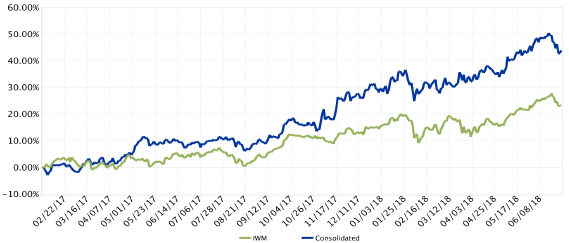
| Year | KCM Composite, Net | IWM | Excess Return |
|---|---|---|---|
| 2017* | 27.20% | 14.26% | +12.94% |
| YTD | 12.26% | 7.67% | +4.59% |
| Annualized | 28.78% | 15.86% | +12.92% |
*Inception date: 02/01/2017
We slightly underperformed in the second quarter as KCM’s micro-cap composite returned 7.44% compared with a return of 7.86% for the benchmark. However, we remain on track through the first six months of the year as KCM’s micro-cap composite has returned 12.29%, outperforming the 7.67% return for the benchmark.
With a return of 51.13%, Simulations Plus (SLP) was the biggest contributor to performance in the second quarter. Simulations Plus provides software and consulting services for use primarily in pharmaceutical and chemical research. Simply put, if you are a scientist looking to develop a new molecule you might use the company’s suite of software products to design the molecule, predict its various properties, simulate its effects on humans and animals, as well as organize and process data for regulatory submission. Simulations Plus is a name we have owned for almost one year and the company’s long-term prospects remain attractive for a number of reasons. First, the company has a long runway for growth in the bio-simulation market, which is estimated to be approximately $1.2B, or more than forty times larger than the company’s trailing twelve-month revenue. The market is also projected to grow by 15% - 16% over the next five years, driven by its ability to deliver significant cost reduction in clinical trials. This combination of market size and growth provides Simulations Plus with ample opportunity for continued growth over many years. Second, the company is run by an outstanding management team, led by the Founder, Chairman, and CEO Walt Woltosz. Before founding Simulations Plus, and in his spare time while working as an Aerospace Engineer, Walt developed text-to-speech software called Words+, that was used by Stephen Hawking and other ALS patients to communicate. In ’96 Walt started Simulations Plus and to this day owns more than 30% of the business. During the second quarter, however, the company announced the appointment of Shawn O’Conner as CEO. Mr. O’Conner has more than three decades of executive experience, including stints as the CEO of two other pharmacology software companies. Given that this succession plan has been in place for a number of years and that Mr. Woltosz will remain as Chairman of the Board, we trust that the company continues to be in good hands going forward. And third, competitive barriers to entry are extremely high for a couple of reasons. 1) The software is highly complex and has been updated and refined for over 20 years. It is designed to solve large sets of differential equations and incorporates machine-learning technology to improve predictive accuracy. As customers generate increasing amounts of data from clinical trials, Simulations Plus is able to quickly compare that data to its prediction models and make the software even more accurate – effectively widening its lead over competitors. And, 2) the switching costs for customers are substantial due to the significant expertise required to operate this extremely sophisticated software. As a result of this steep learning curve, scientists familiar with a certain program are often hesitant to switch to something else due to the heavy burden involved in learning a new system. That is why customers tend to be very “sticky”, which is evidenced by the company’s +95% renewal rates. Given Simulations Plus’ considerable growth opportunity, outstanding management team, and strong competitive advantages, we believe it is likely to continue compounding its per share intrinsic value at high rates for many years to come.
The biggest drag on performance was LeMaitre Vascular (LMAT), which declined 7.55% during the second quarter. LeMaitre is a provider of medical devices for the treatment of peripheral vascular disease and has a portfolio of patent-protected, niche products designed for use in open vascular surgery. LeMaitre is largely a management story. It is run by an owner-operator named George LeMaitre, whose father founded the company in the 80’s after inventing the Valvulotome, a device used to cut the valves in veins in order to convert them to arteries. George took over the business after getting his MBA from Stanford in the early 90’s and has been running the company for over 25 years. However, at the age of 53 he is still a relatively young guy and likely to continue leading LeMaitre for many more years. He owns about 18% of the business and takes a relatively modest salary. Under George’s leadership the company has followed a well-thought out strategy of focusing on niche markets with little competition. As a result, they have the #1 or #2 position in 11 of their 14 product lines and boast returns on invested capital of around 20%. Management also has a fantastic record of capital allocation, which has largely been focused on mergers and acquisitions. The company has made 19 acquisitions over the last 19 years, the vast majority of which have added significant shareholder value. To this day, virtually all of their free cash flow continues to go toward LeMaitre’s extremely successful acquisition program and is a major contributor to the company’s continued ability to invest capital at high rates of return for many years.
Conclusion
The second quarter was a slight disappointment but the results through six months remain on track and we feel good about how the portfolio is positioned going forward. We will continue to consistently apply our investment principles in order to achieve satisfactory long-term results for our clients. As always, thank you for your support of Kehlet Capital Management. If you have any questions or comments, please do not hesitate to contact us.
Disclosures to Performance Results
Actual composite performance results represent the performance of fully discretionary accounts managed by Kehlet Capital Management (KCM) during the corresponding time period. The composite performance results reflect time-weighted rates of return, the reinvestment of dividends and other account earnings. The reinvestment of dividends and other earnings may have a material impact on overall returns.
Past performance is not indicative of future results and the performance of a specific individual client account may vary substantially from the composite performance results. Therefore, no current or prospective client should assume that future performance will be profitable, or equal either the KCM composite performance results reflected above, or the performance results for any of the comparative index benchmarks provided.
For reasons including variances in portfolio account holdings, variances in the investment management fee incurred, market fluctuations, the date on which a client engages KCM’s investment management services, and any account contributions or withdrawals, the performance of a specific client’s account could vary substantially from the indicated KCM composite performance results. A portion of each account can be actively managed in an attempt to respond to changing conditions.
All performance results have been compiled solely by KCM, are unaudited, and have not been independently verified. Therefore, the performance data could be wrong. Information pertaining to KCM’s advisory operations, services, and fees is set forth in KCM’s current Form ADV Part 2A disclosure brochure, a copy of which is available from KCM upon request.
iShares IWM is an exchange-traded fund (ETF) measuring the performance of approximately 2,000 small-cap companies. It serves as a benchmark for small-cap stocks in the United States.
KCM managed accounts may own assets and follow investment strategies which cause them to differ materially from the composition and performance of the ETF shown as a benchmark. The ETF was chosen for its accessibility, transparency, independence, and relevance to KCM’s investment strategy, but there may be other indices that are more appropriate or applicable to the Concentrated Micro-cap Strategy. The historical index performance results are provided exclusively for comparison purposes only, so as to provide general comparative information to assist an individual client or prospective client in determining whether a specific Portfolio meets, or continues to meet, his/her investment objective(s). It should not be assumed that account holdings will correspond directly to any of the comparative indexes.
Different types of investments and/or investment strategies involve varying levels of risk, and there can be no assurance that any specific investment or investment strategy (including the investments purchased and/or investment strategies devised by KCM) will be either suitable or profitable for a client’s or prospective client’s portfolio and may result in a loss of principal. Accordingly, no client or prospective client should assume that the above portfolios (or any component thereof) serve as the receipt of, or a substitute for, personalized advice from KCM, or from any other investment professional.