
“If you’re trying to create a company, it’s like baking a cake. You have to have all the ingredients in the right proportion.”
Introduction
In last quarter’s newsletter I talked about an early investment opportunity in Netflix – a stock that increased in value by nearly 4,800% in less than six years – and the lessons gleaned from it. But that opportunity has, to a large extent, already played out which means that the lessons learned will need to be applied to future investment prospects. How then should we go about identifying these “Netflix-like” opportunities early-on and with enough confidence to remain invested during times of distress?
Unfortunately, there is no simple answer. It is a lot like trying to predict who will become the future president from a group of ten-year old children. The task is made especially difficult by the rarity in which the event occurs as well as the sheer volume and complexity of factors that impact the outcome. Simply put, few will achieve that level of success and those that do will follow their own unique path. Consequently, in our attempt to predict the businesses most capable of extraordinary returns, it is inevitable that at times we will be wrong. The good news, however, is that perfect accuracy is not required to attain satisfactory investment results. There are a couple of reasons for this. First, our strategy to invest in multiple companies with outstanding long-term potential effectively spreads out our bets and increases our chances of success. And second, the highly concentrated nature of our portfolio serves to amplify the impact of correct forecasts on overall returns. Although this amplifying effect applies equally to both correct and incorrect predictions, there is one feature of equity investing that works heavily in our favor; a skewed risk-return profile. In other words, there is no limit to how much a stock can increase in value, but the downside is capped at 100%. This means that one correct prediction can more than offset several incorrect calls. In short, our approach, which balances portfolio diversification with concentration, limits the need for perfect forecasting accuracy.
However, while forecasting precision does not need to be flawless it should be reasonably accurate to maximize returns. Fortunately, our effort to predict business success does not involve random guessing either. Analysis of companies past and present reveals certain characteristics that distinguish great businesses from the rest. These features can be identified early-on to find the companies most capable of achieving long-term success. At KCM, our endeavor to find these opportunities involves evaluating three primary factors. Specifically, we look for businesses that have:
The ability to earn excess returns on invested capital (no less than 10% but preferably greater than 15%). For every incremental dollar a company reinvests, its per share intrinsic value should increase by at least ten cents. Why? Because that is the minimum return we require for investing in the business. If a company earns less than 10% returns on invested capital, it will be extremely difficult for equity investors like us to attain satisfactory long-term outcomes. As a result, virtually every highly successful long-term investment has met this criterion. But here is the tricky part; the ability to earn excess returns on invested capital does not necessarily mean the company has accomplished this feat in the past, only that it is capable of such returns in the future (e.g., as it gains scale or continues to innovate). However, forecasting future returns is extremely difficult and requires thoroughly assessing numerous qualitative factors such as a company’s business model, competitive advantages, and product differentiation. At KCM, we perform this analysis by looking for businesses that have many of the following characteristics: a) a product or service that adds significant value to the customer (i.e., it would be difficult to live without) and is differentiated (i.e., its benefits are hard to obtain anywhere else), b) a business model that is asset-light (i.e., requires minimal capital reinvestment), c) a business model that is capital-light (i.e., reinvestment is financed largely by suppliers or customers), and d) sustainable competitive advantages such as network effects, efficient scale, switching costs, intangible assets, or cost advantages. If a business displays two or more of these features, we can be confident that it is capable of earning excess returns on invested capital and start to evaluate the second condition of exceptional investment opportunities.
Management that is willing and able to lead the company to its full potential. Some businesses are so extraordinary that they can achieve reasonable success even with a subpar management team. But poor management acts as an anchor to even the best companies while great management is more like a propeller. That is why truly exceptional investment results are typically achieved with outstanding managers at the helm. But what constitutes great management? At KCM, we look for four main criteria: 1) integrity, 2) business acumen, 3) passion, and 4) a track record of success. There are various reasons for each of these subjective criteria but that is a discussion best saved for another time. Regardless, if a company’s leadership satisfies these conditions we can move on to the third prerequisite of exceptional investment opportunities.
A large and/or rapidly growing market opportunity. For a company to compound its intrinsic value for many years, it needs an extraordinarily long runway for growth. Assessing this growth opportunity requires three pieces of information: 1) the size of the company’s current market, 2) the expected growth rate of the market, and 3) the company’s ability to increase its market share. Arguably, a fourth item would be the likelihood the company enters new markets. However, this part of the analysis is often highly speculative. Therefore, we view the possibility as more comparable to a built-in call option (i.e., there is potential for upside if the company successfully enters new markets but limited downside if it does not). As a result, we tend to focus most of our efforts on the other three areas. If, based on this analysis, a business has a sufficiently large opportunity for growth and has passed the previous two requirements (i.e., the ability to earn excess returns on invested capital and management that is willing and able to lead the company to its full potential), we believe it can achieve exceptional returns if its shares are acquired at a reasonable price.
At KCM, a portion of our portfolio is dedicated to these types of investment opportunities, which we refer to as terminal value arbitrage due to the likelihood that market participants will underestimate the company’s terminal value when performing a discounted cash flow analysis. At present, we maintain positions in a handful of businesses which we believe are capable of extraordinary returns over the next ten years or longer. But we are always on the lookout for more. And while finding these types of opportunities can be difficult, finding them at reasonable prices is even more rare. Therefore, when we come across a business that meets our qualitative criteria but trades at an elevated price, we add it to a “focus list” of companies to follow in hopes that someday its price will adjust. This tactic maximizes the probability of uncovering attractive investment prospects and allows us to opportunistically capitalize on those ideas.
This focus on finding “Netflix-like” investment opportunities is a key part of our effort to earn the highest risk-adjusted returns possible for our partners. If we consistently follow the process outlined above, we believe we can achieve that goal and provide investors with the greatest possibility of long-term success.
Performance
| Year | KCM Composite, Net | IWM | Excess Return |
|---|---|---|---|
| 2017* | 27.20% | 14.26% | +12.94% |
| YTD | 24.29% | 11.51% | +12.78% |
| Annualized | 31.77% | 15.71% | +16.06% |
*Inception date: 02/01/2017
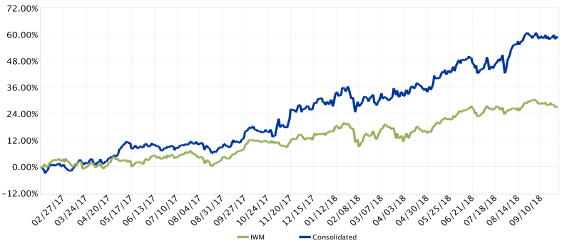
Performance in the third quarter was solid with KCM’s micro-cap composite gaining 10.72% compared to a gain of 3.57% for the benchmark. Year to date, KCM’s micro-cap composite has returned 24.29%, outperforming the 11.51% return of the benchmark.
The largest contribution to performance came from Callaway Golf (ELY), which returned 27.80% during the quarter. Callaway is a designer and manufacturer of golf equipment with one of the strongest brands in the industry. At KCM, we have owned the stock since our inception and believe it remains an attractive investment for several reasons. First, the company is led by a phenomenal CEO named Oliver “Chip” Brewer. Mr. Brewer has consistently displayed many, if not all, of the characteristics we look for in a manager, including business acumen and a track record of success. For instance, prior to joining Callaway Mr. Brewer helped save Adams Golf, a small golf club manufacturer famous for its Tight Lies fairway woods, from the brink of bankruptcy. When Chip took over as CEO of Adams in 2002 the business was losing money and rapidly running out of cash. But Mr. Brewer made several critical changes, quickly returning the company to profitability and putting it on a path toward growth. After selling the business to TaylorMade in 2012, Chip encountered a similar situation as the CEO of Callaway Golf. Like Adams, Callaway had been losing money and was on the verge of bankruptcy. Again Mr. Brewer immediately rightsized the business, helped it achieve profitability, and put it on a path towards sustainable growth. And that momentum has continued to this day.
Second, the golf equipment industry benefits from substantial barriers to entry which help to create sustainable competitive advantages for incumbent manufacturers. These barriers to entry are largely a result of the significant brand strength enjoyed by these companies – TaylorMade, Callaway, Ping, and Titleist. The best example of this is Nike’s attempt to break into the golf equipment industry. Despite being endorsed by two of the best golfers in the world (Tiger Woods and Rory McIlroy) for twenty years it never gained any meaningful market share and eventually decided to exit the business. Our conclusion? If Nike cannot successfully enter the golf equipment business, very few companies can.
Third, Callaway operates in an industry that appears poised for growth. Although golf has been in decline for the past decade there are numerous signs that the industry is nearing a turnaround. Notably, based on annual data from the National Golf Foundation (NGF), the number of golfers as well as rounds played have begun to stabilize. At the same time, the number of non-golfers exhibiting extreme interest in the game has risen sharply over the last several years (from 6.4M in 2011 to 14.9M in 2017), indicating latent demand that is likely to translate into future growth. This increased interest from non-golfers appears driven in part by the tremendous success of the entertainment venue TopGolf – of which Callaway owns a roughly 15% stake. As TopGolf continues to open new locations and expand across the country, we expect interest in the game of golf to rise even further. Add to this the recent resurgence of Tiger Woods, a fan favorite that has already generated increased television ratings, and you have an industry “teed-up” for accelerated growth.
These factors, combined with an appealing valuation, lead us to believe that Callaway Golf remains an attractive investment opportunity for the long-term and a core part of our portfolio.
Our biggest contributor to performance last quarter, Simulations Plus (SLP), turned out to be our most significant detractor this quarter with a decline of 8.86%. As a reminder, Simulations Plus provides software and consulting services for use primarily in pharmaceutical and chemical research. In July, the company reported its third quarter results, which included organic revenue growth of 13%, total revenue growth (including acquisitions) of nearly 27%, and operating income growth of more than 10%. By most standards these numbers would be considered satisfactory. However, given the elevated market expectations that were built in to the price, the stock declined by nearly 22% before partially recovering over the next few months. The market’s disappointment appears to have stemmed from Simulations Plus’ lower than expected margins. Margin compression was driven primarily by one-time costs associated with product testing and a mix shift from higher margin software revenue to lower margin consulting revenue. However, as noted on the earnings call, this mix shift is primarily the result of demand for the company’s software outstripping the industry’s capability to use it. Therefore, new customers tend to lean heavily on Simulations Plus’ consulting resources until they have enough people trained and certified on this complex software. As a result, we believe margins will return to more normalized levels over the next few quarters as the revenue mix shifts back toward software subscriptions.
During the quarter Simulations Plus also announced several grants to expand and improve the functionality of the company’s software. These grants include a funded research collaboration with a European consortium to develop and validate the Transdermal Compartmental Absorption and Transit (TCAT) model in the company’s GastroPlus software, a $0.5M grant by the FDA to integrate drug product quality attributes into the TCAT model in GastroPlus, a funded research collaboration with the FDA to develop and validate the Ocular Compartmental Absorption and Transit (OCAT) model in GastroPlus, and a $1.7M grant by the National Institutes of Diabetes, Digestive and Kidney Diseases (NIDDK) to provide software that can be used to predict a drug’s potential to cause drug-induced kidney injury. In short, the company is working with numerous entities to improve and expand its software, which lowers the cost of development and further strengthens Simulations Plus’ advantages over competitors.
Finally, both Chairman Walt Woltosz and newly appointed CEO Shawn O’Conner expressed an appetite for acquisitions which, based on management’s past transactions, have the potential to add significant shareholder value. This willingness to drive inorganic growth combined with a large and rapidly increasing organic growth opportunity gives us confidence that Simulations Plus can continue to improve its intrinsic value at a highly satisfactory rate for many years.
Conclusion
Third quarter performance was strong and further extended our lead over the benchmark for the year. We continue to diligently search for attractive investment opportunities, including those that we believe are capable of “Netflix-like” returns. By looking for companies with the ability to earn excess returns on capital, an excellent management team, and a large growth opportunity, we hope to continue providing our partners with the greatest possibility of long-term success. As always, thank you for your support of Kehlet Capital Management. If you have any questions or comments, please do not hesitate to contact us.
Disclosures to Performance Results
Actual composite performance results represent the performance of fully discretionary accounts managed by Kehlet Capital Management (KCM) during the corresponding time period. The composite performance results reflect time-weighted rates of return, the reinvestment of dividends and other account earnings. The reinvestment of dividends and other earnings may have a material impact on overall returns.
Past performance is not indicative of future results and the performance of a specific individual client account may vary substantially from the composite performance results. Therefore, no current or prospective client should assume that future performance will be profitable, or equal either the KCM composite performance results reflected above, or the performance results for any of the comparative index benchmarks provided.
For reasons including variances in portfolio account holdings, variances in the investment management fee incurred, market fluctuations, the date on which a client engages KCM’s investment management services, and any account contributions or withdrawals, the performance of a specific client’s account could vary substantially from the indicated KCM composite performance results. A portion of each account can be actively managed in an attempt to respond to changing conditions.
All performance results have been compiled solely by KCM, are unaudited, and have not been independently verified. Therefore, the performance data could be wrong. Information pertaining to KCM’s advisory operations, services, and fees is set forth in KCM’s current Form ADV Part 2A disclosure brochure, a copy of which is available from KCM upon request.
iShares IWM is an exchange-traded fund (ETF) measuring the performance of approximately 2,000 small-cap companies. It serves as a benchmark for small-cap stocks in the United States.
KCM managed accounts may own assets and follow investment strategies which cause them to differ materially from the composition and performance of the ETF shown as a benchmark. The ETF was chosen for its accessibility, transparency, independence, and relevance to KCM’s investment strategy, but there may be other indices that are more appropriate or applicable to the Concentrated Micro-cap Strategy. The historical index performance results are provided exclusively for comparison purposes only, so as to provide general comparative information to assist an individual client or prospective client in determining whether a specific Portfolio meets, or continues to meet, his/her investment objective(s). It should not be assumed that account holdings will correspond directly to any of the comparative indexes.
Different types of investments and/or investment strategies involve varying levels of risk, and there can be no assurance that any specific investment or investment strategy (including the investments purchased and/or investment strategies devised by KCM) will be either suitable or profitable for a client’s or prospective client’s portfolio and may result in a loss of principal. Accordingly, no client or prospective client should assume that the above portfolios (or any component thereof) serve as the receipt of, or a substitute for, personalized advice from KCM, or from any other investment professional.