
“Accounting numbers, of course, are the language of business and as such are of enormous help to anyone evaluating the worth of a business and tracking its progress… (but) managers and owners need to remember that accounting is but an aid to business thinking, never a substitute for it.”
| Coherent Inc. (COHR) | 12.7% |
|---|---|
| DXP Enterprises Inc. (DXPE) | 11.7% |
| Bandwidth Inc. (BAND) | 11.2% |
| Number of holdings | 10 |
|---|---|
| Median market cap | $915M |
| Weighted avg. market cap | $1,156M |
Introduction
I sometimes get asked “what are the one or two best metrics to use to determine if a stock is worth buying?” Though understandable, the question is difficult to answer because it assumes an overly simplified view of investing. It’s a bit like asking a physician which one or two metrics are best to determine a person’s overall health. Just as a doctor requires several measurements (e.g., height, weight, temperature, blood pressure, heart rate, cholesterol level, etc.) to attain a baseline understanding of a patient’s health, an investor needs to evaluate numerous metrics (e.g., revenue growth, profit margin, return on invested capital, price to earnings ratio, cash conversion cycle, etc.) to assess a company’s financial health. One or two indicators are simply not enough. And while some metrics are more informative than others, the few “most important” can rarely be identified ahead of time. Since the importance of any metric depends on its outcome in relation to a predefined normal range of values, it is the abnormal readings that are likely to be of most concern. Therefore, the relative importance of a metric can only be determined after thorough analysis and will vary according to the circumstances. Still, even the most useful metrics provide only limited information without additional analysis. As a result, they are most valuable as a starting point for further investigation. For example, just as a doctor may want to perform an EKG on a patient with high blood pressure, an investor may want to assess the ability of a business with a long cash conversion cycle to meet its future capital requirements. Combined with this type of analysis, the best metrics can provide critical pieces of the overall investment puzzle. But it is only by performing several such studies across various areas of a business that a complete picture can be formed. As a result, the same one or two metrics, by themselves, are severely inadequate at determining a stock’s attractiveness.
If, instead, the original intent of the question was to uncover the most important aspect of a business, in our opinion, the answer is clear – the quality of company management. Why? Because a company’s long-term results are often most significantly impacted by its key decision makers – generally the CEO, CFO, and Chairman of the Board. Just as a patient’s health is driven primarily by the choices they make (e.g., how much to exercise, how much to sleep, and what foods to eat), a company’s long-term health will largely be the result of decisions made by its key executives (e.g., which markets to pursue, what R&D projects to fund, and how aggressively to price their product or service). It is difficult to overemphasize this point. Warren Buffett may have put it best when he wrote, “after ten years on the job, a CEO whose company annually retains earnings equal to 10% of net worth will have been responsible for the deployment of more than 60% of all capital at work in the business.” In other words, for long-term investors like us, few things matter as much as management.
But evaluating company leadership is a highly subjective task. So, how should one approach the endeavor? Although there is no formal standard for great management, in the 2018 third quarter newsletter I wrote about what we, at Kehlet Capital, look for in a management team:
Integrity. Though often underappreciated by investors, we believe integrity is a critically important characteristic of great management for a couple of reasons. First, being a passive shareholder, uninvolved in the day-to-day operations of a business, requires placing one’s trust in the individuals running that business. One must be confident, for example, that a CEO will prioritize projects with significant long-term benefits and high net present values (NPV’s) over projects with more short-term benefits – that could drive increased compensation for the manager – but have lower NPV’s for shareholders. As a result, relying on leadership that is highly trustworthy can significantly minimize the agency costs that arise from conflicts of interest between manager’s and the shareholders they represent. Second, being honest and dependable just makes good business sense. Employees, suppliers, and customers who know what to expect from a company and can count on it to do the right thing are much more likely to feel comfortable doing business with that company. This often causes the firm’s reputation to grow and its relationships to strengthen over time, creating substantial shareholder value.
But how does one evaluate management’s integrity? In our opinion it starts with assessing their willingness to be open and honest about failures and mistakes. In our experience the vast majority of public-company CEO’s attempt to portray their company as an example of perfection – flawlessly managed and absent of weakness. But in virtually every case reality tells a different story. Consequently, these CEO’s are either misleading investors, unaware of the problems facing their companies, or ignoring problems altogether. Therefore, we believe that truly great CEO’s address difficulties openly, honestly and without hesitation.
Business acumen. We believe the best managers possess a deep understanding of their company and its customers as well as general business principles. This may seem obvious but, in our opinion, many CEO’s do not have the necessary skills to run their businesses optimally. How can that be, one may ask? As Warren Buffett explains, “their inadequacy is not surprising. Most bosses rise to the top because they have excelled in an area such as marketing, production, engineering, administration, or sometimes, institutional politics. Once they become CEO’s they face new responsibilities. They now must make capital allocation decisions, a critical job that they may have never tackled and that is not easily mastered. To stretch the point, it’s as if the final step for a highly-talented musician was not to perform at Carnegie Hall but, instead, to be named Chairman of the Federal Reserve.”
How then should one identify managers who display substantial business acumen? We believe it starts with a focus on return on invested capital (ROIC). Exceptional managers understand that shareholder value is created when returns on invested capital exceed the cost of that capital. They therefore realize that growth can be value destroying if it requires too much incremental capital to sustain it. As a result, we favor managers who regularly call attention to ROIC and whose compensation is partially determined by its outcome.
Passion. We think managers who are passionate about their company, its mission, and its customers have a substantial advantage over competitors. Why? Because leaders who are passionate tend to view their work as meaningful and perhaps, at times, even fun. We believe this mentality frequently leads to an outstanding work ethic and a focus on continuous improvement. When it starts from the top, this attitude is often contagious and spreads to other employees throughout the firm. As it does, it regularly creates an extremely productive and highly efficient work environment that is difficult for competitors to replicate.
While there are several ways to evaluate a leader’s passion, in most cases it is obvious by their demeanor. For example, a CEO who gets genuinely excited talking about their company’s product or service is likely passionate about their work. Or a manager who is never satisfied with the status quo and consistently searching for ways to improve, is displaying the type of attitude we look for in a leader.
A track record of success. Even the best subjective analysis can be wrong due to inherent biases that sneak into the process. Thus, investing with manager’s who have a verifiable history of creating shareholder value acts as a check on these biases. For instance, if a subjective analysis suggests the presence of a top tier CEO but historical results have been subpar, an error was likely made along the way. If, however, the analysis is backed up by a track record of meaningful shareholder value creation, one can be confident they have found an exceptional manager.
Although there is no simple way to determine if a stock is worth buying, we think evaluating the quality of company management is a great place to start. By using the criteria outlined above, as we do, we think one can increase the chances of partnering with truly extraordinary managers and position themselves favorably for long-term investment success.
Performance
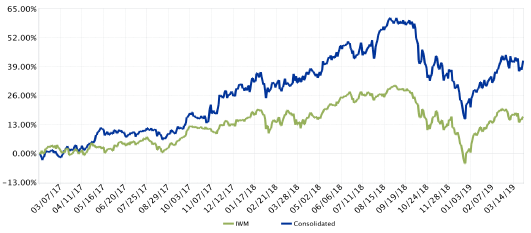
| Year | KCM Composite, Net | IWM | Excess Return |
|---|---|---|---|
| 2017* | 27.20% | 14.26% | +12.94% |
| 2018 | -3.43% | -11.11% | +7.68% |
| 2019 YTD | 14.49% | 14.64% | -0.15% |
| Annualized | 17.11% | 7.30% | +9.81% |
*Inception date: 02/01/2017
During the first quarter of 2019 Kehlet Capital Management’s concentrated micro-cap composite returned 14.49%, roughly in-line with the benchmark which was up 14.64%.
The largest contribution to performance came from Bandwidth Inc. (BAND) which returned 64.49% during the quarter. Bandwidth is a Communications Platform as a Service, or CPaaS, company that provides large enterprises with application programming interfaces (API’s). These API’s enable developers to add communications features – such as voice calling and text messaging – into their own applications without the need to build backend infrastructure and interfaces. The company’s customers include Google Voice, Skype for Business, RingCentral, and Cisco-Webex. Our long-term investment thesis for Bandwidth is threefold.
First, the communications market is enormous at an estimated $1.5T in the U.S. alone. And within that market, CPaaS is projected to grow anywhere from 60% - 110% compound annual growth rate (CAGR) through 2021, driven largely by the growing internet of things (IoT) market and the rise of virtual assistants like Alexa, Siri, and Google Home. As a result, the runway for growth is extremely long.
Second, Bandwidth is the only CPaaS provider in the industry with its own nationwide IP voice network, which was purpose-built for their platform. This provides a number of advantages over other communications providers who rely on leased networks. Namely, it allows the company to provide better quality, customer service, and scalability to its customers. For example, as the network owner, Bandwidth is able to collect call and messaging data in real-time and seamlessly integrate it with customer relationship management (CRM) and Business Intelligence analytics tools. This allows customers to drive actionable insights and make data-driven business decisions. As a result, we believe Bandwidth has significant and sustainable advantages over many of its competitors.
Third, Bandwidth is run by an exceptional management team led by co-Founder, Chairman and CEO, David Morken. Mr. Morken possesses a number of the qualities we look for in a manager: 1) He exhibits substantial business acumen and consistently emphasizes the importance of making prudent investments with shareholder capital, 2) he is visibly passionate about the business and owns a large percentage of the shares outstanding, and 3) he has a long track record of success, having led Bandwidth through a series of business model transitions since its founding in 1999 and helped it achieve significant growth with limited sales and marketing investment. As a result, Mr. Morken has proven to be a fantastic owner-operator capable of creating shareholder value for many years to come.
The largest detractor to performance was Chase Corporation (CCF) which declined 7.47% during the quarter. Chase is a manufacturer of protective materials such as tapes, sealants, adhesives, and coatings, used for high reliability applications across a broad range of markets. Their products include coatings that protect electronic circuit boards from damage and corrosion, sealants used to insulate and shield communications cables, and tapes used to waterproof pipelines. There are a couple things we like about Chase.
First, they have an attractive business model that produces high returns on invested capital within the specialty chemicals industry. This is due to several factors: 1) the company’s solutions are customized for specific customer needs which creates meaningful switching costs and sticky customer relationships, 2) the solutions are typically high-value but low-cost. In other words, Chase’s products often enhance the reliability and performance of their customers end-products but at an extremely low price relative to the overall cost of the product. As a result, customers generally tend to be price-insensitive, and 3) the company’s products are highly-scalable. Consequently, profitability tends to grow meaningfully with increasing volume.
Second, Chase’s management has proven to be astute capital allocators, creating substantial shareholder value through an active M&A program. Given the company’s current financial flexibility (total debt to EBITDA of less than 0.1x) and the highly fragmented nature of the $30B specialty chemicals industry, we think it is likely they will continue to reinvest capital at attractive rates and create meaningful shareholder value for many years.
Portfolio Activity
We made no changes to the portfolio during the first quarter. As long-term investors, this will likely be the case in future quarters more often than not. However, patience should not be mistaken for inactivity. Behind the scenes, we continue to perform extensive bottom-up research, including frequent calls with company managers, in search of the next big investment idea. When we think we have found one, and have initiated a position, we will use this section to describe our thought process. Conversely, whenever we exit a position, we will provide a “post-mortem” analysis to assess what happened and the lessons learned.
Conclusion
First quarter results were roughly in-line with the benchmark index. Although we cannot predict what the remainder of the year will bring, we feel good about the long-term prospects for the portfolio. Based on our analysis, we believe the companies in our portfolio are led by some of the most outstanding managers in the micro-cap space. As such, we expect them to continue creating shareholder value and providing highly satisfactory investment results for years to come. As always, thank you for your support of Kehlet Capital Management. If you have any questions or comments, please do not hesitate to contact us.
Disclosures to Performance Results
Actual composite performance results represent the performance of fully discretionary accounts managed by Kehlet Capital Management (KCM) during the corresponding time period. The composite performance results reflect time-weighted rates of return, the reinvestment of dividends and other account earnings. The reinvestment of dividends and other earnings may have a material impact on overall returns.
Past performance is not indicative of future results and the performance of a specific individual client account may vary substantially from the composite performance results. Therefore, no current or prospective client should assume that future performance will be profitable, or equal either the KCM composite performance results reflected above, or the performance results for any of the comparative index benchmarks provided.
For reasons including variances in portfolio account holdings, variances in the investment management fee incurred, market fluctuations, the date on which a client engages KCM’s investment management services, and any account contributions or withdrawals, the performance of a specific client’s account could vary substantially from the indicated KCM composite performance results. A portion of each account can be actively managed in an attempt to respond to changing conditions.
All performance results have been compiled solely by KCM, are unaudited, and have not been independently verified. Therefore, the performance data could be wrong. Information pertaining to KCM’s advisory operations, services, and fees is set forth in KCM’s current Form ADV Part 2A disclosure brochure, a copy of which is available from KCM upon request.
iShares IWM is an exchange-traded fund (ETF) measuring the performance of approximately 2,000 small-cap companies. It serves as a benchmark for small-cap stocks in the United States.
KCM managed accounts may own assets and follow investment strategies which cause them to differ materially from the composition and performance of the ETF shown as a benchmark. The ETF was chosen for its accessibility, transparency, independence, and relevance to KCM’s investment strategy, but there may be other indices that are more appropriate or applicable to the Concentrated Micro-cap Strategy. The historical index performance results are provided exclusively for comparison purposes only, so as to provide general comparative information to assist an individual client or prospective client in determining whether a specific Portfolio meets, or continues to meet, his/her investment objective(s). It should not be assumed that account holdings will correspond directly to any of the comparative indexes.
Different types of investments and/or investment strategies involve varying levels of risk, and there can be no assurance that any specific investment or investment strategy (including the investments purchased and/or investment strategies devised by KCM) will be either suitable or profitable for a client’s or prospective client’s portfolio and may result in a loss of principal. Accordingly, no client or prospective client should assume that the above portfolios (or any component thereof) serve as the receipt of, or a substitute for, personalized advice from KCM, or from any other investment professional.