
“Inflation is the one form of taxation that can be imposed without legislation.”
| Callaway Golf Co. (ELY) | 13.7% |
|---|---|
| Bandwidth Inc. (BAND) | 12.0% |
| Coherent Inc. (COHR) | 11.5% |
| Number of holdings | 10 |
|---|---|
| Median market cap | $1,163M |
| Weighted avg. market cap | $1,209M |
Introduction
Over the last several years, investors have debated the relative attractiveness of the U.S. stock market. Is it a good time to invest or is the market due for a correction? Analysts on one side point to traditional valuation metrics, such as the price to earnings ratio, well above their historical averages as evidence the market is expensive. On the other side, analysts argue that interest rates, inflation, and volatility are at or near all-time lows, which supports higher stock prices and makes historical averages less relevant. So which side is correct? Are stocks generally expensive or more reasonably priced? While there is no way to know the answer with certainty – since stock prices are forward-looking and the future is inherently uncertain – the winning side is likely to be determined by one key variable: inflation.
In the fourth quarter 2018 newsletter, I described the process of determining the intrinsic value of a stock. In its purest form, intrinsic value is the sum of all future cash flows discounted by a required rate of return. Thus, by definition, the required rate of return is a key determinant of intrinsic value. And though prevailing interest rates primarily drive the required rate of return – as they represent the opportunity cost to equity investing – inflation largely determines interest rates – since lenders need to be compensated for their loss of purchasing power. Just as low interest rates prop up stock market prices, low inflation drives down interest rates. Thus, if inflation remains consistently at or below the Federal Reserve’s 2% annual target, interest rates are likely to remain low and equity values above historical averages. However, if inflation picks up, interest rates will likely rise, and stock market values will fall. Therefore, inflation is one of the most important determinants of stock market values.
But it also has a significant impact on consumers. Many of us had grandparents who reminisced about how cheap things were when they were kids. “Back in my day, a gallon of milk used to cost a nickel,” they might say. At the time, we may have dismissed these statements as hopeless desires for a return to “the good old days.” But there was a valuable lesson in their musings; your savings decrease in value every year due to inflation. This loss of value is not always apparent since it occurs slowly over time and indirectly through a general increase in the cost of living. In other words, as the prices of goods like food, gasoline, and clothing increase over time, a fixed amount of money will be able to purchase less and less. Therefore, inflation can be thought of as a hidden tax on savings. When this tax is low, the reduction in purchasing power is typically manageable. But when it is high, it can put a significant burden on households and create an enormous drag on the economy. This is likely the unofficial reason the Fed targets 2% annual inflation; because it is thought to be the goldilocks level – enough to allow the government to spend more than it takes in, but not so much as to meaningfully impede economic progress.
So, what causes inflation? Simply put, inflation occurs when the Fed prints too much money relative to the demand for that money1. For instance, if the Central Bank (a.k.a. the Fed) floods the economy with newly printed dollars, consumers are likely to increase their spending and businesses expand their investments. If the resulting surge in demand exceeds the available supply of goods and services, consumers may engage in bidding wars and companies will likely raise their prices. On the other hand, if the Central Bank does not print any money, but the supply of goods and services expands (perhaps due to increases in productivity), prices are likely to decline – since there will not be enough demand to absorb the increase in supply. Therefore, to keep prices stable, the Fed has the job of continually balancing the supply of money with the demand for money. Though simple in theory, this balancing act is extraordinarily challenging due to several factors:
There can be a significant lag between the printing of money and its impact on inflation. In other words, an increase in the money supply does not immediately result in higher inflation. When the Fed prints money, it puts it into circulation by buying government bonds from investors in the open market. These former bondholders, now flush with cash, must decide what to do with their newly acquired money. They have several options. They can 1) invest it, 2) spend it, 3) save it, 4) lend it out, or 5) donate it. What they choose in aggregate will ultimately decide the timing and magnitude of the impact on inflation. And since the individual decisions of the group are mostly unpredictable, so too is the money supply’s effect on inflation.
The Fed does not have direct control over the entire money supply. Despite its ability to print money, the Fed only control’s the economy’s supply of narrow money, or physical cash and currency. But other forms of payment, such as credit cards and other forms of credit referred to as broad money, are controlled primarily by commercial banks and other lenders. The reason for this is simple: whenever a bank lends out its deposits, it has effectively increased the money supply. Why? Because both the depositor and the borrower will now have a claim to money that previously only belonged to the depositor. As a result of this dynamic, the actions of commercial banks and other lenders can significantly impact the overall money supply, independent of the Fed’s actions.
Measuring the demand for money is an inexact science since it depends heavily on people’s desire to hold cash – known in economist-speak as their liquidity preference (a.k.a. the velocity of money) – which can fluctuate rapidly. For example, during the 2008/2009 financial crisis, the demand for money spiked and cash became king. As borrowers defaulted on their mortgages, many people feared that banks (who had made the ill-advised loans) would not be able to meet their financial obligations. As a result, they withdrew their money at an alarming rate, which resulted in a massive surge in people’s liquidity preference and thus, the overall demand for money. Had the Fed not printed trillions of dollars to meet this demand, the economy would likely have experienced substantial deflation.
These challenges mean that controlling inflation is like driving a car down the highway by remote control on a five-second lag. You won’t know the vehicle’s exact location (only where it was five seconds ago), you will be slow to react to unexpected changes, and you will be unsure how much adjustment is necessary to get back on track. As a result, the Fed generally does not manage the money supply directly. Instead, it attempts to control inflation by adjusting interest rates, which serve as a proxy for the supply and demand of money. This approach has worked reasonably well, as shown below:
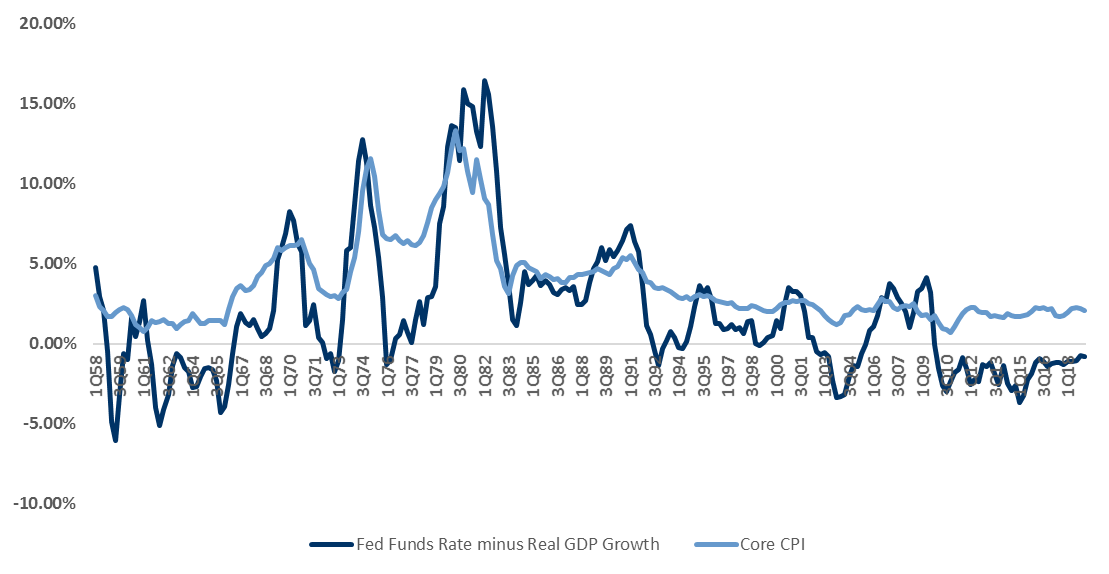
Note that, in general, when interest rates (in dark blue) are low relative to real GDP growth, inflation (in light blue) tends to increase. And when interest rates are high, inflation tends to fall. But the link is imperfect and not fully understood. Therefore, investors and consumers should always be wary of inflation, since it is not easily controlled and can have a particularly onerous effect on the economy.
So how should one protect themselves? The general consensus is to use long-term, fixed-rate debt – which will become less of a burden during times of increasing inflation – to invest in hard assets like gold, commodities, or real estate – which will increase in value. While it is true that this can be a highly profitable strategy during periods of high inflation, it also requires nearly perfect foresight since it is likely to underperform during times of low inflation and can cause significant hardship during economic contractions. But, as mentioned previously, inflation is difficult to control and even harder to predict. Therefore, we suggest a different approach; investing in high-quality businesses with a margin of safety. The reason is simple. High-quality companies can often pass along inflationary price increases while requiring minimal new capital investment. This combination allows them to continue creating shareholder value during times of high inflation. This is partly why, at Kehlet Capital, we invest in these types of businesses; because it reduces downside risk and provides a partial hedge against inflation.
Although inflation has been “beautifully low” in recent years, it can rear its ugly head at any time. And when it does, stocks will almost certainly perform poorly. Over the last few decades, the Fed has done an admirable job of keeping inflation in check through the management of interest rates. But the government’s response to the financial crisis has left it with continuing high levels of debt and an increased money supply relative to GDP. As a result, we believe there is an elevated risk of inflation over the long-term. We cannot predict when it will come (if at all) but think our strategy of investing in quality businesses will provide reasonable protection if it does.
Performance
| Year | KCM Composite, Net | IWM | Excess Return |
|---|---|---|---|
| 2017* | 27.20% | 14.26% | +12.94% |
| 2018 | -3.43% | -11.11% | +7.68% |
| 2019 YTD | 19.02% | 16.85% | +2.17% |
| Annualized | 17.08% | 7.37% | +9.71% |
*Inception date: 02/01/2017
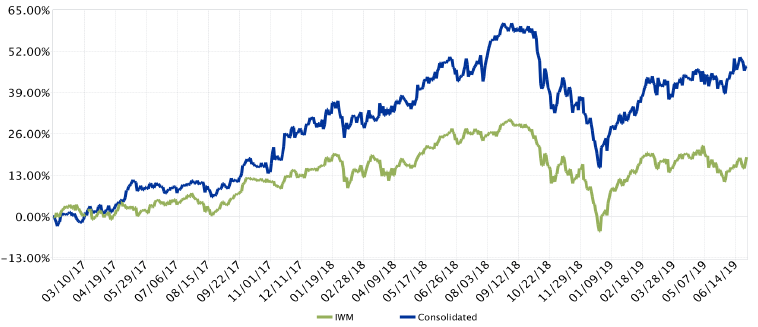
During the second quarter of 2019, Kehlet Capital Management’s concentrated micro-cap composite returned 3.96%, slightly outperforming the benchmark which returned 1.93%. Through the first half of the year, the composite grew 19.02% compared to an increase of 16.75% for the benchmark.
The largest contribution to performance came from Astronics Corporation (ATRO), which returned 22.74% during the quarter. As a reminder, Astronics is a supplier of engineered components to the Aerospace and Defense industry, with approximately 90% share of the in-seat power market. As noted in the first quarter 2018 newsletter, we initiated a position in the company in December 2017, as disappointing financial results overshadowed improvement in leading indicators such as new orders and backlog. Based on these leading indicators, we felt that the company would experience a significant rebound and that the market had mispriced the extent of this recovery. Since then, our thesis has begun to play out. In the second quarter, the company reported revenue growth of 16.3% and operating income growth of 245.0%.
Consequently, the stock has outperformed the benchmark by over 8% annually since our initial purchase. And although Astronics is likely to face some short-term headwinds due to the recent grounding of the Boeing 737 MAX, we remain bullish on the company’s long-term prospects. Notably, we believe Astronics has attractive growth opportunities within a number of their offerings including their business jet tail-mount program, business jet electronic power distribution system (EPDS), New York City subway system test service, and in-seat power products. The company also continues to actively pursue value-added acquisitions and, shortly after the close of the second quarter, announced the purchase of Freedom Communication Technologies (FTC), a high-growth developer and manufacturer of communication test equipment for LTE high-speed wireless customers, for $22M.
On a more somber note, however, during the second quarter Astronics announced the passing of its Chairman, Kevin Keane. Mr. Keane joined the Board of Directors in 1970, was named Chairman in 1974, and served as the company’s President and CEO from 1974 to 2002. He was widely considered the Founder of the company within Astronics. While there remains some uncertainty around the short-term fate of his shares – he owned more than 7% of the company and controlled over 19% of the voting power – we have significant confidence in the remaining management team, including CEO Peter Gundermann. As a result, we believe the thesis continues intact.
The largest detractor to performance was Care.com (CRCM) which declined 43.63% during the quarter. Care.com is the largest online marketplace for finding and managing childcare. Through the company’s website and mobile app, families can search for, qualify, and connect with caregivers based on their specific needs. We have held shares in Care.com since inception in February 2017, and our long-term thesis is based on three factors.
First, Care.com is addressing an enormous market. Often, childcare is one of the most substantial expenses for families and total annual spend for care in the U.S. is estimated to be over $330B. Second, the company is the clear leader among online marketplaces with nearly 14M caregivers on its platform or roughly twice as many as its next closest competitor. This market leadership is also reflected in the company’s brand strength, which is approximately 8x its nearest competitor. And as the go-to destination for childcare, the company benefits from network effects that drive caregivers to its platform, which further reinforces its leadership position and creates a virtuous cycle. And Third, we feel the company is misunderstood by investors due to the nature of its business model, which hides the true profitability potential of the company. For instance, Care.com has historically been unprofitable from a GAAP accounting perspective but generates significant free cash flow. This is due to a couple of reasons: 1) the company benefits from a negative cash conversion cycle since customers pay for their subscriptions up front, but the company does not incur the costs until much later. In other words, investments in growth can largely be financed by customers, which fuels the company’s capital-light business model, and 2) new customer accounts, though initially unprofitable, become extremely profitable as members extend or renew their subscriptions over time. In fact, according to company estimates, the return on customer acquisition costs currently averages 6.4x over the life of a customer. As a result, we believe Care.com has the potential to compound its intrinsic value at high rates of return for many, many years.
However, at the end of the first quarter, the Wall Street Journal published an article critical of Care.com’s screening process. In it, the author found nine instances in the last six years, where caregivers on the site had police records and were later accused of crimes while caring for customers’ children or elderly relatives. It also found hundreds of instances of daycare centers being improperly listed as state licensed. In response, CEO Shiela Lirio Marcelo noted that Care.com performs preliminary screens on all individual caregivers, including a search of a national criminal database and the national sex offender public website but that “Care.com is a marketplace platform designed for shared responsibility overall.” She went on to point out that the company provides three tiers of background checks that families can purchase as well as other tools and recommendations on steps they should take when choosing a caregiver. Despite these protocols, the company later announced changes to its processes for approving and managing caregiver profiles including 1) no longer allowing caregivers to send messages until completion of the preliminary screening, 2) the removal of all unclaimed daycare center listings, and 3) a more prominent notice to users explaining that Care.com does not verify the credentials or licensing information of businesses listed on its marketplace. Shortly thereafter, Best Buy announced that it would suspend its relationship with Care.com’s Care@Work service to do a thorough review of the program and the company. Roughly a month later, Care.com announced its first quarter financial results which included revenue growth of nearly 13%, total member growth of almost 16%, and continued acceleration of growth in the Care@Work service to 51%. On the call, Ms. Marcelo noted that “a handful of Care@Work clients have chosen not to renew” but believed it to have a de minimis impact (less than 0.1%) on revenue. While management maintained top line guidance of 13.5% growth for the second quarter, they reduced their profitability guidance as they incur both one-time and ongoing expenses related to the WSJ article and new investments aimed at increasing safety. These investments include: 1) in-depth background checks that include federal and county-level criminal records dating back seven years, 2) social security number verification, 3) annual updates of background checks, 4) an identity verification pilot program that uses facial recognition to match the caregiver to a government-issued ID, and 5) a plan to verify licensure information on child care center listings provided by the business owners in its free directory. Finally, in June, the company announced the resignation of its CFO, Michael Echenberg, which will become effective August 30, 2019.
Our take on all of this? We believe there are two separate issues to address. First, Care.com’s handling of individual caregivers (which represent the vast majority of Care.com’s business) and second, the company’s handling of daycare center listings (which represents less than 0.5% of their revenue). Concerning the company’s supervision of individual caregivers, we believe it did nothing wrong. Care.com has performed preliminary screens on all caregivers since the start of its service, which has resulted in approximately 10% of new caregiver accounts being closed based on the results of the screen. The company has also been clear that, although their preliminary screen provides a baseline of safety, it is ultimately up to parents to perform the due diligence when choosing a caregiver for their children. We think most people would agree that this method of shared responsibility is not only the right approach but just plain common sense. But despite their position, Care.com has chosen to further support their members by providing more frequent and more rigorous background checks free of charge. We applaud the company’s decision to increase safety measures and provide even more value to families. In the long-term, we believe these efforts will strengthen the company’s offering and further differentiate it from competitors.
But with regards to Care.com’s handling of daycare center listings, the company admits that it had previously used publicly available data to create directory listings for small and medium-sized businesses that provided childcare services, often without their knowledge. And since Care.com made no effort to verify the credentials or licensing information of these businesses, it eventually led to misleading and outright false information generated directly by Care.com. This was very clearly a mistake; one that some might argue was unethical depending on management’s previous knowledge of the deficiency. Although we believe that management is committed to their members and has done the right thing by removing all 40,000+ unclaimed listings, the situation certainly calls into question their credibility and integrity. Even if nothing unethical took place, management undoubtedly suffered a major lapse in judgment. But, as long-term shareholders, we are willing to give them the benefit of the doubt given that this is their first offense. However, we are careful not to fall blindly in love with names we own either. We believe the long-term thesis remains intact despite the near-term headwinds. But we are placing the company on our version of probation, and one more misstep will force us to seriously reconsider the investment.
Portfolio Activity
During the second quarter, we did not initiate or exit any positions. We did, however, rebalance the portfolio by reducing our positions in Astronics Corporation (ATRO) and NRC Health (NRC) as well as adding to our positions in Care.com (CRCM) and Callaway Golf (ELY).
Conclusion
Second quarter results were satisfactory, but markets continue to chug along at levels well above historical averages. Although equity values have been supported for years by “beautifully low” inflation, it is difficult to predict how long this environment will last. If it continues, we will do our best to provide returns in excess of the index without taking on undue risk. But the further away the market gets from historical averages, the more difficult that task becomes. If, however, inflation meaningfully picks up, we believe our portfolio of high-quality businesses will have the opportunity to significantly outperform. Although the portfolio will likely suffer in such a scenario, we think it is likely to be “less hurt” than the overall market. Either way, our goal remains the same; to provide our partners with highly satisfactory long-term returns across all market environments. As always, thank you for supporting Kehlet Capital Management, and please do not hesitate to contact us should you have any questions or comments.
Notes
- Paul Donovan, The Truth About Inflation (New York: Routledge, 2015) ↩
Disclosures to Performance Results
Actual composite performance results represent the performance of fully discretionary accounts managed by Kehlet Capital Management (KCM) during the corresponding time period. The composite performance results reflect time-weighted rates of return, the reinvestment of dividends and other account earnings. The reinvestment of dividends and other earnings may have a material impact on overall returns.
Past performance is not indicative of future results and the performance of a specific individual client account may vary substantially from the composite performance results. Therefore, no current or prospective client should assume that future performance will be profitable, or equal either the KCM composite performance results reflected above, or the performance results for any of the comparative index benchmarks provided.
For reasons including variances in portfolio account holdings, variances in the investment management fee incurred, market fluctuations, the date on which a client engages KCM’s investment management services, and any account contributions or withdrawals, the performance of a specific client’s account could vary substantially from the indicated KCM composite performance results. A portion of each account can be actively managed in an attempt to respond to changing conditions.
All performance results have been compiled solely by KCM, are unaudited, and have not been independently verified. Therefore, the performance data could be wrong. Information pertaining to KCM’s advisory operations, services, and fees is set forth in KCM’s current Form ADV Part 2A disclosure brochure, a copy of which is available from KCM upon request.
iShares IWM is an exchange-traded fund (ETF) measuring the performance of approximately 2,000 small-cap companies. It serves as a benchmark for small-cap stocks in the United States.
KCM managed accounts may own assets and follow investment strategies which cause them to differ materially from the composition and performance of the ETF shown as a benchmark. The ETF was chosen for its accessibility, transparency, independence, and relevance to KCM’s investment strategy, but there may be other indices that are more appropriate or applicable to the Concentrated Micro-cap Strategy. The historical index performance results are provided exclusively for comparison purposes only, so as to provide general comparative information to assist an individual client or prospective client in determining whether a specific Portfolio meets, or continues to meet, his/her investment objective(s). It should not be assumed that account holdings will correspond directly to any of the comparative indexes.
Different types of investments and/or investment strategies involve varying levels of risk, and there can be no assurance that any specific investment or investment strategy (including the investments purchased and/or investment strategies devised by KCM) will be either suitable or profitable for a client’s or prospective client’s portfolio and may result in a loss of principal. Accordingly, no client or prospective client should assume that the above portfolios (or any component thereof) serve as the receipt of, or a substitute for, personalized advice from KCM, or from any other investment professional.