
“I believe (artificial intelligence) is going to change the world more than anything in the history of mankind. More than electricity.”
| Callaway Golf Co. (ELY) | 15.9% |
|---|---|
| Coherent Inc. (COHR) | 13.2% |
| Bandwidth Inc. (BAND) | 10.4% |
| Number of holdings | 10 |
|---|---|
| Median market cap | $879M |
| Weighted avg. market cap | $1,437M |
Introduction
Since the field of artificial intelligence (AI) was born in the 1950’s it has experienced several cycles of enthusiasm and excitement followed by missed expectations and disappointment. Interest and funding have periodically fallen so low that the times have become known as “AI winters.” This is not one of those times. Recent breakthroughs in machine learning (a subfield of artificial intelligence) have enabled new technologies – such as facial recognition, natural language processing, and self-driving cars – and inspired a renewed sense of optimism about the potential for AI. The current round of euphoria has at times reached a fever pitch, with some concluding that the technology is so powerful it represents an existential threat to humanity. Elon Musk, the CEO of Tesla, has even referred to AI research as “summoning the demon.” But with most new technologies comes a level of overconfidence and marketing-driven exaggeration. As investors, it is critical to separate the hype from reality in order to recognize market mispricing’s, position our portfolio optimally and avoid costly mistakes. So, what should we make of today’s artificial intelligence? Is the current environment likely to end with another AI winter? Or will it bring about the end of the world as we know it?
When people think of AI, they tend to think of machines from movies like 2001: A Space Odyssey, The Terminator, or The Matrix. But those are examples of artificial general intelligence (AGI), or AI that is equal to or better than humans. Although AGI is the ultimate goal – minus the threat of human extinction, of course – today’s AI is referred to as artificial narrow intelligence. That is, it can typically master a narrowly defined task but cannot apply that skill more broadly. For example, digital assistants like Siri or Alexa can retrieve existing information, like the size of an elephant or the size of a doorway, but they cannot infer new information, like whether an elephant can fit through a doorway.1 Simply put, intelligence consists of numerous skills including logic, reasoning, perception, and abstract thinking, to name a few. Today’s AI exhibits one or a few of those skills but not all of them. And while there have been major advances in the ability to code various aspects of intelligence, most remain unsolved.
However, the latest breakthrough in AI has received a lot of attention because it appears to have developed a way to program computers with a foundational component of intelligence – the ability to learn. This innovation, known as deep learning, is a highly complex and ingenious algorithm that allows computers to use historical data to recognize patterns and make predictions. 2 The name “deep learning” comes, in part, from the fact that the computer’s predictions become more accurate the more data it obtains. The innovation is undoubtedly a crucial step towards AGI and has sparked the imaginations of many. Once a computer can learn, it will inevitably surpass humans in intelligence, the thinking goes. And once it passes us in intelligence, humans will no longer be the dominant species, right? Not necessarily. Because even though deep learning has extraordinary potential to change the world, it also has significant limitations.
Namely, deep learning requires massive amounts of structured data. For example, if you want to teach a computer how to recognize a cat, you need to provide it with millions of pictures labeled as either containing a cat or not. The more pictures you provide, the more the computer will “learn” to recognize the pattern of pixels that represent a cat. This works great when the required data is easily obtainable in large volumes. But, as you can imagine, a lot of data is not. There are a few reasons for this.
1) The data may require significant human capital to obtain. For instance, to provide a computer with millions of pictures labelled as either containing a cat or not, someone (a human) must sort through all the pictures and individually label each one. And the more variables involved, the more manpower that is required. For example, Google has spent billions of dollars over more than a decade developing its self-driving vehicle technology, which includes over ten million miles of driving on public roads and over seven billion simulated miles.3 Given the potential size of the self-driving vehicle market, the value of the data obtained will likely outweigh the enormous cost to acquire it. But this may not be the case for every application of AI. For example, developing artificial intelligence that can fold laundry, write emails, or take out the trash may prove to be cost-prohibitive relative to the value created.
2) The data may not exist in large enough quantities. Even in circumstances where obtaining the data is not cost-prohibitive, the event in question may happen so infrequently that the amount of data necessary for deep learning to be effective does not exist. For instance, predicting a volcanic eruption, forecasting the results of a presidential election, or estimating how a specific person will respond to an emergency are probably poor applications for deep learning because the events happen so infrequently, and the data is so sparse.
3) The relevant data may be unknown. Many situations in life are complex and impacted by numerous and ever-changing variables. In these scenarios, it may not be clear which data is important and which is not. As a result, obtaining the necessary type and quantity of data to train artificial intelligence can be extremely difficult. As a result, developing AI that can solve crimes, produce a hit movie, or analyze the potential outcome of a merger will likely require breakthroughs other than deep learning.
It’s for these reasons that we believe deep learning is not likely to lead to artificial general intelligence anytime soon. Many more breakthroughs will be needed. In fact, in his book Architects of Intelligence, author Martin Ford asked 23 AI experts to give their best guess as to when there would be at least a 50% probability that human-level artificial intelligence had been achieved. Of the 18 responses, the average prediction was 80 years from now. Even then, there are good reasons to believe AGI, once achieved, will not pose an existential threat to humanity. As Yann LeCun, Professor of Computer Science at NYU and Chief AI Scientist at Facebook, noted “it’s a bit like we haven’t invented the internal combustion engine yet and we are already worrying that we’re not going to be able to invent the brake and the safety belt.” Put another way, fretting about an AI apocalypse now is like worrying about overpopulation on Mars before we’ve stepped foot on the planet.
But despite its limitations, deep learning will almost certainly have a profound impact on society, produce substantial increases in productivity and significantly improve overall quality of life. Self-driving cars are just one of the more obvious benefits. Less obvious is the potential for cheaper prescription drugs. For instance, pharmaceutical companies often spend millions or even billions of dollars developing and testing new drugs. These costs are a direct result of companies’ inability to predict which drugs will be effective and which will not. And these costs ultimately get passed on to patients. But if machine learning techniques, such as deep learning, can be used to analyze data generated from clinical trials to better predict the effectiveness of future drugs, costs could fall precipitously. We think there is enormous potential in this area, which is partly why, at Kehlet Capital, we have invested in a company called Simulations Plus (SLP). As mentioned in the second quarter 2018 newsletter, Simulations Plus provides drug development software that utilizes machine learning to help predict the properties of molecules based on their structure. The company was a very early adopter of machine learning and has spent nearly twenty years developing and refining its proprietary technology. As a result, we believe it is well positioned to benefit from the increased use of artificial intelligence in the drug development process.
In short, advances in deep learning have generated considerable optimism about the potential for artificial intelligence. While the technology is likely to be a game-changer, we think it is important to stay grounded. Although we do not believe that AI represents an existential threat to humanity, we don’t believe another AI winter is likely either. The potential use cases for artificial intelligence and deep learning are substantial. At Kehlet Capital, we will continue to monitor these opportunities as they present themselves in order to provide our partners with the greatest possibility of long-term success.
Performance
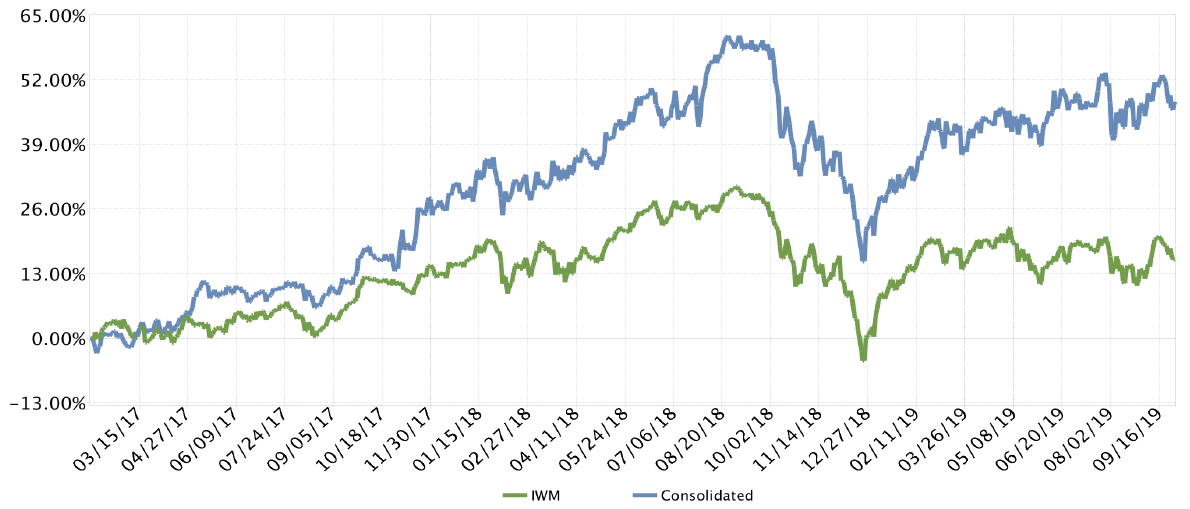
| Year | KCM Composite, Net | IWM | Excess Return |
|---|---|---|---|
| 2017* | 27.20% | 14.26% | +12.94% |
| 2018 | -3.43% | -11.11% | +7.68% |
| 2019 YTD | 19.32% | 14.13% | +5.19% |
| Annualized | 15.46% | 5.71% | +9.75% |
*Inception date: 02/01/2017
During the third quarter of 2019, Kehlet Capital Management’s concentrated micro-cap composite returned 0.27%, outperforming the benchmark which returned -2.33%. Through the first three quarters of the year, the KCM composite has grown 19.32% compared to an increase of 14.13% for the benchmark.
The largest contribution to performance came from Callaway Golf (ELY), which returned 14.78% during the quarter. As a reminder, Callaway is a designer and manufacturer of golf equipment with one of the strongest brands in the industry. As noted in the third quarter 2018 newsletter, we have owned the stock since inception and believe it remains an attractive long-term investment.
But to understand why it outperformed last quarter we need to go back to the fourth quarter of 2018 when the company announced an agreement to acquire Jack Wolfskin, a premium outdoor apparel brand in the DACH region of Europe. At the time, Callaway management asserted that Jack Wolfskin, despite operating outside of the company’s core golf market, offered potential revenue and cost synergies when combined with Callaway’s other soft goods and apparel brands like TravisMathew and OGIO. They also emphasized Jack Wolfskin’s attractive long-term growth prospects but indicated that net sales for the business were expected to be flat for 2019 while earnings before interest, taxes, depreciation, and amortization (EBITDA) would decline by approximately 18%. In other words, despite attractive long-term prospects, Jack Wolfskin and Callaway would struggle to grow in the short-term. The stock market hated the acquisition and sent Callaway shares down nearly 25% over the next month. The price lingered there for about six months until an activist investor, Jana Partners, announced that it had acquired a 9% stake in the company and intended to have discussions with management and the board regarding portfolio composition, strategic alternatives, capital allocation, acquisition strategy, operating performance and cost management. Anticipating positive developments from these talks, the market drove Callaway’s stock back up. Finally, building on the activist investor narrative, Bloomberg suggested that Callaway might sell its 14% stake in TopGolf (valued at approximately $290M, or about $3 per share) sooner than expected, after the company omitted discussion about the venue’s long-term value in a slide deck published ahead of an investor roadshow. The news helped push Callaway’s stock price even higher and drove its outperformance last quarter.
As long-term investors, however, these short-term fluctuations mean little. We believe that, despite the recent increase, Callaway’s stock remains unloved and undervalued. Although the company’s latest acquisition will take time to integrate, management has a long track record of “driving” operational excellence and creating shareholder value. We believe they will continue that trend with Jack Wolfskin and look forward to seeing what the two companies can achieve over the next few years.
The largest contributor to performance last quarter, Astronics Corporation (ATRO), was our largest detractor this quarter with a decline of 26.59%. As a reminder, Astronics is a supplier of engineered components to the Aerospace and Defense industry, with approximately 90% share of the in-seat power market. As mentioned last quarter, we initiated a position in the company in December 2017, as disappointing financial results overshadowed improvement in leading indicators such as new orders and backlog. Based on these leading indicators, we felt the company would experience a significant rebound and that the market had mispriced the extent of this recovery. Although our thesis began to play out last quarter, we took note of some anticipated headwinds due to the recent grounding of the Boeing 737 MAX. As a result, we reduced our position in Astronics in the second quarter.
As expected, when the company announced its financial results on August 5th, management indicated that the grounding of the 737 MAX had caused a drag on performance that would likely continue longer than initially planned. What we did not anticipate, however, was that Astronics’ nascent satellite internet offering would be stalled by a meteorite crashing into a critical third-party satellite. But that is precisely what happened. As a result, sales for the program were put on hold until suitable replacement capacity could be developed. The company was forced to lower its financial guidance for the year and began implementing restructuring and cost reduction efforts. While these events have added modestly to the short-term headwinds facing the company, we believe it is well positioned to benefit from the eventual redeployment of the 737 MAX and that the stock continues to offer an attractive margin of safety. We remain optimistic about Astronics’ long-term prospects and believe the thesis remains intact.
Portfolio Activity
We made no changes to the portfolio during the third quarter. As noted in the first quarter 2019 newsletter, this will likely be the case more often than not. As long-term investors with only a handful of positions, we do not expect to move in and out of names frequently. However, we continue to perform extensive bottom-up research, including frequent calls with company managers, in search of the next big idea. When we think we have found one, and have initiated a position, we will use this section to describe our thought process.
Conclusion
Third quarter results were adequate but markets, like technology, can change quickly. We will continue to stay on top of new trends, while maintaining a long-term perspective, to try and provide our partners with highly satisfactory long-term results across all market environments. As always, thank you for supporting Kehlet Capital Management, and please do not hesitate to contact us should you have any questions or comments.
Notes
Disclosures to Performance Results
Actual composite performance results represent the performance of fully discretionary accounts managed by Kehlet Capital Management (KCM) during the corresponding time period. The composite performance results reflect time-weighted rates of return, the reinvestment of dividends and other account earnings. The reinvestment of dividends and other earnings may have a material impact on overall returns.
Past performance is not indicative of future results and the performance of a specific individual client account may vary substantially from the composite performance results. Therefore, no current or prospective client should assume that future performance will be profitable, or equal either the KCM composite performance results reflected above, or the performance results for any of the comparative index benchmarks provided.
For reasons including variances in portfolio account holdings, variances in the investment management fee incurred, market fluctuations, the date on which a client engages KCM’s investment management services, and any account contributions or withdrawals, the performance of a specific client’s account could vary substantially from the indicated KCM composite performance results. A portion of each account can be actively managed in an attempt to respond to changing conditions.
All performance results have been compiled solely by KCM, are unaudited, and have not been independently verified. Therefore, the performance data could be wrong. Information pertaining to KCM’s advisory operations, services, and fees is set forth in KCM’s current Form ADV Part 2A disclosure brochure, a copy of which is available from KCM upon request.
iShares IWM is an exchange-traded fund (ETF) measuring the performance of approximately 2,000 small-cap companies. It serves as a benchmark for small-cap stocks in the United States.
KCM managed accounts may own assets and follow investment strategies which cause them to differ materially from the composition and performance of the ETF shown as a benchmark. The ETF was chosen for its accessibility, transparency, independence, and relevance to KCM’s investment strategy, but there may be other indices that are more appropriate or applicable to the Concentrated Micro-cap Strategy. The historical index performance results are provided exclusively for comparison purposes only, so as to provide general comparative information to assist an individual client or prospective client in determining whether a specific Portfolio meets, or continues to meet, his/her investment objective(s). It should not be assumed that account holdings will correspond directly to any of the comparative indexes.
Different types of investments and/or investment strategies involve varying levels of risk, and there can be no assurance that any specific investment or investment strategy (including the investments purchased and/or investment strategies devised by KCM) will be either suitable or profitable for a client’s or prospective client’s portfolio and may result in a loss of principal. Accordingly, no client or prospective client should assume that the above portfolios (or any component thereof) serve as the receipt of, or a substitute for, personalized advice from KCM, or from any other investment professional.