
“I think this is the beginning of the fourth generation of the industrial revolution. 5G will be the platform linking billions of devices together.”
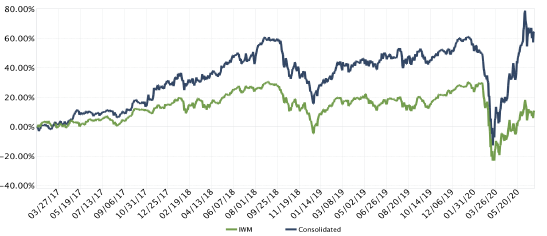
| Year | KCM Composite, Net | IWM | Excess Return |
|---|---|---|---|
| 2017* | 27.20% | 14.26% | +12.94% |
| 2018 | -3.43% | -11.11% | +7.68% |
| 2019 | 27.79% | 25.39% | +2.40% |
| YTD 2020 | 4.08% | -12.96% | +17.04% |
| Annualized | 15.48% | 3.07% | +12.41% |
*Inception date: 02/01/2017
Introduction
While it may seem difficult to focus on anything other than the news these days, as investors it is important to keep up with new technology that offers the potential to bring about enormous disruption and change. One of the more recent technologies expected to do just that is 5G. Simply put, 5G is the next generation of wireless technology for cellular networks, which some have predicted will become the foundation for future innovations such as self-driving cars, virtual reality, and the internet of things. But unsurprisingly, the people making the boldest claims about 5G tend to be the ones that stand to benefit the most from its adoption. Therefore, it is critical to filter out the noise to fully understand the technology and establish realistic expectations for the future. For instance, what makes 5G unique? When will we see it deployed? What impact will it have when it arrives? And how long will it take to achieve its lofty ambitions?
Unlike most 4G networks, which can achieve download speeds of between 30 to 50 megabits per second (Mbps), 5G networks use high frequency radio waves to achieve download speeds as high as 2 gigabits per second (Gbps). This means that 5G networks have the potential to provide internet access at speeds 25 – 50 times faster than 4G. This is great, right? Well, it turns out there are two major problems with using high frequency radio waves. First, they are very bad at transmitting signals through objects like walls or windows. Therefore, they depend on having a clear “line-of-sight” from your device to the cellular antenna. As a result, a 5G signal can be highly intermittent if used in a busy city with lots of cars, buildings, and passersby. And second, high frequency radio waves struggle to travel distances greater than one mile. This means that, to provide ubiquitous 5G coverage, a single city would likely need to install thousands and thousands of antennas. And although 5G antennas are much smaller and cheaper than 4G antennas, a buildout of that scale would take many years. In the meantime, the industry has found a way around these two problems by providing three different layers of 5G access, known as low-band, mid-band, and high-band.1 Low-band 5G uses a similar frequency as 4G cellphones to provide coverage of hundreds of square miles at speeds in the range of 30 – 250 Mbps.2 Mid-band 5G uses higher frequency radio waves to provide coverage over a several-mile radius at speeds between 100 – 900 Mbps. And finally, high-band 5G uses even higher frequency radio waves to provide coverage of about 1-mile or less at speeds of 1 – 2 Gbps. By using all three layers, network operators can provide blanket 5G coverage to their customers, even when true high-speed 5G is only available in limited areas. This solution helps to provide broad coverage, but it comes with a trade-off in speed. For example, if your cellular device happens to be connected to a low-band layer – which covers the largest geographical area – your 5G speeds are likely to be comparable to, or slower than, what you could get with 4G. In fact, Verizon has even aired advertisements demonstrating their 4G network as faster than T-Mobile’s 5G network in New York City. As a result, in the early stages, 5G will not always equate to faster speeds. It is also important to emphasize that the estimated speeds for each layer stated above are theoretical and have primarily been achieved under ideal experimental conditions. But these conditions are unlikely to occur in the real world. Therefore, 5G speeds at every layer are more likely to come in near the low end of the range than the high end. So, even in the higher-speed layers of 5G, speeds may not be as fast as promised. In short, 5G will almost certainly be a significant upgrade over current cellular networks but don’t expect it to provide ubiquitous, blazing-fast speeds anytime soon.
So when can we expect to see 5G? Frankly, the rollout has already begun as most of the large mobile operators like AT&T, Verizon, T-Mobile and Sprint have been testing and building out their 5G networks for a few years now. But given the significant investment required and large geographic area to cover, 5G networks in the U.S. remain sparsely populated. In our opinion, coverage will continue to improve as more antennas are installed, but it will take time to reach meaningful saturation. And since technologies like self-driving cars, virtual reality, and the internet of things require broad access to the internet, it may be a decade or more until 5G is capable of powering them completely. Therefore, we believe, in the initial stages, 5G is likely to be used the same way 4G is used today, only faster. However, the number of 5G capable devices remains low. For instance, the first-ever all-5G smartphone, the Samsung Galaxy S20, was released as recently as March 2020. And although Apple’s iPhone 12, expected to launch in the fall, is rumored to be 5G compatible, it will likely take a few years before consumers have completed the upgrade cycle to new phones.
Although we expect 5G to be a major upgrade and provide increasing speeds over time, we also believe in Amara’s law, which states that “we tend to overestimate the effect of a technology in the short run and underestimate the effect in the long run.” This statement has held true with numerous technologies including the internet, human genome sequencing, and GPS.3 And we think Amara’s law is likely to hold true for 5G as well. Although it will almost certainly usher in massive change and empower new technologies that would otherwise be impossible, that day is likely a long way off. And though it may be awhile before 5G drastically changes the world, in the meantime we will just have to settle for significant improvement.
Performance
During the second quarter of 2020, Kehlet Capital Management’s concentrated micro-cap composite grew 49.74%, significantly outperforming the benchmark which increased 25.50%.
For the second quarter in a row, our largest contribution to performance came from Bandwidth Inc. (BAND), which increased 89.09% during the quarter. Rather than repeat what I wrote last quarter, I will simply sum it up by saying the trends from last quarter – work-from-home arrangements, travel restrictions, and corporate digital transformations – continued during the second quarter. Though we trimmed down our position as the valuation soared, we believe Bandwidth represents a rare business with massive growth potential, significant competitive advantages, and strong management. As such, it remains our second largest position.
The largest detractor to performance was LeMaitre Vascular (LMAT), which returned 6.87% during the quarter. It has been two years since I last wrote about LeMaitre, primarily because it has been one our smaller positions. As a reminder, LeMaitre is a provider of medical devices for the treatment of peripheral vascular disease and has a portfolio of patent-protected, niche products designed for use in open vascular surgery.
During the second quarter LeMaitre reported its first quarter financial results, which were particularly good, all things considered. The company reported revenue growth of 7% and a decline in operating income of just 2% despite an economic shutdown for nearly the full month of March. Management also announced several moves to offset the impact of COVID-19 on its business including a workforce reduction of 18%, salary reductions for all employees earning over $40,000 per year, and a 10% reduction in hours worked for employees making less than $40,000. All told, management believes the net savings from these efforts will total $13.5M in 2020, or about 11.5% of 2019 revenue. Although LeMaitre was one of the better positioned companies going into the crisis – they had almost $33M in cash and cash equivalents on the balance sheet and no debt at the end of 2019 – we believe these efforts will minimize the impact from COVID-19 even further and provide the company with the flexibility to be opportunistic as the economy reopens. In fact, near the end of the second quarter, LeMaitre announced the acquisition of a company called Artegraft, which sells biologic vascular grafts that are implanted in hemodialysis patients. The acquisition, valued at $90M, represents the largest in the company’s history and we are optimistic it will create significant shareholder value over the long-term based on the potential synergies and management’s track record of successful purchases. As such, we added modestly to our position during the second quarter and believe the investment thesis remains strong.
Portfolio Activity
During the second quarter we finished building a position in Tucows Inc. (TCX). Tucows is the second largest domain name registrar in the world and operates under the OpenSRS, eNom, and Ascio brands. It also provides low-cost mobile telephone service and high-speed fiber internet access through the Ting brand. Our investment thesis primarily revolves around the company’s nascent fiber internet business, which management has invested considerable capital in over the last three years. Our thesis is simple: 1) We believe fiber is the clear future of the internet as increasing traffic from video-on-demand, smart home devices, online gaming, high resolution displays, and applications like artificial intelligence require higher bandwidth, faster speeds, and lower latency. In fact, Statista estimates that total internet traffic will grow at a 24% CAGR in the U.S. through 2023. And we think fiber is the only currently available technology capable of meeting these future demands. This is because, unlike copper lines, fiber-optic cable uses light to transmit data. Thus, it can achieve speeds up to 10 Gbps, or roughly 30 times more than coaxial (copper) cable. This transition to fiber is already underway as the number of homes connected to fiber increased from an estimated 3.7M in 2008 to 18.6M in 2018, representing a 17.5% CAGR. And we believe this trend will continue, if not accelerate. 2) Fiber internet has a long runway for growth since the addressable market is enormous. For example, there are roughly 130M households in the U.S. and less than 20% of them have fiber internet. It is estimated that fiber penetration will eventually grow to 60% - 80%, implying an additional market opportunity of 80M – 100M households, or approximately $95B - $120B in annual revenue. Compare this with Ting internet’s $11M in 2019 revenue and it becomes clear there is no shortage of opportunity. And we think Ting is well positioned to take advantage of this opportunity since Ting’s parent company generates significant cash flow to fuel growth in the fiber business with limited debt service, incumbents like Spectrum, AT&T, and Comcast are hesitant to cannibalize their coax business, and new entrants have limited access to capital. As a result, we expect Ting to achieve growth rates significantly above the industry average for the foreseeable future. And 3) we believe the market is overly pessimistic about the fiber opportunity due to inflated expectations for 5G wireless. As mentioned in the introduction above, the hype around 5G is largely due to experimental speeds (in perfect conditions) comparable to fiber but at lower cost in certain geographies. Business Insider even predicts that almost 10% of U.S. households will use 5G fixed wireless by 2024. But we believe this is overly optimistic and that true 5G is likely many years away. Even then, fiber will remain the faster and more reliable (though more expensive) option as wireless will always have to contend with issues like line-of-sight, weather, and network congestion. In fact, Digital Trends estimates “true fixed 5G wireless, as it’s arriving, will have speeds that are comparable to current average internet speeds – around 30 Mbps to 300 Mbps.”4 And Sprint’s vice president of technology development, Ron Marquadt has said “I think a lot of the hype is where things are gonna be 10 years from now with 5G, not what it will be at launch.” As a result, we think fiber will continue to win the lion’s share of the market over the next decade. If we are correct, Ting is likely to generate exceptional returns on invested capital during that time and create substantial value for shareholders over the long-term.
Finally, we made some minor adjustments to portfolio weights during the second quarter, driven by ongoing volatility in the market. Namely we reduced our positions in Bandwidth Inc. (BAND), Callaway Golf (ELY), Fonar Corp. (FONR) and Simulations Plus (SLP) and added to our positions in Astronics (ATRO), LeMaitre Vascular (LMAT) and Tucows Inc. (TCX).
Conclusion
The second quarter was about as good as it gets as markets rebounded sharply off the lows in March. As described in last quarters newsletter, we were in a fortunate position to take advantage of several opportunities as prices fell. Consequently, our portfolio recovered much faster than the benchmark. While we believe there are still attractive opportunities in the market, we expect results to return to a more normal level go forward. That said, our goal remains to provide clients with highly satisfactory long-term results across all market environments. As always, thank you for supporting Kehlet Capital Management, and please do not hesitate to contact us should you have any questions or comments.
| Number of holdings | 11 |
|---|---|
| Median market cap | $606M |
| Weighted avg. market cap | $1,199M |
| Callaway Golf Co. (ELY) | 15.5% |
|---|---|
| Bandwidth Inc. (BAND) | 13.6% |
| Astronics Corp. (ATRO) | 12.2% |
Notes
- “5G”, Wikipedia, https://en.wikipedia.org/wiki/5G ↩
- Horwitz, Jeremy, “The definitive guide to 5G low, mid, and high band speeds”, VentureBeat, https://venturebeat.com/2019/12/10/the-definitive-guide-to-5g-low-mid-and-high-band-speeds/ ↩
- Ridley, Matt, How Innovation Works and Why it Flourishes, (New York: HarperCollins Publishing, 2020) ↩
- Lacoma, Tyler and Kaplan, Jeremy, “What is fixed wireless 5G? Here’s everything you need to know”, Digital Trends, https://www.digitaltrends.com/computing/fixed-wireless-5g/ ↩
Disclosures to Performance Results
Actual composite performance results represent the performance of fully discretionary accounts managed by Kehlet Capital Management (KCM) during the corresponding time period. The composite performance results reflect time-weighted rates of return, the reinvestment of dividends and other account earnings. The reinvestment of dividends and other earnings may have a material impact on overall returns.
Past performance is not indicative of future results and the performance of a specific individual client account may vary substantially from the composite performance results. Therefore, no current or prospective client should assume that future performance will be profitable, or equal either the KCM composite performance results reflected above, or the performance results for any of the comparative index benchmarks provided.
For reasons including variances in portfolio account holdings, variances in the investment management fee incurred, market fluctuations, the date on which a client engages KCM’s investment management services, and any account contributions or withdrawals, the performance of a specific client’s account could vary substantially from the indicated KCM composite performance results. A portion of each account can be actively managed in an attempt to respond to changing conditions.
All performance results have been compiled solely by KCM, are unaudited, and have not been independently verified. Therefore, the performance data could be wrong. Information pertaining to KCM’s advisory operations, services, and fees is set forth in KCM’s current Form ADV Part 2A disclosure brochure, a copy of which is available from KCM upon request.
iShares IWM is an exchange-traded fund (ETF) measuring the performance of approximately 2,000 small-cap companies. It serves as a benchmark for small-cap stocks in the United States.
KCM managed accounts may own assets and follow investment strategies which cause them to differ materially from the composition and performance of the ETF shown as a benchmark. The ETF was chosen for its accessibility, transparency, independence, and relevance to KCM’s investment strategy, but there may be other indices that are more appropriate or applicable to the Concentrated Micro-cap Strategy. The historical index performance results are provided exclusively for comparison purposes only, so as to provide general comparative information to assist an individual client or prospective client in determining whether a specific Portfolio meets, or continues to meet, his/her investment objective(s). It should not be assumed that account holdings will correspond directly to any of the comparative indexes.
Different types of investments and/or investment strategies involve varying levels of risk, and there can be no assurance that any specific investment or investment strategy (including the investments purchased and/or investment strategies devised by KCM) will be either suitable or profitable for a client’s or prospective client’s portfolio and may result in a loss of principal. Accordingly, no client or prospective client should assume that the above portfolios (or any component thereof) serve as the receipt of, or a substitute for, personalized advice from KCM, or from any other investment professional.