
“(Bitcoin) is the most important invention since the internet.”
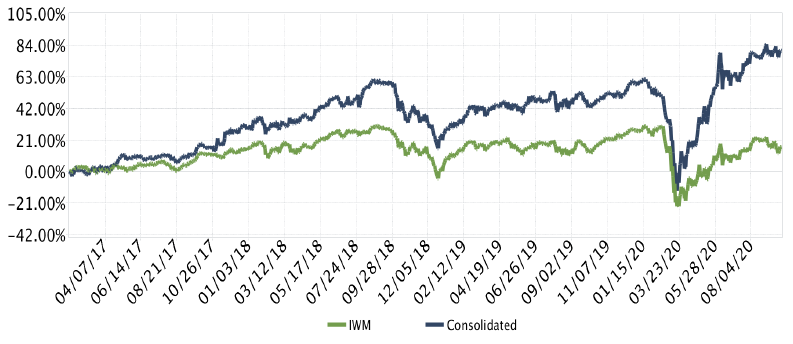
| Year | KCM Composite, Net | IWM | Excess Return |
|---|---|---|---|
| 2017* | 27.20% | 14.26% | +12.94% |
| 2018 | -3.43% | -11.11% | +7.68% |
| 2019 | 27.79% | 25.39% | +2.40% |
| YTD 2020 | 13.83% | -8.58% | +22.41% |
| Annualized | 17.17% | 4.24% | +12.93% |
“Bitcoin is probably rat poison squared”
*Inception date: 02/01/2017
Introduction
Most people are familiar with the concept of cryptocurrency and its most popular usage, Bitcoin. But until recently Bitcoin, which helped launch the cryptocurrency revolution, was mostly used by a small group of enthusiasts, hackers, and criminals. It wasn’t until 2017, when the price of a bitcoin increased 20-fold, that it went mainstream. Although the initial enthusiasm for Bitcoin has faded since that time, there has been renewed interest in it recently as a hedge against possible future inflation. So, what is our take on Bitcoin, cryptocurrencies, and their underlying technology, known as the blockchain? Are they likely to be widely adopted in the future and would they make good investments? First a disclaimer. This newsletter is almost certainly more technical in nature than any of my previous write-ups. Therefore, readers uninterested in the details of cryptocurrencies are advised to skip to the conclusion. But for those of you who are gluttons for punishment, like me, I will do my best to describe what I know in simple and easy to understand language. So here goes.
First, what exactly is cryptocurrency? Simply put, cryptocurrency is a digital asset that is nearly impossible to counterfeit. This is largely because it uses advanced cryptography (hence the term “crypto”) to encrypt and secure transactions. These transactions are then confirmed by a decentralized community of computers and recorded on a ledger known as the blockchain. The blockchain is an ongoing “chain” of historical transactions, with each transaction linked to the one preceding it. Once a group of transactions – known as a block – has been verified by the crypto community it gets added to the chain and work begins on the next one. By linking together these historical transactions, it helps ensure the authenticity of each new transaction – because ownership of the currency can be traced backwards through time. And since the blockchain is a “distributed” ledger run by group consensus, no one entity has control over it. Therefore, it cannot be altered or tampered with once confirmed. That is, if any one person attempted to change information in the blockchain, the rest of the community would easily detect the discrepancy and reject it from inclusion. It is this system of group consensus and secure record keeping that provides trust in cryptocurrencies and their authenticity. But the excitement around cryptocurrency primarily comes from its three main benefits:
First, it provides significant cost savings on international transfers, known as remittances. For example, with traditional currencies sending $200 internationally costs $14 on average, while sending $500 costs about $25 – a fee of 5 - 7%.1 And these fees can add up in a hurry: Americans spend over $30 billion a year on remittance fees. But the cost for sending Bitcoin remains low (about $0.50 - $1.00) regardless how much you send or where you send it, which makes it an ideal solution for international transfers.
Second, it provides economic opportunity to the unbanked (i.e., the roughly 2.5 billion people around the world who do not have access to the banking system). In places like Afghanistan for instance, women are not allowed to spend the money they earn. Instead they must transfer it to a father’s, brother’s, or husband’s bank account. But cryptocurrency accounts, such as Bitcoin, can be set up at home by anyone with internet access. You do not have to go to a bank to open an account or provide proof that you are a man. In fact, Bitcoin does not know your name or gender, thus allowing women in oppressive societies to control their own money. 2
And third, it minimizes or eliminates the ability of central governments to print money and devalue their citizen’s savings through inflation. While this may be viewed as largely a political benefit – attractive to those with a libertarian bent – the issue was quite popular in the wake of the 2008 financial crisis, which put a spotlight on the problems of traditional fiat currencies.
However, cryptocurrencies also suffer from their fair share of problems. Take Bitcoin for example, by far the most popular of all the cryptocurrencies:
First, Bitcoin’s main problem is scalability. For instance, Bitcoin can currently only process about 3.5 to 4 transactions per second, far below the 5,000 – 11,000 transactions per second of Visa. And during periods of heavy congestion, this bottleneck can result in extremely long wait times. At one point in 2017, it took an average of 16 hours for a transaction to get confirmed.
Second, it provides little added benefit for domestic transactions, especially small payments. For example, sending money inside a country, especially the U.S., is fairly streamlined with the conventional financial system. Apps like PayPal, Venmo, and Zelle allow you to transfer money quickly, securely and with little or no fees. Therefore, Bitcoin is generally an inferior option for small, domestic transactions.
Third, the price of Bitcoin is highly volatile, which makes it an extremely poor candidate for use as a currency. The reason for this is simple; the value of any currency needs to be relatively stable so that people can trust the value they are giving and receiving in any transaction. If, however, the price fluctuates rapidly and significantly – like it does with Bitcoin – people will be hesitant to accept or spend the currency for fear that the price will move against them after a transaction.
Fourth, confirming Bitcoin transactions requires an enormous amount of computing power and thus electricity, potentially contributing to climate change. The University of Cambridge, for instance, estimates that Bitcoin’s annual energy consumption is over 80 terawatt-hours, or roughly the annual power consumption of Finland.
Fifth, the supply of Bitcoin could disappear. Although many Bitcoin advocates are attracted to the currency’s finite supply – there will only ever be 21 million issued – which takes away the power of central governments to print money, this control comes with a trade-off. It means any bitcoins that are lost cannot be replaced. And since no one can access bitcoin without a private key (i.e., a passcode), the currency can easily be lost forever if the passcode is forgotten or misplaced. While the permanent loss of currency is likely to be small in any given year, over time it can add up to big shortfalls.
Finally, Bitcoin could be subject to fraud if any one entity gains control of more than 50% of the total Bitcoin computing power (known as hash power). Because Bitcoin is run on group consensus, the majority of hash power on the network must agree to the validity of a block of transactions before it gets added to the chain. But if one entity controlled more than 50% of the total hash power, they could theoretically add fraudulent blocks to the chain at will, since they would represent consensus. Though once thought to be a farfetched scenario, the rise of large data centers, cloud mining, and mining pools has led to substantial concentration of computing resources. In fact, in 2014 the mining pool GHash.io controlled 55% of all hash power and Bitmain’s pools (BTC.com and AntPool) once owned 42% of all hash power.
While these represent some significant hurdles to wide-spread adoption of cryptocurrency, they may not be insurmountable. In fact, there are many alternatives to Bitcoin (known as altcoins) which are trying to solve these issues. Litecoin, for example, offers similar features to Bitcoin but with faster transactions and lower fees. Stablecoins, like Tether, reduce price volatility by pegging the value of their coins to traditional currencies like the U.S. Dollar. And Ethereum allows for the use of smart contracts, which automate the execution of contracts based on well-defined and determinable events. Though it is difficult to know which, if any, of these altcoins will be successful in solving Bitcoins problems, a lot of smart people are working exceptionally hard on a solution. And they may eventually be successful.
But the concerns surrounding Bitcoin have not caused proponents to abandon it. Rather, they now suggest that Bitcoin should not be thought of as a currency, but as an investment. They note that the price of a bitcoin behaves more like a stock or a bond than it does a currency. But the problem with Bitcoin as an investment is that it has no underlying intrinsic value. That is, unlike a business, Bitcoin does not produce any output. It is simply lines of computer code. Astute readers may argue “yes but fiat currencies like the US Dollar have no underlying value either”, but that is not entirely true. Their value comes from the fact that they are widely accepted as currency. That is, they have value because others will accept them in exchange for goods and services. Therefore, Bitcoin’s success as an investment is likely tied to its success as a currency. But we have already outlined the many problems with Bitcoin as a currency. There are still others that say Bitcoin should be thought of as a store of value, like gold. Again, unlike gold, Bitcoin has no underlying value. Even though gold is no longer used as currency nor produces any output, it still has value as a material used in electronics, aerospace components and jewelry. Bitcoin has none of these.
In short, we view Bitcoin as a failed experiment, but one that continues because of the resilience of its fan base. We think an investment in Bitcoin is a bet on the “greater fool” theory, which states that an investment makes sense if you can sell it to a “greater fool” down the road. It is precisely this idea that led to the housing bubble of 2008 and virtually every other bubble before that. But bubbles driven by the greater fool theory are also ticking timebombs. Because as soon as participants wise up, the market collapses. As a result, we tend to side with Warren Buffett when he says that “Bitcoin is probably rat poison squared.” We certainly hope that Bitcoin or one of the many other cryptocurrencies will be able to solve its technical issues. Because doing so would create enormous value for a lot of people. But since we have no way of predicting which, if any, cryptocurrency will ultimately be successful, we are content to sit this one out.
Performance
During the third quarter of 2020, Kehlet Capital Management’s concentrated micro-cap composite increased 9.38%, outperforming the benchmark which increased 5.03%.
For the third quarter in a row, the largest contribution to performance came from Bandwidth Inc. (BAND), which returned 37.46% during the quarter. As a reminder, Bandwidth is a Communications Platform as a Service, or CPaaS, company that provides large enterprises with application programming interfaces (API’s). These API’s enable software developers to add communications features – such as voice calling and text messaging – into their own applications without the need to build backend infrastructure and interfaces. The company’s solutions power many of the largest web conferencing applications including Zoom, Google Voice, Skype for Business (now Microsoft Teams), RingCentral, and Cisco-Webex.
During the third quarter the company reported its second quarter financial results, which were highlighted by revenue growth of 35% and a new 5-year agreement to provide CPaaS services to a Fortune 100 company that is also one of the ten largest banks in the United States. Management also provided (conservative) guidance for revenue growth of 26% in Q3. Needless to say, the momentum from work-at-home arrangements, travel restrictions, and corporate digital transformations does not appear to have slowed down. However, the increase in Bandwidth’s stock this year – it has nearly tripled – has far exceeded our estimated increase in the intrinsic value of the company. Therefore, we believe the valuation has become excessive, even for a software business. As a result, we continued to trim our position as the price climbed. This was not an easy decision. Admittedly, previous selling of Bandwidth shares has been a costly mistake thus far. But as the price of any stock rises, the risk to the portfolio increases twice as fast. A soaring stock creates the dual problem of becoming a disproportionately large portion of the portfolio, precisely at the same time its valuation becomes less attractive. And although we are comfortable taking some valuation risk in the portfolio, we think it is prudent to keep it below a certain threshold. The good news is we still maintain a moderate position in Bandwidth and will therefore continue to participate in any upside, albeit to a lesser degree than we otherwise would have. And while it is possible this decision will ultimately cost us, we think it is the right one to make from a risk management perspective.
The largest detractor to performance was Astronics Corp. (ATRO), which declined 26.95% during the quarter. As a reminder, Astronics is a supplier of engineered components to the Aerospace and Defense industry, with approximately 90% share of the in-seat power market. We first initiated a position in Astronics nearly three years ago, with the expectation that wide-body aircraft production would pick up steam and lead to a substantial rebound. But just as our thesis appeared to be playing out, two fatal plane crashes led to the grounding of Boeing’s 737 MAX and a loss of approximately $60M in annual revenue for Astronics. Though not an insignificant hurdle, we felt this revenue shortfall was manageable until the 737 MAX was cleared to fly again. But roughly one year later, the COVID-19 pandemic caused a near complete shutdown of the airline industry. As a result, the stock has been among our worst performers.
However, we feel strongly that the grounding of the 737 MAX and the outbreak of COVID-19 are temporary setbacks. Looking out three years from now, it seems likely that the airline industry, and thus Astronics, will be largely back to normal. If so, we think the stock offers a very compelling investment at these levels. And although we did not add to our position in the third quarter, we did increase it one quarter prior and may do so again if the stock continues to show weakness.
Portfolio Activity
During the third quarter we initiated a new portfolio holding, which we will outline next quarter assuming we have built a full position. We also made some minor adjustments to portfolio weights, driven by the ongoing volatility in the market. Namely we reduced our positions in Bandwidth Inc. (BAND), Callaway Golf (ELY), and Hibbett Sports (HIBB) and added to our positions in Fonar Corp. (FONR) and LeMaitre Vascular (LMAT)
Conclusion
The third quarter was solid from both an absolute and a relative performance perspective. We used some of the recent gains to rebalance the portfolio and try to position it for continued long-term success. As always, thank you for supporting Kehlet Capital Management, and please do not hesitate to contact us should you have any questions or comments.
| Number of holdings | 12 |
|---|---|
| Median market cap | $693M |
| Weighted avg. market cap | $1,141M |
| Tucows Inc. (TCX) | 11.0% |
|---|---|
| Callaway Golf Co. (ELY) | 10.7% |
| Fonar Corp. (FONR) | 10.0% |
Notes
Disclosures to Performance Results
Actual composite performance results represent the performance of fully discretionary accounts managed by Kehlet Capital Management (KCM) during the corresponding time period. The composite performance results reflect time-weighted rates of return, the reinvestment of dividends and other account earnings. The reinvestment of dividends and other earnings may have a material impact on overall returns.
Past performance is not indicative of future results and the performance of a specific individual client account may vary substantially from the composite performance results. Therefore, no current or prospective client should assume that future performance will be profitable, or equal either the KCM composite performance results reflected above, or the performance results for any of the comparative index benchmarks provided.
For reasons including variances in portfolio account holdings, variances in the investment management fee incurred, market fluctuations, the date on which a client engages KCM’s investment management services, and any account contributions or withdrawals, the performance of a specific client’s account could vary substantially from the indicated KCM composite performance results. A portion of each account can be actively managed in an attempt to respond to changing conditions.
All performance results have been compiled solely by KCM, are unaudited, and have not been independently verified. Therefore, the performance data could be wrong. Information pertaining to KCM’s advisory operations, services, and fees is set forth in KCM’s current Form ADV Part 2A disclosure brochure, a copy of which is available from KCM upon request.
iShares IWM is an exchange-traded fund (ETF) measuring the performance of approximately 2,000 small-cap companies. It serves as a benchmark for small-cap stocks in the United States.
KCM managed accounts may own assets and follow investment strategies which cause them to differ materially from the composition and performance of the ETF shown as a benchmark. The ETF was chosen for its accessibility, transparency, independence, and relevance to KCM’s investment strategy, but there may be other indices that are more appropriate or applicable to the Concentrated Micro-cap Strategy. The historical index performance results are provided exclusively for comparison purposes only, so as to provide general comparative information to assist an individual client or prospective client in determining whether a specific Portfolio meets, or continues to meet, his/her investment objective(s). It should not be assumed that account holdings will correspond directly to any of the comparative indexes.
Different types of investments and/or investment strategies involve varying levels of risk, and there can be no assurance that any specific investment or investment strategy (including the investments purchased and/or investment strategies devised by KCM) will be either suitable or profitable for a client’s or prospective client’s portfolio and may result in a loss of principal. Accordingly, no client or prospective client should assume that the above portfolios (or any component thereof) serve as the receipt of, or a substitute for, personalized advice from KCM, or from any other investment professional.