
“The safe assumption for an investor is that over the next hundred years the (fiat) currency is going to zero.”
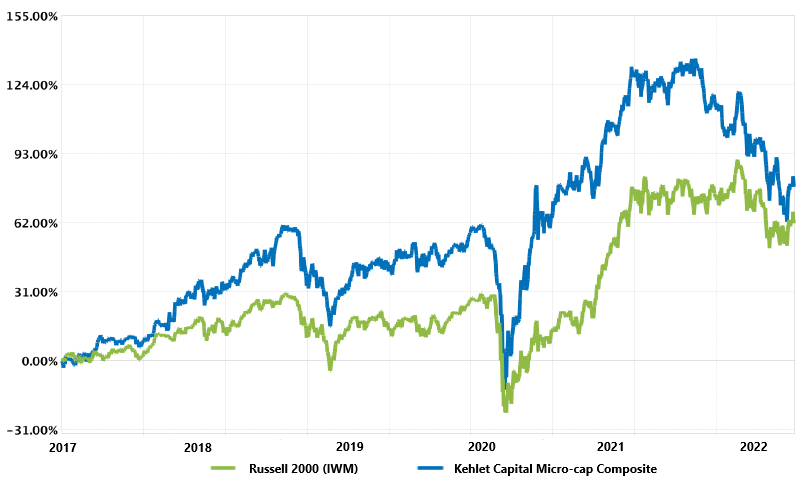
| Year | KCM Composite, Net | IWM | Excess Return |
|---|---|---|---|
| 2017* | 27.20% | 14.26% | +12.94% |
| 2018 | -3.43% | -11.11% | +7.68% |
| 2019 | 27.79% | 25.39% | +2.40% |
| 2020 | 27.52% | 20.03% | +7.49% |
| 2021 | -1.45% | 14.54% | -15.99% |
| YTD 2022 | -10.32% | -7.54% | -2.78% |
| Annualized | 11.68% | 9.78% | +1.90% |
*Inception date: 02/01/2017
Introduction
In previous newsletters I’ve discussed the pros and cons of Bitcoin and why my initial skepticism eventually turned to optimism. But whenever I talk to people about the merits of Bitcoin, the message doesn’t seem to resonate. This is perfectly understandable since the topics of money, cryptography, and blockchain technology are complex and confusing. But the more I’ve learned about these subjects, the more I’ve become convinced that we are in the midst of a rare moment in history – the shift to a digital, global monetary system with massive potential to change the world. But this transition will not come without costs. And those who cling to the old system are likely to be hurt the most. As a result, I feel a growing sense of duty to help people understand the opportunity that lies ahead. So, in this newsletter I will attempt to make a clear and compelling case for Bitcoin. And it starts by making the case against Bitcoin’s biggest competition – government-issued fiat currencies like the U.S. Dollar (USD).
Fiat currencies are problematic for several reasons. First and foremost is that they are an extremely poor long-term store of value. That is, they become less and less valuable over time due to inflation. It’s what Bitcoiners refer to as “money printer go brrrr” – because inflation is the direct result of the government printing too much new money. Usually, in most countries, this isn’t a big deal because the government exercises enough restraint to make inflation manageable. But every so often an economic shock occurs – like the 2008 financial crisis or the COVID-19 pandemic in 2020 – where the printing press is used as a tool to fight recession. The problem with this approach is that once the printing press comes on it is very difficult to turn off. Because politicians on both sides of the aisle find it easier to appeal to constituents with the promise of more – more stimulus checks, more infrastructure spending, more tax credits, more everything. And almost no one has the political will to run for office by promising less.1 But if the printing press stays on for too long, high levels of inflation are the result, as shown in the chart below:
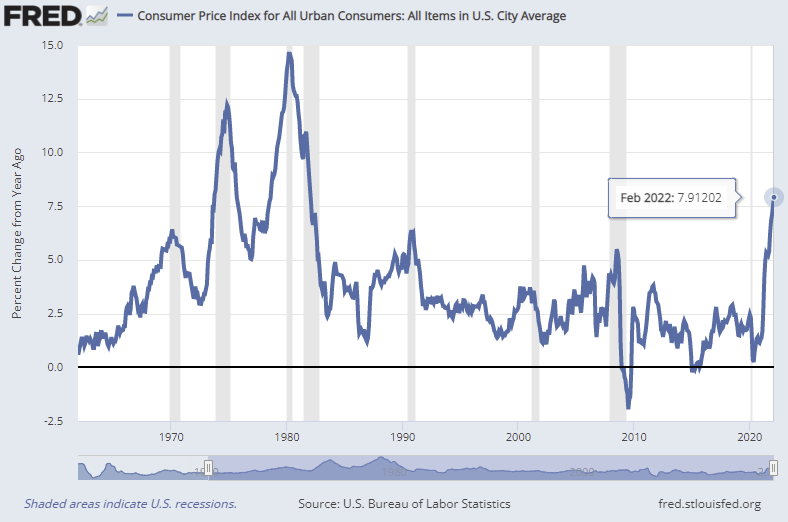
As you can see, stimulus efforts during COVID-19 caused a huge spike in inflation in the U.S., where the consumer price index (CPI) jumped to nearly 8% – it’s highest level in 40 years. In fact, countries such as Turkey and Argentina have recently seen inflation rates as high as 50% - 60%. And as legendary investor Charlie Munger has said, “inflation is a very serious subject. You can argue it is the way democracies die.” Why? Because if inflation remains too high for too long, standards of living erode resulting in mass poverty and depression. While this may sound overly dramatic, it has happened time and again throughout history – from the fall of the Roman Empire in the 5th century to Weimer Germany in the 1920’s to Zimbabwe in 2008 and Venezuela in 2013. The point is this; government-issued fiat currencies, like the USD, depend on political discipline not to print too much money. But history has shown that government leaders rarely exercise this level of restraint. As a result, your money is likely to lose value in the best case or collapse completely in the worst.
The second problem with fiat currency is government control. That is, if you use a government-issued currency it is only because that government has allowed you to do so. But what the government giveth, the government can taketh away – by freezing assets, confiscating funds, or blocking access to the financial system. Consider the recent situation in Canada, where truckers protested COVID-19 restrictions by blocking traffic in multiple cities. As a result, Prime Minister Justin Trudeau invoked the Emergencies Act, granting law enforcement the ability to freeze the assets of anyone suspected of involvement with the protests. Over 200 bank accounts were frozen and nearly $10 million in GoFundMe donations were blocked at the behest of the Canadian government. Whether you agree with the protests or not, the point is this; the government’s control of money gives it significant power. Although this is generally not a problem for most law-abiding citizens, the potential to abuse this power should be concerning to everyone. Because all you have to do is imagine your least favorite politician getting elected to office to realize that your opinions could easily be labelled as “dangerous”, and your actions suddenly considered against the “law”.
The third problem with fiat currency is that it is highly inefficient across borders. That is, sending money internationally typically requires several financial intermediaries and the movement of large amounts of physical dollars, typically resulting in high fees (roughly 5% - 7%) and long processing times (about 3 – 5 business days). This may not be a big deal for the average American, but for migrant workers, who have families overseas that depend on their income, it is a very big problem.
But Bitcoin fixes all this. First, it has a long-term inflation rate of exactly zero, because the protocol limits the issuance of new coins to a maximum of 21 million.2 This means that with Bitcoin, not only does your money not lose value over time, it actually increases in value as the economy grows. And this has massive long-term implications for society. Because in a world where money increases in value, incentives get flipped upside down. Instead of being incentivized to spend money, people are incentivized to save. Instead of being incentivized to borrow money, people are incentivized to invest wisely. Instead of being incentivized to consume resources, they are incentivized to conserve. And these incentives ultimately lead to more efficient allocation of capital, a more resilient economy, higher global living standards, and a cleaner, healthier environment.
Second, Bitcoin is not controlled by anyone because it is a peer-to-peer network that allows for self-sovereignty and self-custody. In other words, it allows you to be your own bank. This means that, with Bitcoin, no one can freeze your assets or lock you out of the network except you.3
Third, Bitcoin is completely digital and requires no financial intermediaries, which makes it extremely efficient across borders. This means you can send virtually any sum of money across the world almost instantly and with extremely low fees.4
But despite the many problems of fiat currencies and the significant potential of Bitcoin, people understandably have concerns. They ask questions like:
What about Bitcoin’s volatility? Isn’t it too volatile to be a currency? Right now, yes. But in the future, probably not. Why? Because in order for an asset to become a currency (i.e., a medium of exchange) it must first establish itself as a store of value. And Bitcoin is perhaps the best store of value the world has ever seen. But it will take time for people to recognize this. As they do, I expect Bitcoin to gradually take market share from other, inferior stores of value like Gold and Government Bonds. And as Bitcoin’s market share matures and stabilizes, so too should its price. At that point it will become more appropriate as a medium of exchange. Until then, volatility is perfectly acceptable for the long-term investor.
What about its scalability? Can it handle enough transactions to be a viable currency? While it’s true that the base blockchain layer can only process 3.5 – 4.0 transactions per second, second layer solutions like the Lightning Network increase Bitcoin’s transaction capacity dramatically. Though the Lightning Network is still in its infancy – it has only been operational since 2017 – and has a long way to go before being fully built out, it can already handle an estimated 1 million transactions per second.5 Compare this to the 5,000 – 11,000 transactions per second handled by Visa, and it’s clear that, with the Lightning Network, Bitcoin scales just fine.
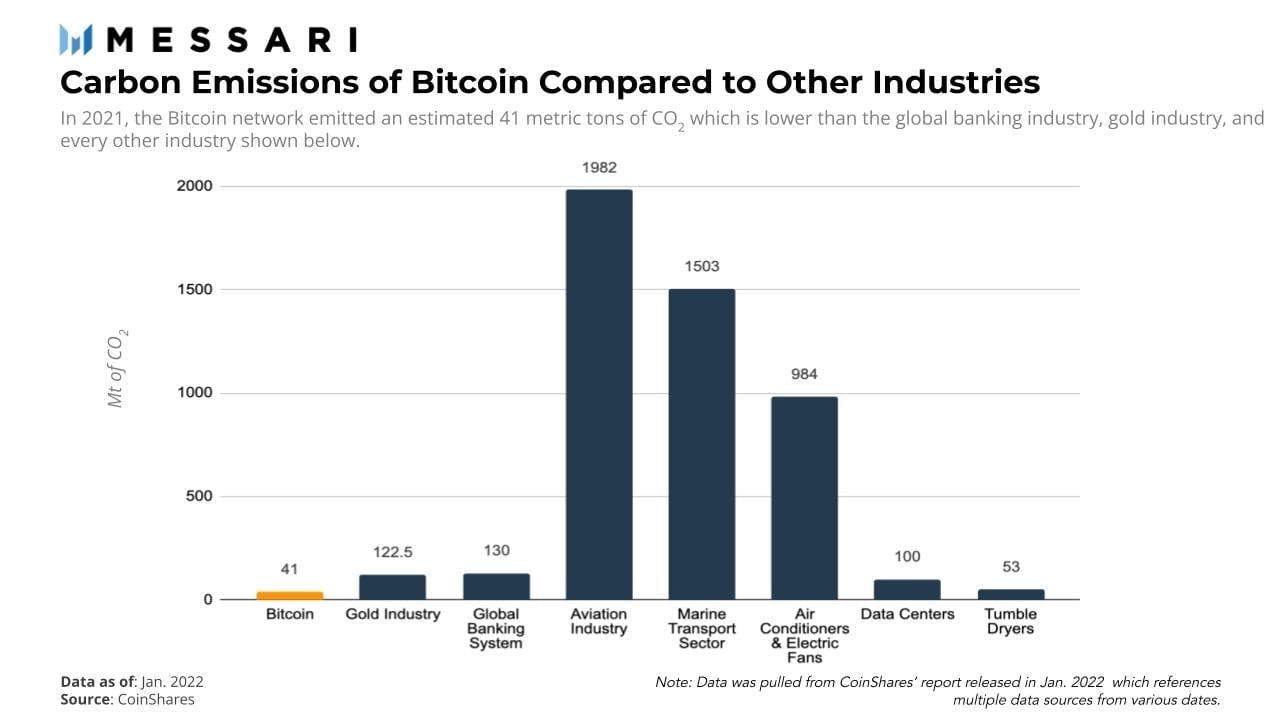
What about its energy usage? Isn’t it bad for the environment? First, it’s important to note that the Bitcoin network emits an estimated 41 metric tons of CO2 per year, or roughly one third the amount emitted by the global banking industry, as shown in the chart below:
Second, Bitcoin mining is likely to spur a revolution in renewable energy. Why? Because Bitcoin mining is equivalent to the monetization of energy – it uses electricity (i.e., energy) as an input to create money (i.e., Bitcoin) as an output. Therefore, Bitcoin mining creates a huge incentive for the use and further development of renewable energy by offering a “reward” to anyone, anywhere, at any time, who finds a cheaper way to produce energy at scale.6 And third, Bitcoin mining helps stabilize the electrical grid by matching energy demand with supply. That is, the demand for electricity from the grid is not constant. It fluctuates based on the time of day, the weather, and other factors. But the capacity of the electrical grid is relatively constant. Therefore, electric utilities have a problem. If they produce too much energy it goes unused most of the time. But if they don’t produce enough, they can’t meet surges in demand when the weather gets bad – and brownouts and blackouts occur. That’s where Bitcoin miners come in. Because as captive customers, they use the excess energy produced by the grid when demand (and price) is low. But when demand surges (and prices increase), they curtail their use and reduce demand, resulting in a more efficient electrical grid.
But governments will never allow it. What if it gets banned? It’s true that governments around the world are not likely to cede control of the money supply willingly. But it’s important to note two things. First, a ban on Bitcoin would be nearly impossible to enforce without exerting strict control over the internet. That is, given the decentralized, open-source nature of the Bitcoin network, anyone with access to the internet can easily download Bitcoin wallet software, run a node, and complete transactions.7 In fact, several countries have attempted to ban Bitcoin – including Algeria, Ecuador, Egypt, Nepal, and Pakistan – with limited success. This is because, even in countries with strict internet controls, a variety of tools exist to bypass these restrictions. The second thing to keep in mind is that global competition means that most governments are hesitant to ban Bitcoin for fear of hurting their country’s competitive standing in the world. In other words, because Bitcoin exists on the internet and is available around the world, a country cannot ban Bitcoin – it can only ban itself from Bitcoin. As a result, countries that understand game theory have been in a race to adopt the technology, rather than ban it.
But what about its price? Isn’t it too expensive? No. In fact, the total value of all the bitcoin in existence today is approximately $0.8 trillion. If we compare this to other, inferior stores of value like gold (~$10 trillion) and bonds (+$100 trillion), bitcoin actually appears quite cheap. So rather than looking at the ~$40,000 price of one bitcoin, it may help to think of it a different way. Just as the smallest unit of a dollar is a penny, the smallest unit of a bitcoin is a satoshi. And there are only about 266,000 satoshis (or 0.00266 bitcoin) available for every one of the nearly 8 billion people on this planet. At today’s price you can acquire that amount of bitcoin for about $106. So, why is bitcoin still so cheap? The short answer is it’s still very, very early. Case in point, Bitcoin has about as many users as the internet in 1997 while growing at an even faster rate.8
What about other cryptocurrencies? Aren’t they just as good or better than Bitcoin? As a superior store of value and potential global currency, absolutely not. The reason Bitcoin is perhaps the greatest store of value the world has ever seen is largely because its scarcity is (virtually) guaranteed. And the reason its scarcity is guaranteed is because it is an open, distributed network maintained by tens of thousands of node operators around the world – each with an equal say on how to manage the protocol.9 Therefore, it cannot be changed or controlled by any one person or group of people. And it’s this decentralization of the Bitcoin network that is the key to its value proposition. Because without decentralization, scarcity is not guaranteed. And if scarcity is not guaranteed, Bitcoin might as well be just another fiat currency. This is also what sets Bitcoin apart from other cryptocurrencies. Because even though many altcoins claim to be decentralized, the truth is that their protocols are often controlled by their founders and/or a handful of early investors who receive pre-mined coins (i.e., coins created before the network is up and running). In many cases, these insiders go on to promote the new cryptocurrency to pump up its price, only to pull the rug later on by selling their coins at a hefty profit. As a result, I believe most cryptocurrencies are scams, devised only as a way to get their founders and early investors rich as quickly as possible.
Although Bitcoin often gets unfairly grouped with all cryptocurrencies, it is in fact a unique asset, albeit a difficult one to understand. But a growing list of smart investors that have made the effort to understand it – Jamie Dimon, Ray Dalio, Stanley Druckenmiller, Paul Tudor Jones, etc. – have eventually come around to its merits. What sets the skeptics apart from the advocates is research. So, if you take one thing from this newsletter, let it be this; do your own research and come to your own conclusion. Because if you wait until the rest of the world recognizes the value of Bitcoin, it could be too late.
Performance
During the first quarter of 2022, Kehlet Capital Management’s concentrated micro-cap composite decreased 10.32%, underperforming the benchmark which fell 7.54%.
Our largest contribution to performance came from Fonar Corp. (FONR), which returned 23.83%. As a reminder, Fonar is a provider of MRI diagnostic imaging services throughout New York and Florida. In the first quarter of 2020 I outlined my thesis that the company was poised for substantial growth due, in part, to increases in no-fault insurance reimbursement rates. And at 7x trailing twelve months earnings (ex-cash) and a price to tangible book value below 1x, the stock appeared significantly undervalued. Though the thesis began to play out last year – revenue was up 13% and operating income grew 64% in calendar year 2021 – the market has been slow to appreciate the potential of this company. For instance, despite the strong performance in Q1, it still trades at a lowly 8.5x trailing twelve months earnings (ex-cash) and only slightly above 1x tangible book value. Considering Fonar’s dirt-cheap valuation, continued momentum, and recent growth investments in equipment and facilities, I believe the stock has further to run. As a result, it is currently our largest position.
Our largest detractor to performance was Bandwidth, Inc. (BAND), which declined 54.52%. In the first quarter the company reported its fourth quarter financial results, which came in well ahead of expectations. Revenue grew 11.6% and adjusted operating income increased to $0.5 million from a loss of $9.3 million a year ago. However, the positive results were overshadowed by a weak outlook for 2022 that included a higher than expected $16M - $24M ongoing impact from last year’s DDoS attack, a negative $15M impact to revenue from price concessions and lower usage at two large customers, and lower than expected organic growth after adjusting for one-time events. Though these short-term headwinds may be alarming for short-term investors, they are of little concern to long-term investors like me. Why? Because adjusted organic growth is still expected to be a very healthy 19% in 2022. And given management’s long history of overly conservative guidance, I expect adjusted organic growth will likely end the year above 20% - well within my long-term expectations.
With that said, as a long-term investor it’s important to maintain conviction in your ideas, even when they move against you. Mr. Market often behaves irrationally and selling stock because he is panicked can be costly. But sometimes Mr. Market knows something you don’t. And if you’re not careful, your conviction can unwittingly become overconfidence. Therefore, it’s important to revisit your prior research every so often to protect against critical errors in judgement. So, in the first quarter, I decided to refresh my research into Bandwidth and stress test my original thesis. As part of this process, I read transcripts of nearly 15 investor calls with industry experts, customers, competitors, and former employees of Bandwidth to better understand the company’s value proposition and competitive differentiation. I also spoke with Bandwidth’s CEO, David Morken, and CFO, Daryl Raiford over Zoom as part of the company’s non-deal roadshow. While my research continues into Q2, the key takeaway so far is this; there remains no other company that does what Bandwith does at the quality, service, and price that Bandwith does it. As such, my conviction in the business, and my belief that Mr. Market is acting irrationally, remains strong. As evidence, consider this; over the past three years Bandwidth’s revenue per share and gross profit per share have grown by 103% and 92%, respectively. At the same time the stock price has fallen by approximately 60%. The disconnect between fundamentals and stock price should be obvious but, in my opinion, is unlikely to be permanent. As a result, I believe the long-term thesis remains intact and I added modestly to our position in Q1.
Portfolio Activity
In the first quarter, I added to our position in Bandwidth Inc. (BAND). No other adjustments to portfolio weights were made during the quarter.
Conclusion
Performance got off to a rough start in 2022 as first quarter results were disappointing on both an absolute and relative basis. However, I remain encouraged by the long-term prospects of the portfolio. Patience remains key. As always, thank you for supporting Kehlet Capital Management, and please do not hesitate to contact me should you have any questions or comments.
| Number of holdings | 10 |
|---|---|
| Median market cap | $649M |
| Weighted avg. market cap | $842M |
| Fonar Corp. (FONR) | 27.0% |
|---|---|
| Wayside Technologies (WSTG) | 14.5% |
| Tucows Inc. (TCX) | 11.1% |
Notes
- Some may argue that the federal reserve, which is responsible for managing the money supply, is independent of politics because the board of governors are not elected officials. This is true. But they are appointed by politicians. And those same politicians are responsible for managing federal spending. So, if you think the Fed isn’t influenced by politics, think again. ↩
- Although this limit can be adjusted anyone, it would require the consensus of tens of thousands of node operators to be adopted by the network. And it is highly unlikely they would agree to any change that benefits some more than others. It’s like Bitcoin Analyst PlanB says “you can change the rules of chess, but you’ll be playing by yourself.” ↩
- As long as you properly safeguard access to your private key(s) ↩
- This is possible today, where transactions on the Bitcoin Lightning Network execute within seconds at fees typically in the range of 0.0001% - 0.1% ↩
- “What is the Lightning Network?”, Bitpay, https://bitpay.com/blog/what-is-the-lightning-network/ ↩
- Armstrong, Drew and Scalia, AJ, “Bitcoin Mining and the Case for More Energy”, Bitcoin Magazine, https://bitcoinmagazine.com/culture/bitcoin-mining-and-the-case-for-more-energy ↩
- Chipolina, Scott and Phillips, Daniel, “Can a Country Actually Ban Bitcoin?”, Decrypt, https://decrypt.co/37366/can-a-country-actually-ban-bitcoin ↩
- Owie, Best, “Comparing Bitcoin and Crypto to the Internet in 1997”, Bitcoinist, https://bitcoinist.com/comparing-bitcoin-and-crypto-to-the-internet-in-1997/ ↩
- A Bitcoin node is any computer that maintains a copy of the Bitcoin blockchain and validates transactions. Because the Bitcoin blockchain is designed to require minimal computing power to maintain, virtually anyone with a computer can run a node. This feature is what keeps the network decentralized and sets Bitcoin apart from any other asset. ↩
Disclosures to Performance Results
Actual composite performance results represent the performance of fully discretionary accounts managed by Kehlet Capital Management (KCM) during the corresponding time period. The composite performance results reflect time-weighted rates of return, the reinvestment of dividends and other account earnings. The reinvestment of dividends and other earnings may have a material impact on overall returns.
Past performance is not indicative of future results and the performance of a specific individual client account may vary substantially from the composite performance results. Therefore, no current or prospective client should assume that future performance will be profitable, or equal either the KCM composite performance results reflected above, or the performance results for any of the comparative index benchmarks provided.
For reasons including variances in portfolio account holdings, variances in the investment management fee incurred, market fluctuations, the date on which a client engages KCM’s investment management services, and any account contributions or withdrawals, the performance of a specific client’s account could vary substantially from the indicated KCM composite performance results. A portion of each account can be actively managed in an attempt to respond to changing conditions.
All performance results have been compiled solely by KCM, are unaudited, and have not been independently verified. Therefore, the performance data could be wrong. Information pertaining to KCM’s advisory operations, services, and fees is set forth in KCM’s current Form ADV Part 2A disclosure brochure, a copy of which is available from KCM upon request.
iShares IWM is an exchange-traded fund (ETF) measuring the performance of approximately 2,000 small-cap companies. It serves as a benchmark for small-cap stocks in the United States.
KCM managed accounts may own assets and follow investment strategies which cause them to differ materially from the composition and performance of the ETF shown as a benchmark. The ETF was chosen for its accessibility, transparency, independence, and relevance to KCM’s investment strategy, but there may be other indices that are more appropriate or applicable to the Concentrated Micro-cap Strategy. The historical index performance results are provided exclusively for comparison purposes only, so as to provide general comparative information to assist an individual client or prospective client in determining whether a specific Portfolio meets, or continues to meet, his/her investment objective(s). It should not be assumed that account holdings will correspond directly to any of the comparative indexes.
Different types of investments and/or investment strategies involve varying levels of risk, and there can be no assurance that any specific investment or investment strategy (including the investments purchased and/or investment strategies devised by KCM) will be either suitable or profitable for a client’s or prospective client’s portfolio and may result in a loss of principal. Accordingly, no client or prospective client should assume that the above portfolios (or any component thereof) serve as the receipt of, or a substitute for, personalized advice from KCM, or from any other investment professional.