
“Tuesday will be Power Plant Day, and Bridge Day, all wrapped up in one, in Iran. There will be nothing like it!!! Open the Fuckin’ Strait, you crazy bastards, or you’ll be living in Hell – JUST WATCH! Praise be to Allah.”
| Year | KCM Composite, Net | IWM | Excess Return |
|---|---|---|---|
| 2017* | 27.20% | 14.26% | +12.94% |
| 2018 | -3.43% | -11.11% | +7.68% |
| 2019 | 27.79% | 25.39% | +2.40% |
| 2020 | 27.52% | 20.03% | +7.49% |
| 2021 | -1.45% | 14.54% | -15.99% |
| 2022 | -22.63% | -20.48% | -2.15% |
| 2023 | 23.12% | 16.84% | +6.28% |
| 2024 | 15.29% | 11.39% | +3.90% |
| 2025 | -1.08% | 12.66% | -13.74% |
| YTD 2026 | -6.08% | 0.93% | -7.01% |
| Annualized | 7.93% | 8.21% | -0.28% |
*Inception date: 02/01/2017
Introduction
The first quarter of 2026 was shaping up to be a quiet one. Then, in late February, Iran shut down the Strait of Hormuz. This narrow waterway carries roughly one-fifth of the world’s oil. Overnight, a location most people rarely think about was all over the news. Oil markets went haywire as the price of oil went from $72 a barrel at the beginning of March to over $155 in early April. Though oil is currently trading at ~$95 a barrel, the market remains volatile. Though a ceasefire has been extended indefinitely at the time of this writing, the status of the Strait on any given day remains uncertain. In the pages that follow, I want to walk through why this waterway matters, lay out a timeline of events, share my thoughts on the situation, and explain what it might mean for our portfolio.
First, some background on the Strait. The Strait of Hormuz is a narrow waterway between Iran and Oman. It connects the Persian Gulf to the open ocean, and it is the only way in or out by sea for six major oil-producing countries. At its narrowest point, it is only 21 miles across. Even though it is small, it is the single most important piece of the world’s oil supply chain. On a normal day, about 20 million barrels of oil flow through it — roughly 20% of all the oil used worldwide. It is the main shipping route for Saudi Arabia, Iraq, Kuwait, the UAE, Qatar, and Iran. Though there are a few pipelines that can carry oil across the Strait, they can only handle about one-third of the normal traffic. In other words, there is no real replacement.
While Iran has threatened to close the Strait for decades, it had never actually done it. However, after the U.S. bombed Iran’s three main nuclear sites (Fordow, Natanz, and Isfahan) in June 2025, Iran responded by firing missiles at American bases in Qatar. A ceasefire held for the rest of the year, until February 28, 2026, when the U.S. and Israel launched airstrikes against Iran, assassinating several Iranian officials, including Iran’s Supreme Leader Ali Khamenei. Iran’s Revolutionary Guard responded by closing the Strait of Hormuz, planting mines in the shipping lanes, and threatening to fire upon any ship that tries to pass without permission. Within a week, Iran attacked three tankers, insurance companies pulled their coverage, and shipping traffic came to a halt.
Since then, the back-and-forth has played out in real time — on social media, on TV, and in official statements. Here is a timeline of the key events:
February 28: The U.S. and Israel launch airstrikes, killing Supreme Leader Khamenei and other Iranian officials. Iran’s Revolutionary Guard closes the Strait.
March 11: President Trump authorizes the release of 172 million barrels of oil from the Strategic Petroleum Reserve (SPR) over the next 120 days to combat rising prices caused by the conflict with Iran.
March 22: President Trump posts on Truth Social, “Iran has made a BIG MISTAKE closing the Hormuz Strait. Oil prices are going through the roof! We will reopen it one way or another. ALL OPTIONS ARE ON THE TABLE.”
March 30: President Trump threatens to blow up all of Iran’s electric generating plants, oil wells, desalination plants, and Kharg Island if the Strait of Hormuz is not immediately “Open for Business”.
March 31: President Trump appears to pave the way for a U.S. exit from Iran and implores other countries to “build up some delayed courage, go to the Strait, and just TAKE IT. You’ll have to start learning how to fight for yourself, the U.S.A. won’t be there to help you anymore…” He later tells White House reporters, “We’ll leave (within two weeks, maybe three) because there’s no reason for us to do this.”
April 1: In a video address to the nation, President Trump says, “If Iran does not open the Strait of Hormuz immediately, we are going to bomb them back to the Stone Age. Over the next two to three weeks, we will conduct the most precise and most powerful air campaign in history. Then we will leave, and let others worry about opening the Strait.”
April 2: Iran’s Deputy Foreign Minister, Kazem Gharibabadi, says Iran is working with Oman on a new agreement to jointly manage shipping through the Strait.
April 3: Iran refuses a U.S. request to meet in Islamabad. State media report that “American demands are unacceptable and reflect the mindset of a bully, not a negotiator.”
April 5 (Easter Sunday): President Trump posts on Truth Social: “Tuesday will be Power Plant Day, and Bridge Day, all wrapped up in one, in Iran. There will be nothing like it!!! Open the Fuckin’ Strait, you crazy bastards, or you’ll be living in Hell – JUST WATCH! Praise be to Allah.”
April 7: Trump warns, “A whole civilization will die tonight, never to be brought back again.” Later that day, he backtracks, announcing that “subject to the COMPLETE, IMMEDIATE, and SAFE OPENING of the Strait of Hormuz, I agree to suspend the bombing and attack of Iran for a period of two weeks.” Iran’s Supreme National Security Council releases a statement saying, “If attacks against Iran are halted… safe passage through the Strait of Hormuz will be possible via coordination with Iran’s Armed Forces.”
April 8: Israel launches “Operation Eternal Darkness”, killing 357 people in Lebanon. Iran sees this as a breach of the Ceasefire and immediately recloses the Strait of Hormuz.
April 11: Trump posts on Truth Social “Massive number of completely empty oil tankers are heading to the United States to load up with the best and ‘sweetest’ oil (and gas!) anywhere in the world. We have more oil than the next two largest oil companies combined – and higher quality. We are waiting for you. Quick turnaround!” Later that day, Vice President JD Vance says that after 21 hours of peace talks in Islamabad, no agreement was reached.
April 12: President Trump appears to change course, announcing a blockade of all vessels entering or departing Iranian ports.
April 16: Israel and Lebanon announce a 10-day ceasefire.
April 17: Iran’s Foreign Minister states that “In line with the ceasefire in Lebanon, the passage for all commercial vessels through the Strait of Hormuz is declared completely open.”
April 18: Iran recloses the Strait due to the U.S.’s refusal to lift its naval Blockade.
April 21: President Trump announces that “Based on the fact that the Government of Iran is seriously fractured, not unexpectedly so and, upon the request of Field Marshal Asim Munir, and Prime Minister Shehbaz Sharif, of Pakistan, we have been asked to hold our Attack on the Country of Iran until such time as their leaders and representatives can come up with a unified proposal. I have therefore directed our Military to continue the Blockade and, in all other respects, remain ready and able, and will therefore extend the Ceasefire until such time as their proposal is submitted, and discussions are concluded, one way or the other.”
And that is where we stand at the time of this writing. How it all plays out from here is anyone’s guess. But, in my opinion, President Trump has recently come to believe that the closure of the Strait of Hormuz has minimal impact on the U.S., but significant downside for Iran. Why? Because 1) The U.S. can partially offset rising gas prices with releases from the strategic petroleum reserve. And even though Americans are being squeezed, U.S. consumers have proven resilient time and again. 2) The U.S. Oil & Gas industry benefits immensely from a reduction in oil available from Arab countries, allowing U.S. companies to take global market share while selling at higher-than-normal prices. And 3) Iran’s economy, which is highly dependent on oil, loses an estimated $500 million in revenue every day the Strait remains closed.1 As a result, the leverage appears largely with the U.S., and the stock market, gas prices, and the overall economy seem to support this view. Hence, Trump’s shift in strategy from threatening to bomb Iran if they don’t open the Strait immediately to declaring a Ceasefire of indefinite length. Only time will tell if the new approach pays off.
So, what does all this mean for our portfolio? The short answer is: not much, directly. We own U.S.-based small companies, and very few are tied to oil or the Middle East. Our primary exposure is through BJ’s Restaurants (BJRI), since higher gas prices leave people with less money to eat out, and increased food costs squeeze restaurant margins. However, I bought the stock based on a company-specific turnaround unrelated to the overall economy and believe it can outperform the market, even amid a weak consumer backdrop.
More broadly, I would warn against letting headlines drive investment decisions. History is full of investors who sold their stocks during wars and crises, only to miss the recovery that followed. Markets usually react quickly. When things feel their worst, the damage is often already priced in. That said, the situation remains fluid, and a deal is far from done. A breakdown in talks could quickly push oil prices back up and hurt the economy. For now, I am comfortable with how our portfolio is positioned and believe our holdings can weather whatever comes next.
Market Valuation
For readers interested in where the overall market stands from a valuation perspective, I present the following two charts based on KCM analysis:
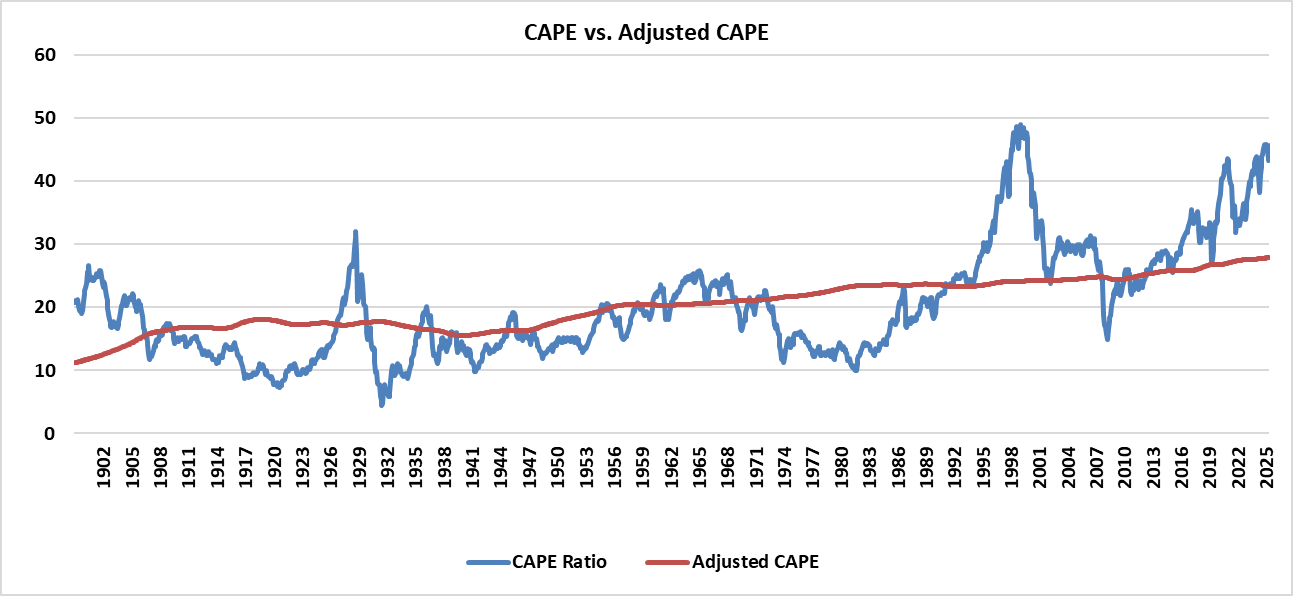
The blue line above is the CAPE ratio, and the red line is my estimate of fair value based on historical averages of interest rates, equity risk premiums, and corporate earnings growth.
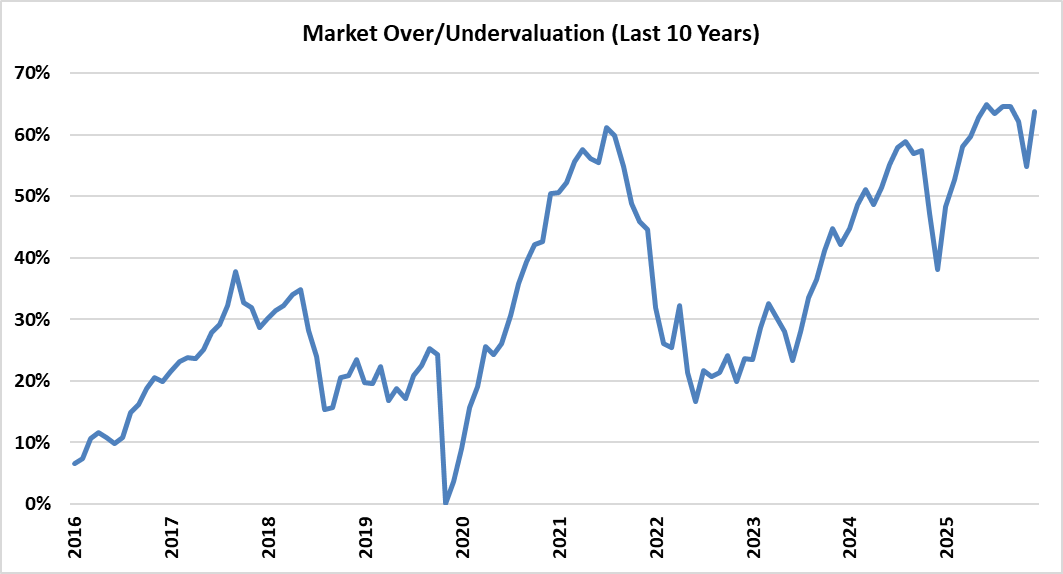
As you can see from the charts above, the market remains at historically elevated levels, with a recent dip and recovery due to the conflict with Iran.
Performance
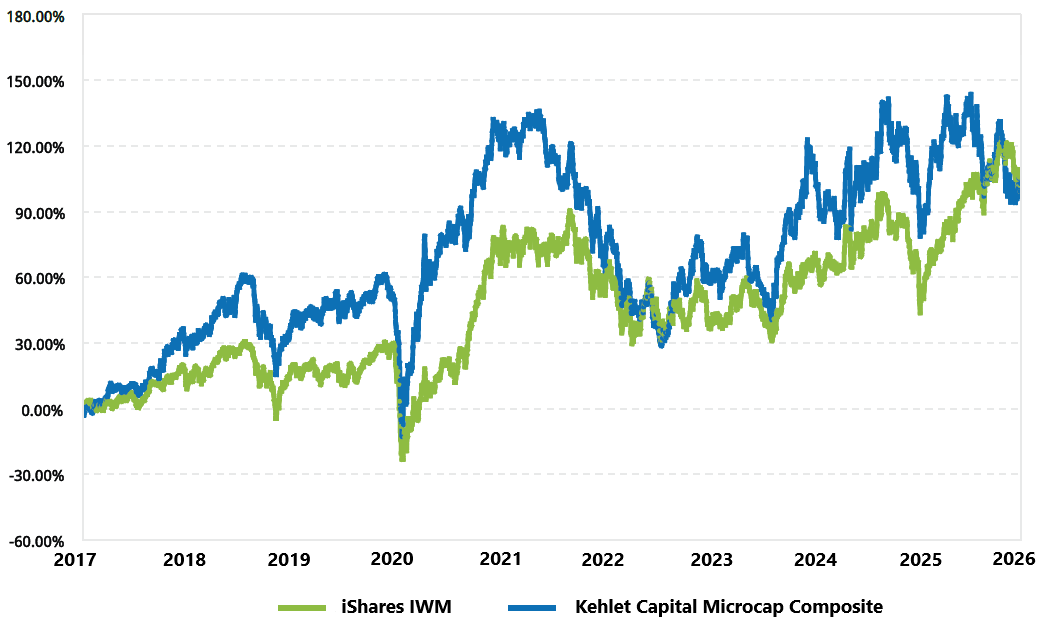
During the first quarter of 2026, Kehlet Capital Management’s concentrated micro-cap composite decreased by 6.08%, underperforming the benchmark, which rose by 0.93%.
Our largest contributor to first-quarter performance was Bandwidth Inc. (BAND), which increased 15.85%. In February, the company reported strong fourth-quarter and full-year 2025 results, with organic revenue growth of 10% for the year and 12% in the fourth quarter. CEO David Morken highlighted the growing adoption of Bandwidth’s platform for AI-driven voice applications, which helped drive 11% year-over-year growth in voice revenue. Management also guided to 2026 revenue growth of about 16% and adjusted EBITDA growth of roughly 30%, with plans for the highest R&D investment in the company’s history, focused on AI innovation. Late in March, Bandwidth announced a partnership with Salesforce’s newly launched Agentforce Contact Center, further extending its AI footprint. Finally, the Board authorized an $80 million share repurchase program — the company’s first ever. With fundamentals improving, capital return beginning, and AI momentum building, the thesis remains intact.
Our largest detractor to performance was Climb Global Solutions Inc. (CLMB), which declined 22.70%. The decline can be traced primarily to the company’s fourth-quarter and full-year 2025 report, released in late February. Although full-year revenue grew 40% to $652.5 million and earnings per share 14%, fourth-quarter adjusted EBITDA fell 19% year-over-year, as the prior-year period had benefited from an unusually high-margin vendor transaction. At the same time, the Board suspended the company’s quarterly dividend to prioritize acquisitions and organic investment — a move the market appeared to interpret negatively. Broader small-cap weakness following the Middle East crisis added further pressure. Still, there were several positive developments during the quarter. Climb completed the accretive acquisition of interworks.cloud, a Greek cloud distributor that expands its presence across Southern and Eastern Europe, and announced a four-for-one stock split. A new partnership with Fortinet, signed in December 2025, is expected to become a top-three vendor relationship within eighteen months. Given these fundamentals, the thesis remains intact.
Portfolio Activity
During the quarter, I trimmed our position in Fonar Corp. (FONR). I redeployed the capital into Strive Inc. (ASST), the iShares Bitcoin Trust ETF (IBIT), and a new position I will introduce next quarter.
Turning to an update from last quarter, I mentioned SATA, a perpetual preferred stock I added to the portfolio. SATA is a security issued by Strive Inc. (ASST) — the same company that acquired Semler Scientific (SMLR) in late 2025. I began acquiring the stock for our portfolio in November of last year at $89.77 per share, and today it trades at just under $100, while paying a tax-deferred dividend of 13%. Here’s how it works. Each share of SATA has a stated value of $100 and pays a variable monthly dividend set by Strive. The company sets the dividend each month based on the previous month’s trading range, aiming to keep the price around $100. That is, if the stock trades below $100, the company raises the dividend, and if it drifts above $100, it lowers the dividend (or issues more shares). Because the stock is perpetual, there is no maturity date; as long as Strive remains solvent, the dividend keeps coming. And because the stock is “preferred,” it sits ahead of common shareholders in line for dividend payments and, in the event of a liquidation, for the return of capital.
So, why own it? In short, SATA is an attractive alternative to cash. A money market fund today yields around 4% to 5%. SATA currently offers a tax-deferred yield of 13% paid monthly and trades very close to its $100 stated value, with limited volatility. Its price does fluctuate — it is, after all, a stock — but its volatility has historically been far lower than the broader equity market. The main risk is credit: if Strive runs into financial trouble, it could suspend dividends. However, because SATA is a cumulative preferred, any missed dividends would accrue and be owed to shareholders. Given Strive’s Bitcoin-backed balance sheet and the attractive yield, I view the trade-off as favorable. For a portion of the portfolio, I would otherwise hold in cash, SATA offers a meaningfully higher return with theoretically low volatility.
Conclusion
The first quarter of 2026 was a difficult one, as our portfolio was negatively impacted by a sharp post-earnings decline in Climb Global Solutions. However, short-term volatility is the price we pay for long-term outperformance, and I remain confident that our portfolio — built on high-quality businesses with strong fundamentals — is well-positioned to come out the other side in good shape. As always, patience remains our greatest advantage. Thank you again for your continued support of Kehlet Capital Management. Please do not hesitate to contact me with any questions or comments.
| Equity holdings | 7 |
|---|---|
| Median market cap | $559M |
| Weighted avg. market cap | $316M |
| Bandwidth Inc. (BAND) | 18.5% |
|---|---|
| Fonar Corp. (FONR) | 16.9% |
| Climb Global Solutions (CLMB) | 12.0% |
Notes
- Based on claims made by President Trump ↩
Disclosures to Performance Results
Actual composite performance results represent the performance of fully discretionary accounts managed by Kehlet Capital Management (KCM) during the corresponding time period. The composite performance results reflect time-weighted rates of return, the reinvestment of dividends and other account earnings. The reinvestment of dividends and other earnings may have a material impact on overall returns.
Past performance is not indicative of future results and the performance of a specific individual client account may vary substantially from the composite performance results. Therefore, no current or prospective client should assume that future performance will be profitable, or equal either the KCM composite performance results reflected above, or the performance results for any of the comparative index benchmarks provided.
For reasons including variances in portfolio account holdings, variances in the investment management fee incurred, market fluctuations, the date on which a client engages KCM’s investment management services, and any account contributions or withdrawals, the performance of a specific client’s account could vary substantially from the indicated KCM composite performance results. A portion of each account can be actively managed in an attempt to respond to changing conditions.
All performance results have been compiled solely by KCM, are unaudited, and have not been independently verified. Therefore, the performance data could be wrong. Information pertaining to KCM’s advisory operations, services, and fees is set forth in KCM’s current Form ADV Part 2A disclosure brochure, a copy of which is available from KCM upon request.
iShares IWM is an exchange-traded fund (ETF) measuring the performance of approximately 2,000 small-cap companies. It serves as a benchmark for small-cap stocks in the United States.
KCM managed accounts may own assets and follow investment strategies which cause them to differ materially from the composition and performance of the ETF shown as a benchmark. The ETF was chosen for its accessibility, transparency, independence, and relevance to KCM’s investment strategy, but there may be other indices that are more appropriate or applicable to the Concentrated Micro-cap Strategy. The historical index performance results are provided exclusively for comparison purposes only, so as to provide general comparative information to assist an individual client or prospective client in determining whether a specific Portfolio meets, or continues to meet, his/her investment objective(s). It should not be assumed that account holdings will correspond directly to any of the comparative indexes.
Different types of investments and/or investment strategies involve varying levels of risk, and there can be no assurance that any specific investment or investment strategy (including the investments purchased and/or investment strategies devised by KCM) will be either suitable or profitable for a client’s or prospective client’s portfolio and may result in a loss of principal. Accordingly, no client or prospective client should assume that the above portfolios (or any component thereof) serve as the receipt of, or a substitute for, personalized advice from KCM, or from any other investment professional.