
“The way to win is to work, work, work, work, and hope to have a few insights. And you’re probably not going to be smart enough to find thousands in a lifetime. And when you get a few, you really load up. It’s just that simple.”
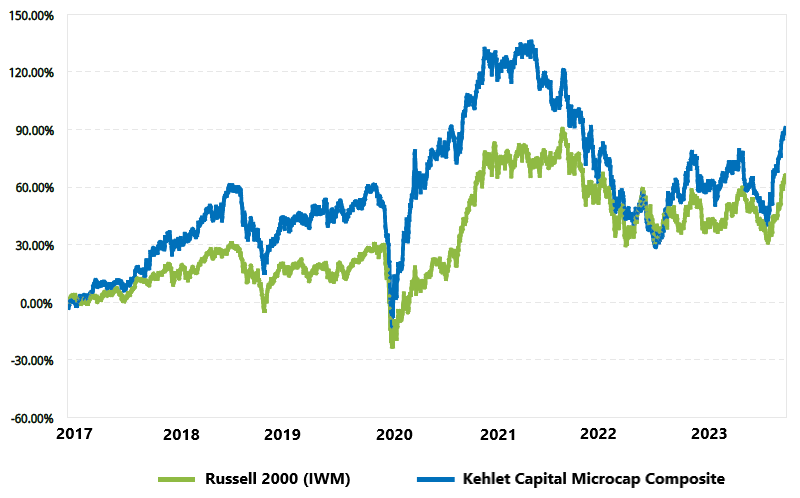
| Year | KCM Composite, Net | IWM | Excess Return |
|---|---|---|---|
| 2017* | 27.20% | 14.26% | +12.94% |
| 2018 | -3.43% | -11.11% | +7.68% |
| 2019 | 27.79% | 25.39% | +2.40% |
| 2020 | 27.52% | 20.03% | +7.49% |
| 2021 | -1.45% | 14.54% | -15.99% |
| 2022 | -22.63% | -20.48% | -2.15% |
| 2023 | 23.12% | 16.84% | +6.28% |
| Annualized | 9.55% | 7.29% | +2.26% |
*Inception date: 02/01/2017
Introduction
As you are likely aware, Charlie Munger, an investing legend and vice chairman of Berkshire Hathaway for 45 years, recently passed away at the age of 99. I first learned about Mr. Munger in 2008 when I attended the Berkshire Hathaway shareholder’s meeting in Omaha, Nebraska. At the time, I had studied Warren Buffett extensively but knew little about his partner, Charlie. But as I sat in the audience listening to Warren and Charlie answer questions, I quickly became enamored with him. His responses were direct, insightful, pithy, and often humorous. It didn’t take long to realize that Charlie embodied a rare combination of massive intellect, common sense, quick wit, and extremely high character. He promptly became someone I looked up to. Soon after the meeting, I bought his book, Poor Charlie’s Almanack. It was chock-full of practical advice about investing, psychology, and life in general. It had a huge influence on me and guides my investing style to this day. So, in honor of Charlie, I thought I would share some of my favorite quotes of his:
On Intelligence
“It is remarkable how much long-term advantage people like us have gotten by trying to be consistently not stupid, instead of trying to be very intelligent.”
“You don’t have to be brilliant, only a little bit wiser than the other guys, on average, for a long, long, time.”
“Knowing what you don’t know is more useful than being brilliant.”
“We’re emphasizing the knowable by predicting how certain people and companies will swim against the current. We’re not predicting the fluctuation in the current.”
On Learning
“Forgetting your mistakes is a terrible error if you are trying to improve your cognition.”
“Recognize reality even when you don’t like it. Especially when you don’t like it.”
“Spend each day trying to be a little wiser than you were when you woke up. Day by day, and at the end of the day, if you live long enough… you will get out of life what you deserve.”
“The game of life is the game of everlasting learning. At least it is if you want to win.”
On Patience
“If you took our top 15 decisions out, we’d have a pretty average record. It wasn’t hyperactivity, but a hell of a lot of patience. You stuck to your principles and when opportunities came along, you pounced on them with vigor.”
“I always knew from when I was a little boy that the opportunities that were important that were going to come to me were few and that the trick was to prepare myself for seizing the few that came.”
“The big money is not in the buying and selling, but in the waiting.”
“There are worse situations than drowning in cash and sitting, sitting, sitting. I remember when I wasn’t awash in cash, and I don’t want to go back.”
“It takes character to sit there with all that cash and do nothing. I didn’t get to where I am by going after mediocre opportunities.”
On Risk
“We have the same problem as everyone else: It’s very hard to predict the future.”
“We look for a horse with one chance in two of winning and which pays you three to one.”
“Suppose you were a real estate investor with 1/3 interest in the best apartment complex in town, the best mall, and the best office building. Would you feel like a poor, undiversified investor? No! But as soon as you get into stocks, people feel this way.”
“We tend to buy things – a lot of things – where we don’t know exactly what will happen, but the outcome will be decent.”
“There’s no way that you can live an adequate life without making many mistakes.”
On Life
“Remember that reputation and integrity are your most valuable assets and can be lost in a heartbeat.”
“All I want to know is where I’m going to die, so I’ll never go there.”
Rest in peace, Charlie. You will be missed.
Project Update
Before moving on to performance, I wanted to provide a quick update on the project I spoke about last quarter. As a reminder, the goal was to access the SEC’s API to develop a customized database and screening tool for finding and monitoring new ideas in near-real time.
But screening tools are nothing new. There are numerous paid and/or free versions easily accessible online or through third-party software vendors. So why bother creating one myself? Because, in my experience, third-party screening tools have two major problems. First, the quality of the data is subpar. It’s not that the raw data being screened is wrong (although that is oftentimes the case as well) but that the calculations being made with the data are useless for my purposes. For example, let’s say I want to screen for companies with a return on invested capital (ROIC) greater than 10%. It’s a simple calculation, right? Return divided by invested capital. But what return should be used? Net income? Operating income after taxes? Should one-time expenses be included or excluded? If excluded, which expenses are considered one-time? The calculation is suddenly not so simple. Determining the proper invested capital can be just as complicated. If you use third-party screening tools, you are at the mercy of their assumptions, whether they are correct or not – and, in my opinion, they’re usually not. It’s a case of garbage in, garbage out.
Second, there are limitations in what can be screened for. For instance, let’s take the previous ROIC example a step further. Let’s say I was fortunate enough to find a screening tool that calculated ROIC exactly the way I wanted, and I decided to search for companies with ROIC greater than 10%. The tool would likely spit out a list of businesses that had ROIC greater than 10% over the recent past – either the previous quarter or year. But what if these companies had experienced a temporary boost from one-time events, like COVID-19, and their ROIC was artificially inflated? One year’s worth of data might not be trustworthy. What if instead, I wanted to look for companies that have averaged greater than 10% ROIC over the last three, four, or five years? Or what if I wanted to look for companies that have increased ROIC each of the last three years? Most likely, a third-party screen will not provide that kind of flexibility. But a customized screen using self-audited data loaded directly from the SEC will, which is why I am highly optimistic about the potential to supercharge my idea generation process.
Although the project is unlikely to ever be truly “finished” – since my database needs to be updated regularly and I have several ideas for improvements – I am now at a point where I can start extracting value from it. And the initial results are promising. From a list of more than 1,100 companies, my customized screen identified 14 businesses for further evaluation. I then narrowed the list down to six high-priority ideas and am optimistic that at least one or two will qualify for placement in the portfolio relatively soon. If so, this would be a highly encouraging result for three reasons: 1) It would suggest the tool is designed appropriately – selective enough to find high-quality ideas but not so selective as to find nothing at all, 2) it would provide almost immediate benefit to the portfolio, and 3) it would indicate the tool could be used regularly to monitor 1,100+ companies as information changes. As such, I am currently in the process of researching the six high-priority ideas and will keep you posted on my progress.
Performance
During the fourth quarter of 2023, Kehlet Capital Management’s concentrated micro-cap composite increased 23.97%, outperforming the benchmark which grew 13.99%.
Our largest contribution to performance for the quarter came from FONAR Corp. (FONR), which increased 26.98%. As a reminder, Fonar is a provider of MRI diagnostic imaging services throughout New York and Florida. I’ve written extensively about the undervaluation of Fonar stock in the past and suggested various items that could unlock its value. Most revolve around increasing the growth rate of earnings. In the third quarter 2022 newsletter, I noted how two of those items seemed to be coming to fruition with the company 1) significantly increasing its reinvestment back into the business, and 2) announcing a share repurchase program that had the potential to reduce the shares outstanding by up to 10%. During the fourth quarter of 2023, these factors helped drive momentum for the business as revenue grew 11.4%, adjusted operating earnings grew 22.5%, and earnings per share grew 103.4%. The strong results helped propel the stock higher, though it still trades below book value and at a mere 7.3x trailing twelve months earnings (ex-cash). As a result, I believe there is still tremendous upside for this stock and the thesis remains intact.
Our largest detractor to performance for the quarter was Chase Corp. (CCF), which increased 0.24%. As noted last quarter, Chase announced an agreement to be acquired by KKR, an investment management company, for $1.3 billion, or $127.50 per share. The deal was officially closed on November 15th, and the stock ceased trading on the New York Stock Exchange.
Our largest contribution to performance for the full year 2023 came from Climb Global Solutions (CLMB), which increased by 76.44%. In the third quarter 2022 newsletter I outlined my conviction for Climb (known at the time as Wayside Technologies), which was driven in large part by the company’s outstanding management team. I also noted that the stock traded for a highly attractive price-to-earnings (P/E) multiple of about 10.5x, despite having grown earnings by an average of roughly 19% annually since management took over 4.5 years prior. Since then, management has continued to execute, growing earnings by an additional 18.7% (from $2.57 to $3.05 per share, excluding a one-time stock grant to the CEO in the second quarter of 2023) in just over a year. Given the increase in stock price, the company now trades at a more reasonable P/E of 18.0x. However, when adjusted for net cash on the balance sheet, the P/E falls to 14.5x. In my opinion, this is entirely too low for a company consistently growing in the high teens. Therefore, I believe there remains considerable upside in the stock and the thesis remains intact.
Our largest detractor to performance for the full year 2023 was Bandwidth Inc. (BAND), which declined 35.84%. The company has now been the worst performer in the portfolio two years in a row. It has been through a lot over that time, including a cybersecurity attack at the end of 2021, moderating growth in 2022 due to a COVID-induced boom cycle the prior year, and further moderating growth in 2023 due to an election cycle boost in 2022. However, I believe the worst is now behind us, and the company is set up for an outstanding 2024 due, in part, to the presidential election, which should drive significant growth in political text messaging revenue. If so, we will be well positioned for a rebound as we acquired shares nearly the entire way down. Simply put, 2024 is an important year for the company and one in which I believe our patience will be rewarded.
Portfolio Activity
During the quarter, our position in Chase Corp (CCF) was closed due to its acquisition by KKR. A portion of the proceeds were used to increase our position in Bandwidth Inc. (BAND). No other adjustments to portfolio weights were made during the quarter.
Conclusion
The fourth quarter of 2023 was outstanding from both an absolute and relative performance perspective. The Kehlet Capital Microcap Composite finished the year up more than 23% and outperformed the benchmark by over 6%. I believe the portfolio is well positioned to continue this momentum heading into 2024 and, with my recent project now complete, I believe there is significant potential to enhance the portfolio even further going forward. Thank you again for supporting Kehlet Capital Management, and please do not hesitate to contact me should you have any questions or comments.
| Number of holdings | 9 |
|---|---|
| Median market cap | $333M |
| Weighted avg. market cap | $305M |
| Fonar Corp. (FONR) | 26.9% |
|---|---|
| Climb Global Solutions (CLMB) | 21.8% |
| Bandwidth Inc. (BAND) | 16.0% |
Disclosures to Performance Results
Actual composite performance results represent the performance of fully discretionary accounts managed by Kehlet Capital Management (KCM) during the corresponding time period. The composite performance results reflect time-weighted rates of return, the reinvestment of dividends and other account earnings. The reinvestment of dividends and other earnings may have a material impact on overall returns.
Past performance is not indicative of future results and the performance of a specific individual client account may vary substantially from the composite performance results. Therefore, no current or prospective client should assume that future performance will be profitable, or equal either the KCM composite performance results reflected above, or the performance results for any of the comparative index benchmarks provided.
For reasons including variances in portfolio account holdings, variances in the investment management fee incurred, market fluctuations, the date on which a client engages KCM’s investment management services, and any account contributions or withdrawals, the performance of a specific client’s account could vary substantially from the indicated KCM composite performance results. A portion of each account can be actively managed in an attempt to respond to changing conditions.
All performance results have been compiled solely by KCM, are unaudited, and have not been independently verified. Therefore, the performance data could be wrong. Information pertaining to KCM’s advisory operations, services, and fees is set forth in KCM’s current Form ADV Part 2A disclosure brochure, a copy of which is available from KCM upon request.
iShares IWM is an exchange-traded fund (ETF) measuring the performance of approximately 2,000 small-cap companies. It serves as a benchmark for small-cap stocks in the United States.
KCM managed accounts may own assets and follow investment strategies which cause them to differ materially from the composition and performance of the ETF shown as a benchmark. The ETF was chosen for its accessibility, transparency, independence, and relevance to KCM’s investment strategy, but there may be other indices that are more appropriate or applicable to the Concentrated Micro-cap Strategy. The historical index performance results are provided exclusively for comparison purposes only, so as to provide general comparative information to assist an individual client or prospective client in determining whether a specific Portfolio meets, or continues to meet, his/her investment objective(s). It should not be assumed that account holdings will correspond directly to any of the comparative indexes.
Different types of investments and/or investment strategies involve varying levels of risk, and there can be no assurance that any specific investment or investment strategy (including the investments purchased and/or investment strategies devised by KCM) will be either suitable or profitable for a client’s or prospective client’s portfolio and may result in a loss of principal. Accordingly, no client or prospective client should assume that the above portfolios (or any component thereof) serve as the receipt of, or a substitute for, personalized advice from KCM, or from any other investment professional.