
“There is an immense amount to be learned simply by tinkering with things.”
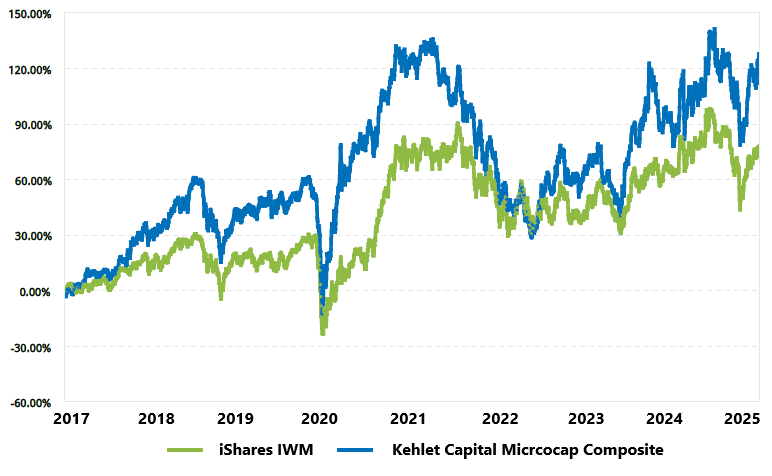
| Year | KCM Composite, Net | IWM | Excess Return |
|---|---|---|---|
| 2017* | 27.20% | 14.26% | +12.94% |
| 2018 | -3.43% | -11.11% | +7.68% |
| 2019 | 27.79% | 25.39% | +2.40% |
| 2020 | 27.52% | 20.03% | +7.49% |
| 2021 | -1.45% | 14.54% | -15.99% |
| 2022 | -22.63% | -20.48% | -2.15% |
| 2023 | 23.12% | 16.84% | +6.28% |
| 2024 | 15.29% | 11.39% | +3.90% |
| YTD 2025 | 4.47% | -1.85% | +6.32% |
| Annualized | 10.19% | 7.08% | +3.11% |
*Inception date: 02/01/2017
Introduction
I recently finished reading Henry Ford’s autobiography, My Life and Work. I was struck by the profound impact one man has had on the world and how many of his ideas – from manufacturing to business to everyday life – still resonate today. Ford’s story is about more than just producing cars; it’s about being of service, taking risks, being persistent, and always striving to be better. As such, I want to share some of the key lessons and quotes from the book I found particularly valuable:
1. Think for Yourself
Henry Ford consistently challenged conventional wisdom:
"I do not recall anyone who thought that the internal combustion engine could ever have more than a limited use. All the wise people demonstrated conclusively that the engine could not compete with steam. They never thought that it might carve out a career for itself. That is the way with wise people—they are so wise and practical that they always know to a dot why something cannot be done; they always know the limitations."
"At first the 'horseless carriage' was considered merely a freak notion and many wise people explained with particularity why it could never be more than a toy."
“We made and sold 1,708 cars in the first year. In the second year we scattered our energies among three models and increased prices–and therefore sold fewer cars than in the first year. The sales were 1,695 cars. In 1905-1906 we made only two models… and our sales dropped to 1,599 cars. Some said it was because we had not brought out new models. I thought it was because our cars were too expensive–they did not appeal to the 95 percent. I changed the policy in the next year… and right there came the complete demonstration of what price meant. We sold 8,423 cars–nearly five times as many as in our biggest previous year.”
2. Take Risks
Ford was not afraid to bet on himself:
"I had to choose between my job and my automobile. I chose the automobile, or rather I gave up the job—there was really nothing in the way of a choice. For already I knew that the car was bound to be a success. I quit my job on August 15, 1899, and went into the automobile business."
"It might be thought something of a step, for I had no personal funds. What money was left over from living was all used in experimenting. But my wife agreed that the automobile could not be given up—that we had to make or break. There was no 'demand' for automobiles—there never is for a new article."
“Our policy is to reduce the price, extend the operations, and improve the article. You will notice that the reduction of price comes first. The more usual way is to take the costs and then determine the price. One of the ways of discovering what a cost ought to be is to name a price so low as to force everybody in the place to the highest point of efficiency.”
3. Don’t Give Up
Ford believed almost anything was achievable with sufficient determination and hard work:
"The habit of failure is purely mental and is the mother of fear."
"More men are beaten than fail. It is not wisdom they need or money, or brilliance, or 'pull,' but just plain gristle and bone. This rude, simple, primitive power which we call 'stick-to-it-iveness' is the uncrowned king of the world of endeavor."
"People are utterly wrong in their slant upon things. They see the successes that men have made and somehow they appear easy. But that is a world away from the facts. It is failure that is easy. Success is always hard."
4. Focus on Continuous Improvement
Ford was never satisfied with the status quo:
"A man who knows a job sees so much more to be done than he has done, that he is always pressing forward and never gives up an instant of thought to how good and how efficient he is."
"Everything can always be done better than it is being done."
"The pressing to do work better and faster solves nearly every factory problem."
"Along about April 1, 1913, we first tried the experiment of an assembly line. We try everything in a little way first—we will rip out anything once we discover a better way, but we have to know absolutely that the new way is going to be better than the old before we do anything drastic."
5. Never Rest on Your Laurels
Ford believed that success was not an end goal, but rather an ongoing opportunity to provide greater service:
"Life, as I see it, is not a location, but a journey. Even the man who most feels himself 'settled' is not settled—he is probably sagging back. Everything is in flux and was meant to be. Life flows. We may live at the same number of the street, but it is never the same man who lives there."
"We were a prosperous company. We might easily have sat down and said: 'Now we have arrived. Let us hold what we have got.’ I regarded our early progress merely as an invitation to do more—as an indication that we had reached a place where we might begin to perform a real service."
6. Give Back Intelligently
Ford encouraged meaningful philanthropy. He emphasized the importance of addressing the root causes of societal issues rather than providing temporary relief:
"It is easy to give; it is harder to make giving unnecessary."
"If human sympathy prompts us to feed the hungry, why should it not give the larger desire—to make hunger in our midst impossible? If we have sympathy enough for people to help them out of their troubles, surely we ought to have sympathy enough to keep them out."
"The charitable system that does not aim to make itself unnecessary is not performing service. It is simply making a job for itself and is an added item to the record of non-production."
Performance
During the second quarter of 2025, Kehlet Capital Management’s concentrated micro-cap composite increased 14.74%, outperforming the benchmark, which grew 8.47%.
For the second consecutive quarter, our largest contribution to performance came from Astronics Corp. (ATRO), which increased by 37.80%. During the second quarter, Astronics reported its first quarter results, which included revenue growth of 11.3%, gross profit growth of 28.1%, and adjusted operating income growth of 313.0%. The company maintained its strong momentum, with bookings increasing 42.8% sequentially and 37.0% year-over-year. Included within bookings was a $57 million order related to the United States Army’s Future Long-Range Assault Aircraft (FLRAA) program. Excluding this order, bookings would still have increased 13.7% sequentially and 9.1% year-over-year. Looking ahead, however, management remained cautious despite the outperformance due to uncertainty around future tariffs. As such, they maintained their full-year guidance. Nevertheless, I believe the company’s long-term prospects remain bright and the thesis remains intact.
Our largest detractor to performance was Climb Global Solutions Inc. (CLMB), which declined 3.34%. During the second quarter, Climb reported its first quarter results, which included revenue growth of 49.4%, gross profit growth of 37.5%, and adjusted operating income growth of 35.2%. Although the results were solid, the stock’s underperformance was likely due to its previous overvaluation, which I noted in last year’s fourth-quarter newsletter. Fundamentally, however, the company continues to fire on all cylinders with CEO Dale Foster noting that “we are well-positioned to continue driving organic growth and further improve operating leverage. While still early, we expect the implementation of our ERP system to drive meaningful efficiencies across our global operations. We also plan to remain active with M&A as we evaluate accretive targets that can enhance our comprehensive offerings and expand our presence in both North America and overseas”. Simply put, the future remains bright for Climb, and the thesis remains intact.
Portfolio Activity
During the quarter, I trimmed our position in Astronics Corp. (ATRO) due to valuation and position-sizing concerns. I redeployed the capital into Semler Scientific Inc. (SMLR). No other adjustments to portfolio weights were made during the quarter.
Conclusion
The second quarter of 2025 was solid from both a relative and absolute return perspective. I believe our portfolio is well-positioned for the long term and am cautiously optimistic about the second half of 2025. Thank you again for your support of Kehlet Capital Management. Please do not hesitate to contact me with any questions or comments.
| Number of holdings | 7 |
|---|---|
| Median market cap | $492M |
| Weighted avg. market cap | $344M |
| Semler Scientific Inc. (SMLR) | 19.4% |
|---|---|
| Fonar Corp. (FONR) | 17.1% |
| Bandwidth Inc. (BAND) | 14.7% |
Disclosures to Performance Results
Actual composite performance results represent the performance of fully discretionary accounts managed by Kehlet Capital Management (KCM) during the corresponding time period. The composite performance results reflect time-weighted rates of return, the reinvestment of dividends and other account earnings. The reinvestment of dividends and other earnings may have a material impact on overall returns.
Past performance is not indicative of future results and the performance of a specific individual client account may vary substantially from the composite performance results. Therefore, no current or prospective client should assume that future performance will be profitable, or equal either the KCM composite performance results reflected above, or the performance results for any of the comparative index benchmarks provided.
For reasons including variances in portfolio account holdings, variances in the investment management fee incurred, market fluctuations, the date on which a client engages KCM’s investment management services, and any account contributions or withdrawals, the performance of a specific client’s account could vary substantially from the indicated KCM composite performance results. A portion of each account can be actively managed in an attempt to respond to changing conditions.
All performance results have been compiled solely by KCM, are unaudited, and have not been independently verified. Therefore, the performance data could be wrong. Information pertaining to KCM’s advisory operations, services, and fees is set forth in KCM’s current Form ADV Part 2A disclosure brochure, a copy of which is available from KCM upon request.
iShares IWM is an exchange-traded fund (ETF) measuring the performance of approximately 2,000 small-cap companies. It serves as a benchmark for small-cap stocks in the United States.
KCM managed accounts may own assets and follow investment strategies which cause them to differ materially from the composition and performance of the ETF shown as a benchmark. The ETF was chosen for its accessibility, transparency, independence, and relevance to KCM’s investment strategy, but there may be other indices that are more appropriate or applicable to the Concentrated Micro-cap Strategy. The historical index performance results are provided exclusively for comparison purposes only, so as to provide general comparative information to assist an individual client or prospective client in determining whether a specific Portfolio meets, or continues to meet, his/her investment objective(s). It should not be assumed that account holdings will correspond directly to any of the comparative indexes.
Different types of investments and/or investment strategies involve varying levels of risk, and there can be no assurance that any specific investment or investment strategy (including the investments purchased and/or investment strategies devised by KCM) will be either suitable or profitable for a client’s or prospective client’s portfolio and may result in a loss of principal. Accordingly, no client or prospective client should assume that the above portfolios (or any component thereof) serve as the receipt of, or a substitute for, personalized advice from KCM, or from any other investment professional.