
“If you were to start a company today, how would you do it? You would do what most startups do. You would begin with a foundation of machine labor and only add human labor when necessary and valuable… At some point, running companies on a foundation of human labor will no longer be feasible.”
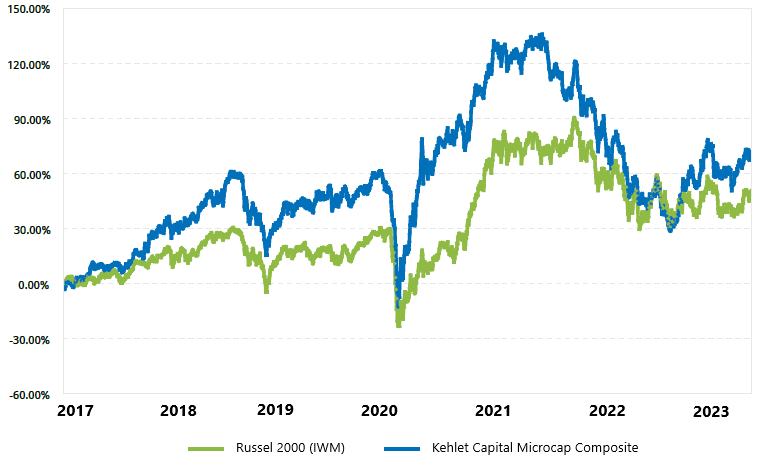
| Year | KCM Composite, Net | IWM | Excess Return |
|---|---|---|---|
| 2017* | 27.20% | 14.26% | +12.94% |
| 2018 | -3.43% | -11.11% | +7.68% |
| 2019 | 27.79% | 25.39% | +2.40% |
| 2020 | 27.52% | 20.03% | +7.49% |
| 2021 | -1.45% | 14.54% | -15.99% |
| 2022 | -22.63% | -20.48% | -2.15% |
| YTD 2023 | 11.83% | 8.09% | +3.74% |
| Annualized | 8.69% | 6.59% | +2.10% |
*Inception date: 02/01/2017
Introduction
Since its release in November 2022, ChatGPT, an artificial intelligence (AI) chatbot, has generated a lot of buzz. By January 2023 it was the fastest-growing consumer software application in history, with over 100 million users.1,2 If you’ve used the program, you might understand why.3 What it can do at times seems almost magical. Not only can it hold realistic conversations, it can produce original songs, write computer code, and has even aced the Bar Exam. The tool is so impressive it has sparked increased investment in the field of AI and renewed concerns that artificial intelligence may soon displace human intelligence. So how should we think about this new technology? Is it as good as advertised? How can it be used for maximum benefit? And where are investment opportunities likely to be found?
First, it’s helpful to understand some background. In my third quarter 2019 newsletter, I talked about the latest breakthrough in AI at the time, known as deep learning. It utilized clever algorithms – loosely based on the structure of neurons in the brain – to “train” computers to identify complex patterns and make predictions. Until recently, deep learning had primarily been used for things like facial recognition, natural language processing, and fraud detection. In other words, it could provide information about data or content, but it couldn’t do the reverse – generate content based on information. However, that changed with ChatGPT. By expanding its algorithm to include hundreds of billions of parameters (i.e., variables) and training it on trillions of words from the internet, ChatGPT took deep learning further than it had ever gone before. The result was a sophisticated large language model (LLM) representing a breakthrough in the field of “generative AI” (i.e., artificial intelligence that could create content).
Though ChatGPT is impressive, the program is far from perfect. Most notably it often writes “plausible-sounding but incorrect or nonsensical answers”, referred to as hallucinations.4 For example, you may have read about “the tale of Steven Schwartz, a personal-injury lawyer at the New York firm Levidow, Levidow & Oberman, who used ChatGPT to help him prepare a court filing. He relied a bit too heavily on the artificial intelligence chatbot. It created a motion replete with made-up cases, rulings and quotes, which Mr. Schwartz promptly filed after the bot assured him that the ‘cases provided are real and can be found in reputable legal databases’ (they were not and could not).”5 One might think that hallucinations like these are the exception, rather than the norm. But these errors are still quite common. I experienced them frequently myself when attempting to perform financial analysis with the tool.
That said, ChatGPT will almost certainly get better over time. And just because it isn’t perfect yet, doesn’t mean it’s not useful. As automation expert Robert Whiteman puts it, we should “think of (large language models) as digital workers (that) can (be “employed”) to make life easier. Initially, these models might feel like a waste of time. The outputs are rarely good enough to use without edits. After mastering the art of prompt writing, you may be surprised by how helpful they can be in life.”6 Put another way, Reid Hoffman, co-founder of LinkedIn, advises users to “treat ChatGPT and others like an undergraduate research assistant.”7 That is, be specific about what you want and check the work for errors.
But despite its utility, I believe ChatGPT’s initial impact on the real economy will be limited for two reasons:
While ChatGPT can significantly improve our digital experience, it currently has little influence over the physical world. In other words, the tool is valuable for those who operate mostly in the digital world – like content creators, programmers, and students. But it is less beneficial for those who need to navigate the physical world – like factory workers, farmers, construction crews, and truck drivers.8 Though improving the digital world is important, I believe the most significant value of AI will be realized when it can improve the physical world as well. That’s partly why the potential for self-driving cars is so exciting. Because it would arguably represent the first meaningful foray of AI into the physical world.
As The Economist writes “it is difficult to make the case that any single new technology by itself has ever radically changed the economy. Even the industrial revolution of the late 1700’s… was caused by all sorts of factors coming together: increasing use of coal, firmer property rights, the emergence of scientific ethos and much more besides. Perhaps most famously, in the 1960’s Robert Fogel published work about America’s railways that would later win him a Nobel Prize in economics. Many thought that rail transformed America’s prospects, turning agricultural society into an industrial powerhouse. In fact, it had a very modest impact, Fogel found, because it replaced technology – such as canals – that would have done just about as good a job. Of course, no one can predict with any certainty where a technology as fundamentally unpredictable as AI will take humans. Runaway growth is not impossible: nor is technical stagnation. But you can still think through the possibilities. And, so far at least, it seems as though Fogel’s railways are likely to be a useful blueprint.”9
So how should we think about ChatGPT and AI? First, I believe society will continue to make random, unpredictable breakthroughs in AI technology that will incrementally improve our lives over time – much as technology has done for the last 150 years. While the impact on our lives is likely to be small measured over any 2 or 3-year period, the effects will likely add up to monumental change when compounded over decades. Second, I believe new AI tools like ChatGPT should not be ignored but instead viewed through the lens of automation. That is, their main purpose is to automate manual tasks.10 Therefore, when a new AI tool is released, I believe we should ask ourselves “what can this automate for me?” Though the answer may not seem obvious at first, with a little experimentation you might find some interesting use cases. If done with each new tool, over time you will build an arsenal of “digital workers” that make life easier. Third, I believe most of the future breakthroughs in AI will be driven by big tech companies with huge budgets and tons of data. For example, GPT-4, one of OpenAI’s chatbots, reportedly cost more than $100 million to train, a sum few firms have lying around – OpenAI is primarily funded by Microsoft. It’s also worth noting that “… the value of previous advances in machine learning… has accrued almost entirely to the incumbents.”11 But that doesn’t mean other companies won’t try jumping on the AI bandwagon. As Robert Whiteman puts it, “in the coming years, you will hear plenty of stories from companies building and deploying automation technologies. Most of those stories will be wishful thinking. Resist the temptation to go ‘all-in’ on the latest hype unless you are sure stories will translate to profit.”12 Therefore, investors like us need to be wary of the myriad of small and mid-size companies claiming to have developed proprietary AI.
In sum, I believe ChatGPT and generative AI are legitimate breakthroughs, but their impact on the real economy will be limited and its benefits will accrue to only a handful of large firms. As a result, it is important not to get caught up in the hype. As The Economist notes, “investors have been known to get overexcited about novel technologies. The internet made a new generation of companies (and their bumper profits) possible. It set off a wave of productivity improvements for economies around the world. The problem is that much of this happened after a stock market bubble, which caused speculators to lose their shirts.”13 One can only hope that this time will be different. The key is understanding that AI is neither a fad nor an apocalypse, but a tool in its infancy.14
Performance
During the second quarter of 2023, Kehlet Capital Management’s concentrated micro-cap composite increased 5.33%, roughly in line with the benchmark which grew 5.26%.
Our largest contribution to performance for the quarter came from Astronics Corp. (ATRO), which increased 48.65%. As a reminder, Astronics is a supplier of engineered components to the Aerospace and Defense industry, with approximately 90% share of the in-seat power market. Three years ago, I wrote in the third quarter 2020 newsletter:
“(I) first initiated a position in Astronics… with the expectation that wide-body aircraft production would pick up steam and lead to a substantial rebound. But just as (the) thesis appeared to be playing out, two fatal plane crashes led to the grounding of Boeing’s 737 MAX and a loss of approximately $60M in annual revenue for Astronics. Though not an insignificant hurdle, (I) felt this revenue shortfall was manageable until the 737 MAX was cleared to fly again. But roughly one year later, the COVID-19 pandemic caused a near complete shutdown of the airline industry. As a result, the stock has been among our worst performers. However, (I) feel strongly that the grounding of the 737 MAX and the outbreak of COVID-19 are temporary setbacks. Looking out three years from now, it seems likely that the airline industry, and thus Astronics, will be largely back to normal. If so, (I) think the stock offers a very compelling investment at these levels.”
And three years later, as predicted, the airline industry is nearly back to pre-COVID levels based on almost every metric – passenger traffic, profitability, capital spending, etc. – while Astronics stock has increased 157.3%, from $7.72 at the end of Q3 2020 to $19.86 at the end of Q2 2023. That said, I believe there is still plenty of runway for the company, which has only recently begun to see the benefit of increased airline spending. For example, during the second quarter, Astronics reported 29.7% organic revenue growth, significantly improved profitability, and strong bookings. This momentum is expected to continue throughout the second half with revenue expected to grow 27% for the full year. Given these short-term tailwinds and the company’s long-term competitive advantages, I believe the stock continues to offer attractive returns at these levels.
Our largest detractor to performance for the quarter was Climb Global Solutions, Inc. (CLMB), which declined 9.88%. Last quarter, I noted how Climb’s price-to-earnings (P/E) multiple had grown from 10.5x to 19.0x during Q1 but should trade closer to 22.5x based on an estimated future earnings growth rate of 10%. And during the second quarter the company reported adjusted operating income growth of 32.4%, well above the 19% CAGR the company has achieved over the last five years (since current management took over) and significantly ahead of my 10% estimate. Despite that, the stock price fell 10.19% in Q2, from $53.29 to $47.86, and its P/E multiple decreased to 16.3x.15 As a result, I believe the stock continues to have meaningful upside potential and the thesis remains intact.
Portfolio Activity
No adjustments to portfolio weights were made during the quarter. It is worth noting that this is the third quarter in a row without any trading activity. As an active manager, I view my primary role as taking advantage of inefficiencies in the market due to either excessive pessimism or overoptimism. But when the market is behaving mostly efficiently, there is little to do except be patient. Therefore, in times like these I believe it is appropriate to follow the advice of investor Terry Smith, Founder and CEO of Fundsmith, who says “buy good companies, don’t overpay, and do nothing.”
Conclusion
The second quarter of 2023 was positive on both an absolute and relative basis. Though there remains significant uncertainty related to the economy and the Federal Reserve’s path for interest rates in the second half of the year, I believe we remain well positioned for whatever the future holds. Thank you again for supporting Kehlet Capital Management, and please do not hesitate to contact me should you have any questions or comments.
| Number of holdings | 10 |
|---|---|
| Median market cap | $475M |
| Weighted avg. market cap | $441M |
| Fonar Corp. (FONR) | 25.8% |
|---|---|
| Climb Global Solutions (CLMB) | 20.8% |
| Astronics Corp. (ATRO) | 13.9% |
Notes
- “ChatGPT”, Wikipedia, https://en.wikipedia.org/wiki/ChatGPT ↩
- This record has since been surpassed by Threads, a Twitter-like app that was launched by Facebook’s parent company, Meta Platforms, in early July. ↩
- If you haven’t tried the tool yet, I highly recommend you do at https://openai.com/blog/chatgpt. ↩
- “ChatGPT: Optimizing Language Models for Dialogue”, OpenAI, https://openai.com/blog/chatgpt ↩
- 2023, June 10th – 16th, “First Thing We Do, Let’s Bot All The Lawyers”, The Economist, Volume 447 Number 9350, page 54 ↩
- Whiteman, Robert, Artificially Human: Making Sense of Automation and AI, (Better Future Publishing, 2023), page 109 ↩
- 2023, April 22nd – 28th, “Schumpeter: Meet the New Co-pilot”, The Economist, Volume 447 Number 9343, page 58 ↩
- This may be one reason why Mark Zuckerberg is pushing so hard for people to adopt Virtual Reality and the Metaverse. Because fully submerging people into the digital world minimizes the need to bring AI into the physical world and eliminates significant barriers to AI development (namely data acquisition). ↩
- 2023, May 13th – 19th, “Your New Colleague”, The Economist, Volume 447 Number 9346, pages 55 - 56 ↩
- While it’s true that AI can also perform completely new tasks that were previously uneconomical, I believe the average person will get the most value out of AI by automating tasks that were previously done manually. ↩
- 2023, May 20th – 26th, “Buttonwood: Machine Earning”, The Economist, Volume 447 Number 9347, page 67 ↩
- Whiteman, Robert, Artificially Human: Making Sense of Automation and AI, (Better Future Publishing, 2023), page 132 ↩
- 2023, June 10th – 16th, “Buttonwood: Great Predicted Turnover”, The Economist, Volume 447 Number 9350, page 62 ↩
- 2023, June 10th – 16th, “First Thing We Do, Let’s Bot All The Lawyers”, The Economist, Volume 447 Number 9350, page 54 ↩
- The difference between the 9.88% decline stated at the beginning of the paragraph and the 10.19% drop in stock price is due to the company’s quarterly dividend. ↩
Disclosures to Performance Results
Actual composite performance results represent the performance of fully discretionary accounts managed by Kehlet Capital Management (KCM) during the corresponding time period. The composite performance results reflect time-weighted rates of return, the reinvestment of dividends and other account earnings. The reinvestment of dividends and other earnings may have a material impact on overall returns.
Past performance is not indicative of future results and the performance of a specific individual client account may vary substantially from the composite performance results. Therefore, no current or prospective client should assume that future performance will be profitable, or equal either the KCM composite performance results reflected above, or the performance results for any of the comparative index benchmarks provided.
For reasons including variances in portfolio account holdings, variances in the investment management fee incurred, market fluctuations, the date on which a client engages KCM’s investment management services, and any account contributions or withdrawals, the performance of a specific client’s account could vary substantially from the indicated KCM composite performance results. A portion of each account can be actively managed in an attempt to respond to changing conditions.
All performance results have been compiled solely by KCM, are unaudited, and have not been independently verified. Therefore, the performance data could be wrong. Information pertaining to KCM’s advisory operations, services, and fees is set forth in KCM’s current Form ADV Part 2A disclosure brochure, a copy of which is available from KCM upon request.
iShares IWM is an exchange-traded fund (ETF) measuring the performance of approximately 2,000 small-cap companies. It serves as a benchmark for small-cap stocks in the United States.
KCM managed accounts may own assets and follow investment strategies which cause them to differ materially from the composition and performance of the ETF shown as a benchmark. The ETF was chosen for its accessibility, transparency, independence, and relevance to KCM’s investment strategy, but there may be other indices that are more appropriate or applicable to the Concentrated Micro-cap Strategy. The historical index performance results are provided exclusively for comparison purposes only, so as to provide general comparative information to assist an individual client or prospective client in determining whether a specific Portfolio meets, or continues to meet, his/her investment objective(s). It should not be assumed that account holdings will correspond directly to any of the comparative indexes.
Different types of investments and/or investment strategies involve varying levels of risk, and there can be no assurance that any specific investment or investment strategy (including the investments purchased and/or investment strategies devised by KCM) will be either suitable or profitable for a client’s or prospective client’s portfolio and may result in a loss of principal. Accordingly, no client or prospective client should assume that the above portfolios (or any component thereof) serve as the receipt of, or a substitute for, personalized advice from KCM, or from any other investment professional.