
“Learn the rules like a pro so you can break them like an artist.”
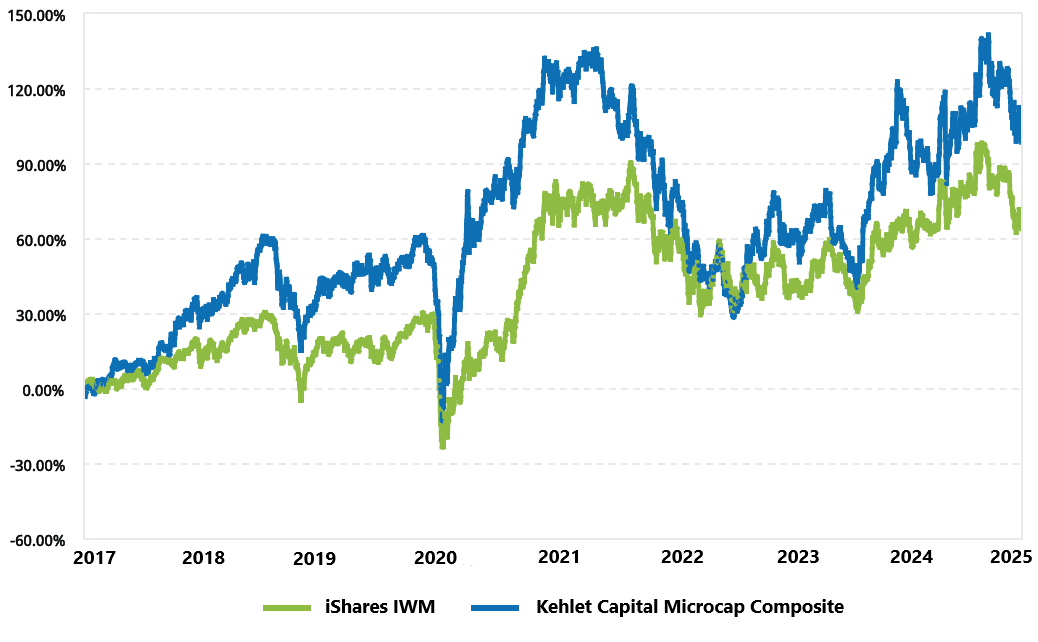
| Year | KCM Composite, Net | IWM | Excess Return |
|---|---|---|---|
| 2017* | 27.20% | 14.26% | +12.94% |
| 2018 | -3.43% | -11.11% | +7.68% |
| 2019 | 27.79% | 25.39% | +2.40% |
| 2020 | 27.52% | 20.03% | +7.49% |
| 2021 | -1.45% | 14.54% | -15.99% |
| 2022 | -22.63% | -20.48% | -2.15% |
| 2023 | 23.12% | 16.84% | +6.28% |
| 2024 | 15.29% | 11.39% | +3.90% |
| YTD 2025 | -8.95% | -9.51% | +0.56% |
| Annualized | 8.67% | 6.24% | +2.43% |
*Inception date: 02/01/2017
Introduction
In this quarter’s newsletter, I want to introduce the newest addition to our portfolio, Semler Scientific (SMLR). But before I do, I would be remiss if I didn’t briefly address the most important news affecting the markets: international tariffs. On April 2, President Trump signed an executive order implementing 10% tariffs on all countries importing to the United States and individualized “reciprocal” tariffs on countries with which the U.S. has the largest trade deficits.1 Individual rates were 46% for Vietnam, 34% for China, and 20% for the European Union. As a result, markets worldwide plummeted, with the S&P 500 falling nearly 11% over three days. While I provided some general thoughts about tariffs in my fourth quarter 2019 newsletter, my thinking on the current situation is as follows:
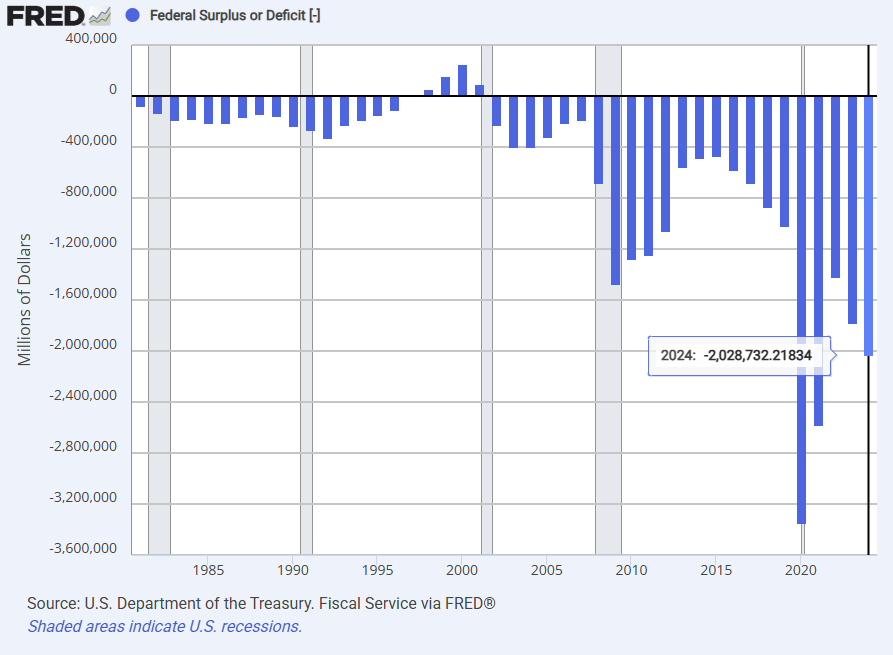
First, the United States has been on an unsustainable fiscal path for decades. For example, the federal deficit (spending minus tax receipts) has ballooned from $216 billion in 1985 to over $2 trillion in 2024:
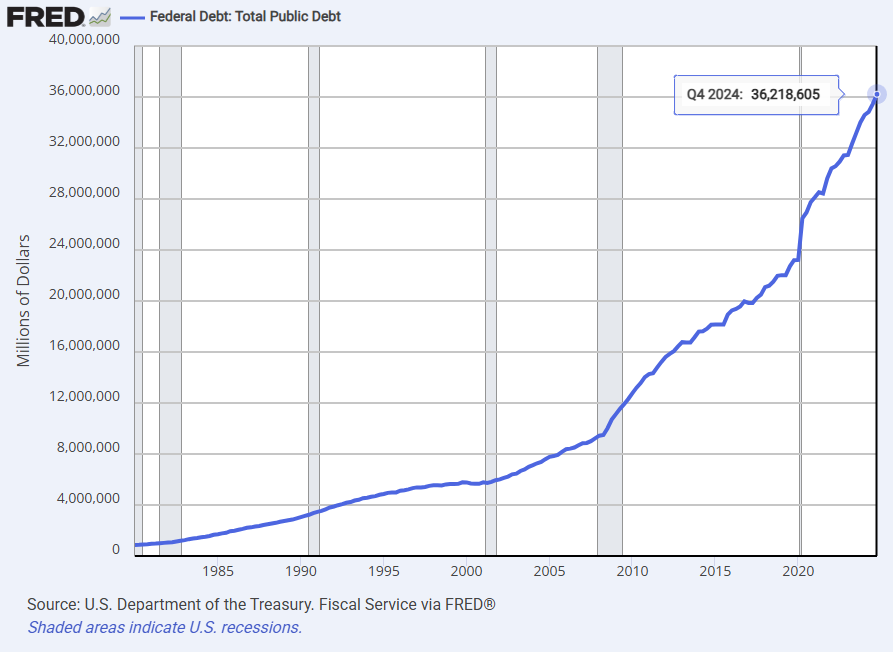
At the same time, federal debt has grown from $1.9 trillion to $36.2 trillion:
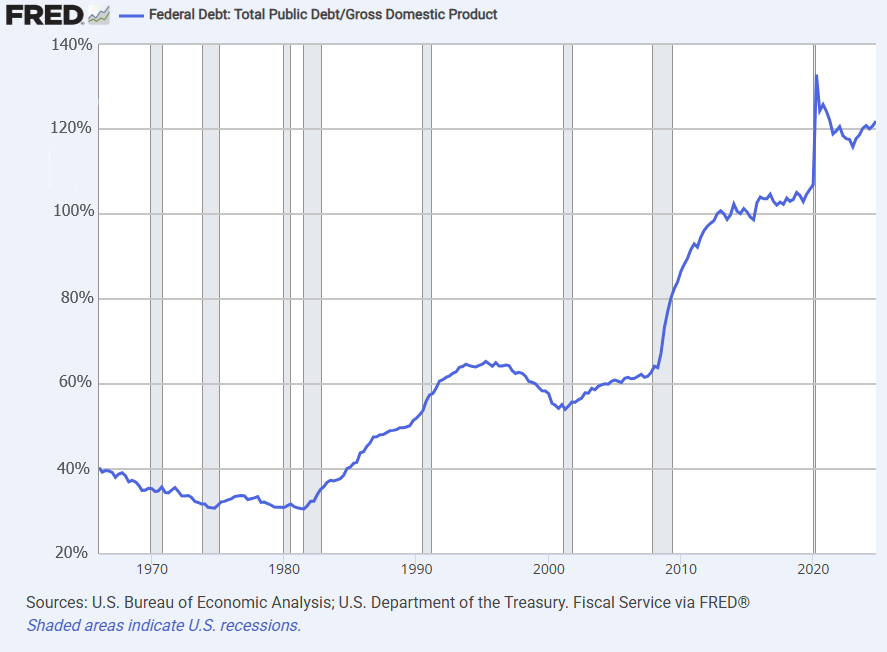
Viewed another way, federal debt has grown from 40% of GDP to over 120% of GDP:
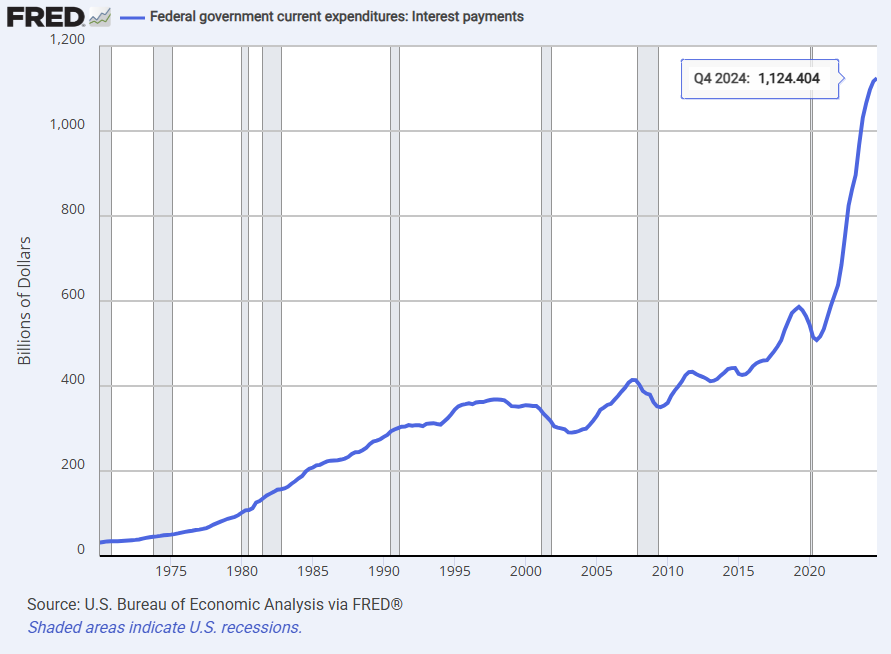
To put it into perspective, the U.S. now has over $106,400 in debt for each of its 340 million citizens. And that does not include the unfunded liabilities of Social Security, Medicare, and Medicaid, which would add another $50 trillion - $200 trillion to the national debt. The ever-increasing debt load, combined with higher interest rates, has led to an explosion in interest payments to over $1.1 trillion annually – more than the entire national defense budget:
With roughly $9 trillion in government debt due this year, the fiscal situation is set to become significantly worse. Simply put, the U.S. is heading toward financial calamity. Continuing on the current path is no longer an option.
However, changing course requires two things: 1) cutting expenses and 2) growing the economy to increase tax revenue. Cutting expenses is straightforward. To do this, The Trump Administration created the Department of Government Efficiency (DOGE), led by Elon Musk, to eliminate waste and fraud and reduce government spending by $1 trillion. But growing the economy is more complicated. Most experts can’t agree on the best way to do it. That is where tariffs come in. Even though nearly every economist will tell you that tariffs are bad for economic growth, most countries have them.2 So, the most apparent way to unleash economic growth in the U.S. is to have trading partners reduce or eliminate their tariffs on the United States. Doing so would make U.S. products and services more competitive abroad, drive demand for U.S. goods, incentivize companies to produce in America, and create jobs in the U.S. But this is easier said than done. Other countries are unlikely to reduce their tariffs out of the kindness of their hearts. Many have been living off the largesse of the United States for decades and don’t want the easy money to stop. So, the Administration decided to force their hand.
It’s a bold strategy, to be sure. But the good news is that, given the relative size of its economy and enormous trade deficits, the U.S. is negotiating from a position of significant strength. In other words, America’s trading partners are significantly more dependent on the U.S. than the U.S. is on them. While nobody knows how the trade war will play out or if it will work, I am optimistic that the Administration’s ultimate goal is to eliminate trade barriers and set the stage for long-term economic prosperity.3 As Treasury Secretary Scott Bessent has said, “What is wrong with reciprocal tariffs? If you have a tariff, we’re going to put it at the same level. If you take it to zero, we’ll take it to zero.” Now, on to Semler Scientific.
Semler Scientific is a healthcare company focused on the early detection of peripheral artery disease (PAD). The company markets and sells QuantaFlo PAD, a medical device and related software that non-invasively measures a patient’s fluctuations in blood volume at their extremities to provide early detection of peripheral artery disease. However, it was their newly implemented Bitcoin treasury reserve strategy that attracted me to the Company. In the Kehlet Capital fourth quarter 2020 newsletter, I noted my expectation that Bitcoin would outperform equities. Since then, Bitcoin is up 143% at the time of this writing compared to 38% for the S&P 500. Though Kehlet Capital could not invest in Bitcoin directly at the time – there were no Bitcoin ETFs – I noted that we could invest indirectly by owning businesses tied to Bitcoin’s success. I wrote, “At present, there are very few (of these companies) in the micro-cap space… But I suspect that, as Bitcoin becomes more entrenched and people come to realize its value, more and more companies will hold Bitcoin on their balance sheets in lieu of cash.” And I kept my eyes peeled for this development ever since.
For example, MicroStrategy (MSTR) was the first Company to announce Bitcoin as its primary treasury reserve asset in August 2020. Though I wanted to invest, the stock’s market capitalization of $1.5 billion was above my self-imposed limit of $1.0 billion for new positions. Over the next four years, I watched its stock price increase by over 2,700%, from $15 per share to approximately $430 near its peak.4 It was a huge missed opportunity I thought I would never see again, until I came across Semler Scientific.
I first researched Semler in January 2024, before the Company had any association with Bitcoin. I decided not to invest based on some significant headwinds facing the business. But the idea was interesting enough to keep on my radar if something changed. Then, in May 2024, the Company acquired 581 Bitcoins for $40 million and announced it would adopt Bitcoin as its primary treasury reserve asset. I had a call with Semler’s Chairman, Eric Semler, and its CFO, Renae Cormier, in June, but again decided not to invest as management seemed uninterested in acquiring more Bitcoin or implementing MicroStrategy’s proven and highly successful playbook (more on that later). However, Semler continued to make small purchases of Bitcoin with excess cash flows from their operating business until November 2024, when it acquired $21.5 million in Bitcoin through an at-the-money (ATM) equity offering. At the same time, the Company announced it would adopt BTC Yield – a measure of the growth in Bitcoin per share – as a key performance indicator. After watching several interviews with Chairman Semler about the announcement, it became clear that his mindset had changed. The Company was beginning to adopt the highly successful MicroStrategy plan. Over the next two weeks, I built a position in Semler Scientific for our portfolio.
So, what is the strategy, and how does it work? Though the idea is simple – raise debt and equity at a low cost of capital (0% - 7%) to invest in an asset (Bitcoin) that averages 60%+ annualized returns – understanding how and why it works is more complicated. So, let’s break it down.
Here is how the process works:
Step 1: Semler uses the excess cash from its operating business to buy Bitcoin
Step 2: For every $1 of Bitcoin the Company buys, the market adds a premium (currently around $1.45, but at one point, it was above $4.00) to Semler’s market value.
Step 3: The Company raises either debt or equity at a premium to the value of the Bitcoin on its balance sheet – referred to as the net asset value (NAV) – and uses the proceeds to acquire Bitcoin at a lower price, thus capturing the arbitrage for the benefit of shareholders. For example, at a premium of 3x, the Company effectively raises capital at $3 of Bitcoin per share. Then, it acquires more Bitcoins for $1 per share. And by doing so, it increases the Bitcoin per share owned by Semler shareholders.
Step 4: Repeat steps 1, 2, and 3 until the premium to NAV is fully (or mostly) captured.
The beauty of this strategy is that you don’t necessarily need to believe in Bitcoin to appreciate it. It works the same way for any asset, whether peanuts, crude oil, or tennis shoes. Bitcoin is simply the asset that makes the strategy possible. If you sell peanuts for $3 apiece and use the money to buy them back for $1, you can make significant profits with very little risk. So, the real question is not whether the strategy will work, but rather, “Why is the market paying a premium for the Bitcoin on Semler’s balance sheet, and how long will that premium last?” The simple answer is that the premium exists because the market expects Bitcoin to outperform. It makes no sense otherwise. In contrast, when the market expects an asset (like cash) to underperform, it will trade at a discount to its net asset value.5 So, how long will Semler’s premium to NAV last? The short answer is as long as the expectations for Bitcoin remain high and the Company can generate a BTC yield.
But that begs the question, “If the market expects Bitcoin to outperform, why not just buy the ETF?” There are two reasons for this:
Many investment mandates prohibit institutional investors from owning Bitcoin or a Bitcoin ETF. However, they can invest in the debt or equity of a business that holds Bitcoin on its balance sheet. Because they expect Bitcoin to outperform, they are willing to pay a premium for it. Simply put, MicroStrategy and Semler act as funnels for vast pools of capital that want access to Bitcoin but have been restricted from owning it. You can watch MicroStrategy CEO Michael Saylor explain it in his own words here.
Other investors invest in Semler because they expect the Company to increase its Bitcoin per share (i.e., its BTC Yield) over time, thus outperforming Bitcoin itself. The Company does this in three ways:
By using cash generated from their operating business to buy Bitcoin
By taking on debt to fund BTC purchases and then paying off the debt (or converting it to equity) as the price of Bitcoin appreciates
By issuing equity at a premium to NAV
Now, I’m aware that Bitcoin is a controversial subject. Suppose you believe that the digital peanuts acquired for $1 are worth $0. Then, in that case, you undoubtedly deem this trade doomed to fail. But if you believe, as I do, that Bitcoin is orders of magnitude undervalued and will continue to be the best-performing asset in the world for many years, then you understand this trade has the potential to generate eye-popping returns. Whether I am right or wrong, only time will tell. But it is the kind of asymmetric payoff I am happy to add to the portfolio.
Performance
During the first quarter of 2025, Kehlet Capital Management’s concentrated micro-cap composite decreased 8.95%, slightly outperforming the benchmark, which declined 9.51%.
Our largest contribution to performance came from Astronics Corp. (ATRO), which increased 51.44%. Last quarter, I wrote about an unfavorable ruling against Astronics in the UK, which had the potential to cost the Company more than $105 million in damages and interest. This possibility of a negative outcome likely hurt the stock in the fourth quarter despite the Company’s positive financial performance. But during the first quarter, Astronics announced the final hearing results, which awarded damages of $11.9 million to the plaintiff – significantly below the $105 million being sought and only $4.8 million above the amount already in reserve by Astronics. The outcome was highly favorable for the Company and helped propel the stock during the quarter.
Additionally, during the first quarter, Astronics reported its fourth-quarter results, which included revenue growth of 6.8%, adjusted gross profit growth of 31.4%, and adjusted operating income growth of 105.3%. These results were despite a strike at Boeing, which shut down Astronic’s most significant program at its largest customer for seven weeks. Management also guided for full-year 2025 revenue growth of roughly 6%. CEO Pete Gundermann noted that “we expect growth to moderate in 2025, but margin improvement to continue… (as) input cost pressures continue to subside, and pricing adjustments are taking hold. The signs are strong that 2025 will be a very good year for the Company.” Though the forecast will likely need to be revised downward due to the recent trade war with China, the Company is performing well, and the thesis remains intact.
Our largest detractor to performance was our newest position, Semler Scientific Inc. (SMLR), which declined 32.96%. During the quarter, Semler reported its fourth-quarter financial results, which included a revenue decline of 17.6%, a gross profit decline of 3.1%, and operating income growth of 33.3%. CFO Renae Cormier noted, “We expect we may see some further pressure on revenue in 2025, following the additional phase-in of the 2024 CMS rate announcement.” COO Jennifer Herrington added that “despite the government decision about payment for risk adjustment for PAD, we continue to add new clients for software licenses relating to our QuantaFlo product… Our priority for 2025 is to minimize the declines to QuantaFlo revenue while maintaining sufficient infrastructure to support, innovate, and grow our operations related to cardiovascular diseases.” As such, the Company continues to seek 510k clearance for a product extension of their QuantaFlo technology into the cardiovascular space, hoping to obtain this clearance sometime in 2025. Overall, Semler has done an outstanding job of managing costs as its legacy business declines. However, in 2025, we will likely see another step down in revenue, and cost management will be key to generating meaningful cash flow. Given this dynamic, the Company’s recent increase in leverage, and the current lack of meaningful premium over net asset value, I expect the pace of Bitcoin purchases to slow significantly until the price rebounds. As such, the stock will likely be correlated with the price of Bitcoin for the foreseeable future.
Consequently, the weakness in Semler’s stock price during the quarter was likely the result of the price of Bitcoin, which fell 11.65%. Despite the decline, there were several extremely positive developments during the quarter:
In January, the SEC repealed Staff Accounting Bulletin (SAB) 121, which restricted banks from custodying Bitcoin. With SAB 121 gone, major banks now have the opportunity to custody Bitcoin, which substantially increases the chances that large public companies will add it to their balance sheets. Subsequently, in March, GameStop Corp. (GME) announced a $1.3 billion convertible note offering with plans to acquire Bitcoin for the first time.
Earlier in March, BlackRock, the world’s largest asset manager, added a 1% - 2% allocation of its Bitcoin ETF (IBIT) to one of its model portfolios. Though the specific portfolio represents one of BlackRock’s smaller portfolios, the announcement was an important step forward since it represented the first major model portfolio to add Bitcoin. Though BlackRock's model portfolios directly manage $150 billion, they are used as references by Investment Advisors throughout the industry.
Also, President Trump established a Strategic Bitcoin Reserve in March, which declared that the United States would not sell any Bitcoin and authorized the Secretary of Treasury and Secretary of Commerce to develop budget-neutral strategies for acquiring additional Bitcoin.
Finally, the President’s son, Eric Trump, joined Japanese Bitcoin Treasury Company MetaPlanet’s strategic board of advisers to help them in their mission to become a "global leader in the Bitcoin economy." Shortly afterward, he partnered with Hut 8 to create American Bitcoin, a company aimed at becoming the world's largest, most efficient pure-play Bitcoin Mining Company.
Simply put, this Administration has been highly favorable towards Bitcoin. In my opinion, it is an asset that can no longer be ignored. As such, I believe the future is bright for both Bitcoin and Semler.
Portfolio Activity
No adjustments to portfolio weights were made during the quarter.
Conclusion
The first quarter of 2025 was adequate from a relative return perspective despite the overall decline. Though the second quarter got off to a chaotic start, with trade wars dominating the headlines, I believe our portfolio is nicely positioned. As such, I am confident we will navigate the turbulence well, take advantage of opportunities presented by the volatility, and come away stronger than before. Thank you again for supporting Kehlet Capital Management. Please do not hesitate to contact me with any questions or comments.
| Number of holdings | 7 |
|---|---|
| Median market cap | $375M |
| Weighted avg. market cap | $340M |
| Fonar Corp. (FONR) | 18.4% |
|---|---|
| Climb Global Solutions (CLMB) | 17.1% |
| Astronics Corp. (ATRO) | 14.9% |
Notes
- "Fact Sheet: President Donald J. Trump Declares National Emergency to Increase our Competitive Edge, Protect our Sovereignty, and Strengthen our National and Economic Security," The White House, https://www.whitehouse.gov/fact-sheets/2025/04/fact-sheet-president-donald-j-trump-declares-national-emergency-to-increase-our-competitive-edge-protect-our-sovereignty-and-strengthen-our-national-and-economic-security/ ↩
- As well as other non-tariff barriers like value-added taxes (VAT) ↩
- Factors that could derail the Administration’s efforts include threats to national security, natural disasters, economic recession or depression, pandemics, and other unforeseen circumstances ↩
- Adjusted for a 10:1 stock split in August 2024 ↩
- Our position in FONAR (FONR) is a painful reminder of this ↩
Disclosures to Performance Results
Actual composite performance results represent the performance of fully discretionary accounts managed by Kehlet Capital Management (KCM) during the corresponding time period. The composite performance results reflect time-weighted rates of return, the reinvestment of dividends and other account earnings. The reinvestment of dividends and other earnings may have a material impact on overall returns.
Past performance is not indicative of future results and the performance of a specific individual client account may vary substantially from the composite performance results. Therefore, no current or prospective client should assume that future performance will be profitable, or equal either the KCM composite performance results reflected above, or the performance results for any of the comparative index benchmarks provided.
For reasons including variances in portfolio account holdings, variances in the investment management fee incurred, market fluctuations, the date on which a client engages KCM’s investment management services, and any account contributions or withdrawals, the performance of a specific client’s account could vary substantially from the indicated KCM composite performance results. A portion of each account can be actively managed in an attempt to respond to changing conditions.
All performance results have been compiled solely by KCM, are unaudited, and have not been independently verified. Therefore, the performance data could be wrong. Information pertaining to KCM’s advisory operations, services, and fees is set forth in KCM’s current Form ADV Part 2A disclosure brochure, a copy of which is available from KCM upon request.
iShares IWM is an exchange-traded fund (ETF) measuring the performance of approximately 2,000 small-cap companies. It serves as a benchmark for small-cap stocks in the United States.
KCM managed accounts may own assets and follow investment strategies which cause them to differ materially from the composition and performance of the ETF shown as a benchmark. The ETF was chosen for its accessibility, transparency, independence, and relevance to KCM’s investment strategy, but there may be other indices that are more appropriate or applicable to the Concentrated Micro-cap Strategy. The historical index performance results are provided exclusively for comparison purposes only, so as to provide general comparative information to assist an individual client or prospective client in determining whether a specific Portfolio meets, or continues to meet, his/her investment objective(s). It should not be assumed that account holdings will correspond directly to any of the comparative indexes.
Different types of investments and/or investment strategies involve varying levels of risk, and there can be no assurance that any specific investment or investment strategy (including the investments purchased and/or investment strategies devised by KCM) will be either suitable or profitable for a client’s or prospective client’s portfolio and may result in a loss of principal. Accordingly, no client or prospective client should assume that the above portfolios (or any component thereof) serve as the receipt of, or a substitute for, personalized advice from KCM, or from any other investment professional.