
“If you aren’t willing to own a stock for ten years, don’t even think about owning it for ten minutes.”
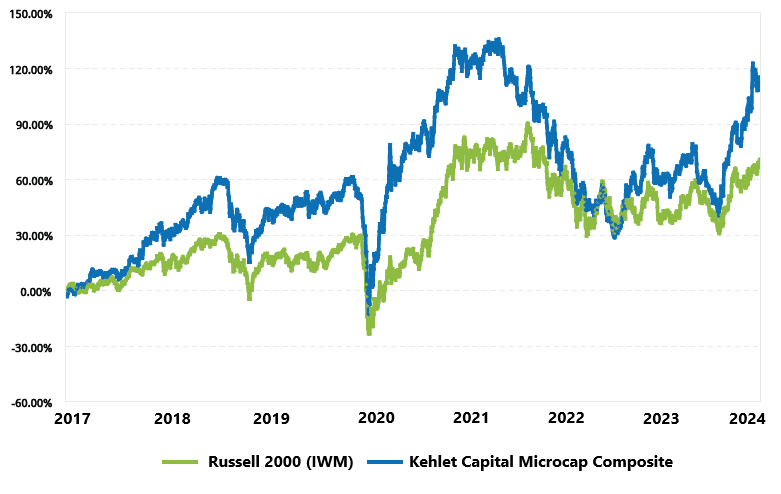
| Year | KCM Composite, Net | IWM | Excess Return |
|---|---|---|---|
| 2017* | 27.20% | 14.26% | +12.94% |
| 2018 | -3.43% | -11.11% | +7.68% |
| 2019 | 27.79% | 25.39% | +2.40% |
| 2020 | 27.52% | 20.03% | +7.49% |
| 2021 | -1.45% | 14.54% | -15.99% |
| 2022 | -22.63% | -20.48% | -2.15% |
| 2023 | 23.12% | 16.84% | +6.28% |
| YTD 2024 | 11.91% | 5.04% | +6.87% |
| Annualized | 10.93% | 7.77% | +3.16% |
*Inception date: 02/01/2017
Introduction
I was recently interviewed for an investing newsletter that highlights under-the-radar managers.1 Though I was initially hesitant to accept the invitation – I’m not particularly comfortable talking about myself – I’m glad I did. The response from friends, family, and even strangers was highly positive. I made several new connections on LinkedIn and added dozens of subscribers to my newsletter. But the interview also gave me an important insight; I haven’t done a good enough job getting my message out. Even some clients may not know the whole story – why I started Kehlet Capital Management (KCM) and what makes the fund unique. So, in this newsletter, I aim to give interested readers a deeper understanding of KCM.
My Story
My fascination with the stock market began at a young age. I remember in eighth grade when Yahoo! had its IPO. After school, I would log on to AOL and find chatrooms to talk with people about the stock. However, I never thought of investing as a career and instead chose to study mechanical engineering in college. After graduation, I worked as an engineer for six years, but my affinity for investing remained, and I would frequently travel to Omaha to attend the Berkshire Hathaway shareholders’ meetings. Eventually, I decided to go back to school to get an MBA. While there, I applied to be on the student-run MBA Investment Fund, which actively managed $14 million.
Being on the fund opened a lot of doors for me. It allowed me to take investing courses that would have otherwise been unavailable. It gave me real-world experience managing money and evaluating companies. It also introduced me to fantastic professors, one of whom would help me land an internship as an Equity Research Analyst. The internship eventually led to a job offer. It was a fantastic opportunity that allowed me to do what I loved - research small and microcap stocks - while learning from one of the most respected small and microcap fund managers in the industry. But things got off to a rocky start. The fund underperformed its benchmark, my portfolio manager and I did not see eye to eye on which investments were appropriate, and my personality didn’t mesh with a few people at the firm. After three years, I was fired.
At that point, I had to consider my options: 1) I could find another job, which would provide financial security but likely require some sacrificing of my investing principles, or 2) I could start my own fund, which would entail significantly more risk, but allow me to invest the way I saw fit. At the time, I had built up modest savings, knew a handful of family and friends willing to back me, and had an amazingly supportive wife. I decided to bet on myself and start Kehlet Capital Management.
Investing Principles
The firm would have a singular focus: to maximize long-term returns. To that end, I decided to structure Kehlet Capital in alignment with my core investing principles. The first three I learned from Charlie Munger and Warren Buffett. One was to “fish where the fish are.” In other words, if I wanted to find stocks that could win big over the long term, I needed to look in areas where big winners were likely to be found. For me, that meant focusing on microcap companies, where stocks often had significant potential to become larger but remained undiscovered by the broader market. In essence, I wanted to find the next Netflix or Google before it became Netflix or Google. The second principle was to bet big when opportunities present themselves. As Buffett has said, “When it’s raining gold, reach for a bucket, not a thimble.” Since great opportunities are rare, I decided to manage a concentrated portfolio of just 10 – 15 stocks. This would allow me to take meaningful positions in my highest conviction ideas while still reaping the benefits of diversification. The third principle was to stay within my circle of competence. As such, I would not invest in banks, insurance companies, REITs, or early-stage biopharma. And I would only invest in U.S.-listed companies.
The fourth principle, to focus on the long-term, I learned the hard way – through experience. In business school, I applied to the student-run MBA Investment Fund. As part of the application process, candidates were split into teams, and a stock was chosen for them to analyze. Each team was to present their thesis, along with either a buy or sell recommendation, to a panel of outside industry experts. These judges would then choose the team they felt presented the most compelling argument and declare them the winner. During this process, my team and I extensively researched the chosen company. We felt we had a solid grasp of the business’s long-term prospects and thoroughly believed in management. Therefore, we confidently offered a buy recommendation. On the day of the competition, each team presented their analysis. Three recommended buys and three recommended sells. When the judges chose the winner, it was a team that had offered a sell recommendation.
I was surprised by the outcome but, despite the defeat, had conviction in our analysis. I felt confident the stock would prove us right. But the price plummeted 53% over the next year from $17 per share to around $8. I was crushed. This had been the first real test of my stock-picking ability, and I had failed miserably. I was incredibly humbled by the experience but unsure where our team had gone wrong. So, I followed the company for several years, and the results were astonishing. After less than six years, the stock increased in value by nearly 4,800% to almost $390 per share.2 To put that in perspective, if I had invested $10,000 at the time of our competition, it would have been worth almost $490,000 just six years later. For curious readers, the stock was Netflix, and our competition occurred after the company announced it was splitting its DVD-by-mail business from its streaming business, effectively doubling the subscription price. Looking back, I realized that investing requires extreme patience. In business, one year is a considerably brief period, but when the value of an investment is falling by more than half, it can feel like an eternity. Though stocks often behave strangely in the short term, they are more likely to act rationally in the long run. As Benjamin Graham once said, “In the short run, the market is like a voting machine – tallying up which firms are popular and unpopular. But in the long run, the market is like a weighing machine – assessing the substance of a company.”
The Strategy
With these lessons in mind, I decided Kehlet Capital’s strategy would be to search for “moonshots” – companies that could provide 100x return over the next 20 – 30 years. In a concentrated portfolio, just one or two successful moonshots could drive performance for a long time. The strategy would be like venture capital for the public market. The problem was that successful moonshots were extremely rare. A worthy investment candidate would need to:
Provide a strong value proposition to customers.
Have a defensible competitive advantage.
Be led by a solid management team.
Have meaningful growth opportunities.
Trade at a reasonable price.
Finding more than three or four stocks that met these criteria at any given time would be difficult. But a portfolio of only three or four stocks would be massively volatile. Even successful companies face large drawdowns from time to time. And one or two bad investments could prove disastrous. Therefore, to minimize volatility, I would also include some value, growth at a reasonable price (GARP), and special situation stocks in the portfolio. Though I expected the bulk of portfolio performance to be driven by moonshots over the long run, these other “volatility minimizers” would help boost returns during periods of moonshot underperformance.
The Process
Next, I needed to determine the best way to search for and analyze stocks that fit my criteria. There were two approaches to consider. The first was through fundamental, qualitative research – trying to understand the fundamentals of a business, how it operates, the competitors, the value proposition, etc. The second was through quantitative analysis, which looks at data such as profit margins, revenue growth rates, and leverage ratios and analyzes them for patterns or trends. While fundamental research had the advantage of being forward-looking and, therefore, better at predicting the future, it would be extremely slow since it required tasks like reading documents, asking questions, and thinking deeply about a business. On the other hand, quantitative research would be lightning fast – since it could be automated with computers – but backward-looking and, therefore, less reliable at predicting the future. In my opinion, the optimal idea-generation process would harness the best of both worlds.
Until recently, the way I searched for ideas was, by necessity, entirely qualitative. Though screening tools for quantitative analysis were readily available online or through third-party software vendors, in my experience, they had two problems: 1) The data was often wrong or improperly adjusted, and 2) the screens were not flexible enough for my needs. In other words, they didn’t allow me to screen metrics and ratios the way I wanted. However, after reading “Artificially Human” by Robert Whiteman, which discussed the relationship between machine labor, artificial intelligence, and humans, I was convinced I needed to learn to code. I signed up for an online course in Python programming, started experimenting with the SEC’s API, and realized I could improve several KCM processes. Motivated by this realization, I spent the next six months creating a customized screening tool, which significantly enhanced my ability to find new ideas.
The key to identifying potential moonshots was understanding that they must invest a significant amount of capital at high rates of return. The combination of these two factors resulted in a metric I refer to as “expected future growth.” Notably, a high return on invested capital (ROIC) by itself is insufficient to create above-average expected future growth. A business must also reinvest a large portion of its profits back into the business. For example, a company that earns 20% ROIC but only reinvests a quarter of its profits will be expected to grow by an average of 5% annually, all else equal.3 However, a company that earns 15% ROIC and reinvests all its profits will be expected to grow 15% annually, thus creating more shareholder value over time. This insight would allow me to identify potential moonshots for the portfolio.
Once an idea was identified, the qualitative research would begin. Typically, this process starts with an investor presentation and the most recent annual report. Initially, I would try to understand what products and services drove most of the company’s revenue and earnings and why customers purchased them from the company instead of elsewhere. If everything checked out, I would review the proxy statement to learn about the management team and the board of directors, how well their incentives aligned with shareholders, and how relevant their experience was to their current role. Next, I would listen to the last three or four earnings calls to better understand management and the business’s current issues. If everything still looked good, I would schedule a call with management and investor relations to fill in any blanks from my initial research. Generally, this meant gaining a better understanding of the competitive environment, the company’s competitive advantages, and future growth opportunities.4
At that point, I could filter out about 98% - 99% of the ideas I looked at. But, for the 1% - 2% of businesses that remained, I’d turn my attention from information gathering to verification. Despite having a solid understanding of the business and the investment thesis, my source of information to that point would primarily come from the company itself. However, companies often paint the rosiest picture possible rather than the one that best portrays reality. So, it would be essential to confirm or deny the thesis by finding less biased sources of information – customers, suppliers, competitors, former employees, etc. This would probably be the most challenging part of the research process but arguably the most important. Finally, if the company passed all the tests, I would run the stock through my valuation models, set a price target, and wait for an opportunity to buy.
Examples
Since launching the fund in 2017, I have added five potential moonshots to the portfolio. As these investments take 20 – 30 years to play out, the verdict is still out on most of them. However, we have had two moderately successful moonshots to date. The first was Care.com (CRCM), the largest online marketplace for finding and managing childcare. We owned the stock for three years, and it returned an average of 35.4% annually until it was acquired by InterActiveCorp (IAC) for $500 million. The result was bittersweet. Though the acquisition provided a tailwind to returns, our participation in a potential moonshot was cut short.
The second was Bandwidth Inc. (BAND), a communications platform as a service (CPaaS) company. I started buying the stock in early 2018, shortly after its IPO, at an initial price of $27.08 per share. Less than three years later, the stock hit a high of $193, over 7x my initial purchase price. Though it has since fallen sharply due to various factors, the fundamentals of the business have remained strong, and expected future growth has averaged more than 13% over the last five years. Though the jury is still out on Bandwidth, it has shown significant progress at times and remains one of my highest conviction ideas.
Three other moonshots remain in the portfolio with mixed results. But while these businesses gather momentum, a handful of “volatility minimizers” have come to the rescue. One was Hibbett Sports (HIBB), a sporting goods retailer in the southeast. I bought the stock as a value play in March 2020, near the bottom of the COVID-19 market downturn. Though the company was highly profitable, had a strong balance sheet, and competent management, it had limited growth prospects. But when the stock price fell over 71% from its previous twelve-month high – and traded at 70% of tangible book value – it became too good to pass up. The thesis was simple: Hibbett was priced for bankruptcy despite having no debt and significant cash on the balance sheet. I knew the company would be impacted by the COVID-19 shutdowns but felt strongly they could weather the storm. And the thesis quickly proved correct as restrictions were eased, and businesses were allowed to operate in a limited capacity. What I had not anticipated, however, was that pent-up demand, government stimulus, and competitor bankruptcies would provide a massive boost to Hibbett’s financial results. Consequently, the stock increased 904%, from less than $8 per share to nearly $90 less than a year later, providing a substantial short-term boost to portfolio returns.
Another “volatility minimizer” has been Climb Global Solutions (CLMB), a new and emerging software distributor I bought as a special situation turnaround play in August 2020. The company had been a highly profitable, sleepy, low-growth business for many years. However, in 2018, the company brought in Dale Foster as Executive Vice President to rejuvenate the business and accelerate growth. Having been the CEO of ProMark, a competitor of Climb’s, for over 20 years and growing it from $26 million in revenue to $580 million, Dale struck me as the ideal candidate to get Climb back on track. He was promoted to CEO in January 2020, and financial results began to improve. I spoke with him shortly after he became CEO and was convinced he would do great things for the company. And he and his team have done just that. In the three years we’ve owned the stock, earnings per share have grown rapidly, and the stock price has nearly tripled, from $23.50 to almost $70.
What Sets KCM Apart
In sum, Kehlet Capital Management looks for companies that can compound capital 100x over the next 20 – 30 years. Like venture capital for the public market, the goal is to find the next Netflix or Google before it becomes Netflix or Google. To do this, I invest in microcap companies with significant growth potential that have yet to be discovered by the broader market. I use a combination of quantitative and qualitative processes to identify high-quality businesses that can invest significant capital at high rates of return. And since great opportunities are rare, I invest in a concentrated portfolio of 10 - 15 high-conviction ideas.
So, what makes Kehlet Capital unique? It is the combination of alignment and focus. The firm’s core principles, strategy, processes, and incentives (most of my liquid net worth is invested alongside my clients) are all aligned around one purpose: maximizing long-term returns. While other firms may have multiple strategies in several geographies, supported by armies of Analysts, Kehlet Capital Management focuses on doing one thing well – investing in publicly traded U.S. microcap stocks. As a one-person shop in San Antonio, Texas, the firm has no office politics, human resources issues, or any of the distractions of Wall Street. By incorporating recent technological advancements to enhance and automate my processes, KCM is quickly narrowing the gap between it and larger firms with more resources. As a result, I believe Kehlet Capital has a differentiated approach that allows investors to maximize long-term returns in a highly aligned and focused way.
Performance
During the first quarter of 2024, Kehlet Capital Management’s concentrated micro-cap composite increased 11.91%, outperforming the benchmark which grew 5.04%.
Our largest contribution to performance for the quarter came from Bandwidth Inc. (BAND), which increased 28.33%. As a reminder, in last quarter’s newsletter, I said:
“I believe… the company is set up for an outstanding 2024 due, in part, to the presidential election, which should drive significant growth in political text messaging revenue. If so, we will be well positioned for a rebound as we acquired shares nearly the entire way down. Simply put, 2024 is an important year for the company and one in which I believe our patience will be rewarded.”
The first quarter was off to a great start, as the company announced it expected revenue for the full year 2024 to grow 16.5% and adjusted EBITDA to increase 49.4% at the midpoint of the guidance range. The stock popped nearly 52% the day of the report. Despite the increase in price, I believe the stock is still absurdly cheap, and there remains significant potential upside. The thesis remains intact.
Our largest detractor to performance for the quarter was Tucows Inc. (TCX), which declined 31.24%. As a reminder, Tucows operates three businesses. It is the second-largest domain name registrar in the world. It provides telecom software to mobile virtual network operators (MVNOs), like Boost Mobile, through its “Wavelo” brand, and it is a provider of high-speed fiber internet access through its “Ting Internet” brand. The company is one of the moonshots in our portfolio mentioned earlier. The thesis is simple. The U.S. is in the midst of a generational transition in the way internet service is delivered to the home – from coaxial cable to fiber optic cable. Though this transition has been ongoing for several years, it will likely continue for several more as a massive amount of construction is needed to lay fiber in neighborhoods throughout the country. However, once fiber has been installed, the builder enjoys a virtual monopoly on providing high-speed internet service to that location, effectively allowing them to operate a toll-road like business for internet service. Though the buildout requires massive upfront investment, the payback takes place over multiple decades and should result in highly attractive long-term returns on capital. As a result, Tucows is using all the cash flows (and then some) from its domains and software businesses to invest in this highly attractive long-term opportunity.
So why has the stock suffered? I believe the primary concern right now is funding. As Tucows has accelerated its buildout to take advantage of the opportunity, the company’s debt has grown, and its profitability has fallen. Between capital expenditures and operating losses, Ting Internet is burning approximately $120 million annually. Though Tucows has almost $93 million of cash on the balance sheet and should generate another $45 – $50 million in 2024 from its Domains and Wavelo businesses, it will likely need to raise capital before year-end. Available funding in the telecom industry is typically based on subscribers, and Tucows estimates it can borrow roughly $50 million for every 8,000 subscribers it adds to its network. At the current pace, I expect the company to add approximately 15,000 subscribers by year-end as compared to its last round of funding, allowing it to borrow an additional ~$100 million. At that point the flywheel of momentum should kick in, where the company adds subscribers, allowing it to borrow more, which enables it to add more subscribers and so on. Though being in a constant need to raise capital is not ideal, the situation is of little concern to me for three reasons: 1) I believe raising money is the right thing to do given the enormous opportunity and the potential for highly attractive long-term returns, 2) the situation should prove temporary as the business starts to generate more and more cash on its own, and 3) there is negligible risk of imminent default since much of the company’s debt does not mature for nearly 30 years (in 2053). As a result, I remain highly optimistic about the long-term potential of this moonshot idea, and the thesis remains intact.
Portfolio Activity
During the quarter, I reduced our position in Climb Global Solutions, Inc. (CLMB) due to its elevated valuation and used the proceeds to build a position in the iShares Bitcoin ETF (IBIT). During the first quarter, clients of Kehlet Capital Management approved a change to the Investment Policy Statement (IPS) to allow up to 10% of the portfolio to be held in a Bitcoin ETF. The reasoning for this change was as follows. First, we found ourselves in a unique position. The cash level of the portfolio was elevated, due in part to the acquisition of Chase Corp. (CCF) in November of last year, and I was having difficulty finding new ideas that fit my return criteria to absorb the excess cash. At the same time, we had a handful of companies in the portfolio nearing sell prices. Though our IPS allowed for up to 20% cash, the rate of return on cash is often subpar and likely to be a drag on performance amid bull markets.
Second, spot bitcoin ETFs began trading in January, which made it possible to add Bitcoin to the portfolio in a cost-effective manner. Therefore, given my conviction in the upside potential of Bitcoin, I proposed including it in the portfolio as a substitute for excess cash. That is, the fund will only hold Bitcoin when cash levels exceed 10%. For example, instead of having 15% cash, the fund would have 10% cash and 5% in a Bitcoin ETF. But when ideas are plentiful, and cash is below 10%, the fund will not own Bitcoin. I believe this move accomplishes three objectives:
It keeps the focus of the portfolio on owning great microcap businesses (or moonshots) that can become much larger over time.
It adds a high-conviction idea to the portfolio with significant upside potential.
It allows us to maintain cash's hedging and optionality benefits during high market valuations.
Though I gave clients the option to hold cash in lieu of Bitcoin going forward, the change was unanimously approved. No other adjustments to the portfolio were made during the quarter.
Conclusion
The first quarter of 2024 was excellent from an absolute and relative return perspective, and I continue to be cautiously optimistic about the remainder of the year. Thank you again for supporting Kehlet Capital Management, and please do not hesitate to contact me should you have any questions or comments.
| Number of holdings | 9 |
|---|---|
| Median market cap | $402M |
| Weighted avg. market cap | $331M |
| Fonar Corp. (FONR) | 25.9% |
|---|---|
| Bandwidth Inc. (BAND) | 18.1% |
| Climb Global Solutions (CLMB) | 16.0% |
Notes
- The full interview can be found at https://www.capitalemployed.com/p/interview-84-michael-wright-kehlet ↩
- The original analysis was done in 2018. At the time of this writing, the stock is now valued at over $600 per share. ↩
- 20% ROIC x 25% reinvestment ratio = 5% expected growth ↩
- For a more in-depth look at my investing framework, I recommend reading my second, third, and fourth-quarter 2021 newsletters ↩
Disclosures to Performance Results
Actual composite performance results represent the performance of fully discretionary accounts managed by Kehlet Capital Management (KCM) during the corresponding time period. The composite performance results reflect time-weighted rates of return, the reinvestment of dividends and other account earnings. The reinvestment of dividends and other earnings may have a material impact on overall returns.
Past performance is not indicative of future results and the performance of a specific individual client account may vary substantially from the composite performance results. Therefore, no current or prospective client should assume that future performance will be profitable, or equal either the KCM composite performance results reflected above, or the performance results for any of the comparative index benchmarks provided.
For reasons including variances in portfolio account holdings, variances in the investment management fee incurred, market fluctuations, the date on which a client engages KCM’s investment management services, and any account contributions or withdrawals, the performance of a specific client’s account could vary substantially from the indicated KCM composite performance results. A portion of each account can be actively managed in an attempt to respond to changing conditions.
All performance results have been compiled solely by KCM, are unaudited, and have not been independently verified. Therefore, the performance data could be wrong. Information pertaining to KCM’s advisory operations, services, and fees is set forth in KCM’s current Form ADV Part 2A disclosure brochure, a copy of which is available from KCM upon request.
iShares IWM is an exchange-traded fund (ETF) measuring the performance of approximately 2,000 small-cap companies. It serves as a benchmark for small-cap stocks in the United States.
KCM managed accounts may own assets and follow investment strategies which cause them to differ materially from the composition and performance of the ETF shown as a benchmark. The ETF was chosen for its accessibility, transparency, independence, and relevance to KCM’s investment strategy, but there may be other indices that are more appropriate or applicable to the Concentrated Micro-cap Strategy. The historical index performance results are provided exclusively for comparison purposes only, so as to provide general comparative information to assist an individual client or prospective client in determining whether a specific Portfolio meets, or continues to meet, his/her investment objective(s). It should not be assumed that account holdings will correspond directly to any of the comparative indexes.
Different types of investments and/or investment strategies involve varying levels of risk, and there can be no assurance that any specific investment or investment strategy (including the investments purchased and/or investment strategies devised by KCM) will be either suitable or profitable for a client’s or prospective client’s portfolio and may result in a loss of principal. Accordingly, no client or prospective client should assume that the above portfolios (or any component thereof) serve as the receipt of, or a substitute for, personalized advice from KCM, or from any other investment professional.